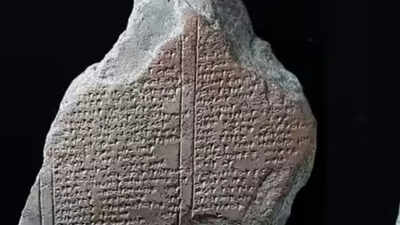
For many years, thousands of clay tablets have languished in museum drawers and digital archives with parts of their stories lost. Some were cracked beyond recognition, while others were so badly faded that even experienced specialists struggled to distinguish the marks pressed into the clay more than 3,000 years ago.
In the world of ancient Near Eastern studies, progress often depended on patience measured in decades rather than months.Now, a new AI tool developed in Germany appears to be changing that pace dramatically. Called ‘Palaeographicum’, the system can reportedly identify subtle differences in handwriting within ancient cuneiform, something scientists had to manually examine under a carefully angled light.
What used to take days may now take minutes.
How AI helps reconstruct ancient broken cuneiform tablets
Long before the spread of paper, civilizations throughout the ancient Near East recorded laws, rituals, trade agreements, and royal correspondence on wet clay. Scribes pressed wedge-shaped symbols into the surface with sharp pens, creating what is now known as cuneiform.Researchers at the University of Würzburg and the Academy of Sciences and Letters in Mainz have spent decades building tools to digitally reconnect those parts.
In the case of the Hittites, who lived in Anatolia about 3,500 years ago, scholars used hundreds of distinct signs representing sounds, syllables, and whole words. One damaged line can change the meaning of the entire text.This challenge has increased because most tablets have not survived intact. Over the centuries, they dispersed and dispersed. Parts of the same document may now reside in completely different museums, separated by boundaries and cataloging systems created thousands of years after the texts themselves.
How artificial intelligence reveals the hidden “handwriting” patterns of ancient cuneiform scribes
At first glance, the cuneiform marks may appear almost identical. However, specialists say that scribes often left behind recognizable habits, much like modern handwriting. Some pressed the pen deeper into the clay. Others created sharper wedge corners or left unusual spaces between symbols. Some of them appear to have pulled the pen away with enough force to leave faint designs on the surface of the clay.These details may seem minor, but they can help experts determine whether fragments came from the same workshop, archive, or even from the same scribe.
This can make the reconstruction work much more accurate. The difficulty has always been vision. Old tablets are 3D objects, and worn surfaces can look very different depending on lighting conditions. A sign that appears unreadable in a photograph may suddenly appear under a different angle of light.The new AI system reportedly works through huge collections of digital images, identifying tags that are visually similar across thousands of tablets.
It can then isolate those codes and group them for comparison. According to the development team, the current version has access to nearly 70,000 images containing more than five million cuneiform marks.
How AI has been added to one of the world’s largest inductive tablet archives
The recent breakthrough did not occur in isolation. It builds on years of digital preservation work associated with the Hethitologie-Portal Mainz, an online research center that has gradually become central to global Hethitologie scholarship.About 25 years ago, the portal reportedly began cataloging every known fragment of Hittite clay tablets. What started as a specialized academic database has since developed into a major international reference point used daily by researchers in many countries.Over time, additional tools were added. One system introduced about a decade ago allowed cuneiform marks to be recorded in three dimensions, which helped scientists compare damaged surfaces more accurately.
Another searchable platform later made it easier to navigate transliterated texts.The Palaeographicum appears to push this process further by introducing AI-assisted handwriting analysis directly into the archive itself.According to Professor Daniel Schwimmer, who leads the Department of Ancient Near Eastern Studies at Würzburg, tasks that previously took several days can now be completed in minutes.
This does not eliminate human expertise, but it changes the way scientists spend their time.
Artificial intelligence may help solve another long-standing mystery
Dating the Hittite tablets has always been difficult because many texts have no clear dating at all. Historians rely instead on indirect evidence: linguistic changes, political references, archaeological context, and writing style.This is where paleontology becomes especially valuable. Handwriting styles evolve gradually over generations, often reflecting broader historical periods.
Experts suggest that artificial intelligence could eventually help place undated fragments within narrower time frames by comparing writing characteristics to known examples.
The increasing role of artificial intelligence in unlocking forgotten civilizations
Developers say the AI is still being retrained and improved, with researchers’ feedback shaping future versions. It seems that some requests from users are already influencing how the system develops.However, there is a feeling that something bigger may be quietly happening within the field. Studies of the Ancient Near East have traditionally relied on highly specialized manual analysis conducted by a relatively small global community. AI tools like Palaeographicum do not replace that expertise, but they appear to be changing the speed and scale at which researchers can work.For parts that have remained separate for centuries, this shift could eventually reveal stories that historians didn’t even realize were still missing.