

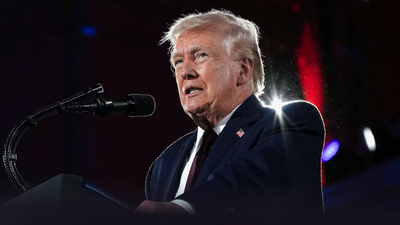
A year after the Emancipation Day tariffs, US President Donald Trump imposed another set of tariffs, this time targeting medicines and essential minerals. This step aims to push companies to manufacture within the United States.
The new measures impose tariffs on steel, aluminum and copper, reinforcing efforts to boost domestic production.The announcements come a year after Trump imposed sweeping tariffs on multiple trading partners as part of what he called “Liberation Day” on April 2, a move that disrupted global supply chains and financial markets. Although the Supreme Court struck down these measures earlier this year, the administration has continued to pursue similar policies through alternative mechanisms.Here’s what it says:
100% customs duties on pharmaceutical goods
The latest drug order imposes a strict 100% tariff on patented drugs produced outside the United States. This measure aims to encourage companies to move production locally, unless countries negotiate trade agreements with Washington or companies commit to establishing manufacturing facilities in the United States.Officials said major pharmaceutical companies have 120 days to submit “repatriation plans,” while smaller companies have 180 days before the tariffs take effect.
Companies that commit to building the factories, expected to be completed by the end of Trump’s second presidency, will instead face a reduced 20% tariff.A senior US official said: “We expect the lion’s share of global pharmaceutical patents to be in America.” Commenting on the countries included in this new move, which will also include India, a White House executive said the measures will reduce the United States’ dependence on foreign countries for essential medicines.
“100% tariff on patented products. Any imports of patented medicines from India by companies that do not get approval for the RSP will be subject to 100% tariff,” ANI quoted the official as saying.States with exemptionsSome partners have been granted exemptions and reduced prices. These countries include the European Union, Japan, South Korea and Switzerland, which will face a 15% tariff under previous agreements, while Britain has guaranteed duty-free access to its medicines for three years as part of a broader deal, according to the Office of the US Trade Representative.Additional facilities are available to companies that enter into “most favored nation” pricing arrangements with the administration while also investing in U.S. manufacturing. Generic medicines are not currently included in the definitions, although this will be reviewed after a year.
Metals are on the radar too
Along with the drug measures, Trump also signed a proclamation reshaping tariffs on steel, aluminum and copper, citing national security concerns and the need to boost domestic industry.Under the revised framework, tariffs will be calculated based on the full value of imported products rather than lower foreign price benchmarks. Products made almost entirely of these metals will attract a flat 50% tariff, while derivative goods containing large quantities will face a 25% duty on their full value. Some industrial and electrical grid equipment will be taxed at 15% through 2027, and goods produced abroad using entirely American metals will face a lower 10% tariff.
Items with a minimum metal content, 15% or less, will not be subject to these fees.The changes will take effect starting at 12:01 a.m. ET on Monday.A senior administration official said the reform addresses concerns that “foreign countries were artificially manipulating” prices to reduce tariff payments. The official added that the revised structure aims to simplify the system and ensure fairer implementation.“It’s a matter of simplification and a matter of fairness,” the official said.Despite concerns about rising costs ahead of the midterm elections, the administration stressed that the measures will not affect household expenses. “This will have no impact on the price of the item on the shelf,” the official insisted.The White House said the steps form part of a broader campaign to boost domestic production of strategic materials and enhance economic and national security.
Officials highlighted the continued expansion of US metals industries, including new steelmaking capacity and investments in aluminum and copper production, as evidence of the impact of current tariff policies.The latest announcement builds on previous actions under the Section 232 program, which was used to impose and expand tariffs on key industrial imports. According to the administration, these measures have supported domestic producers, encouraged investment and helped create jobs, while ensuring that American industries can compete more effectively.