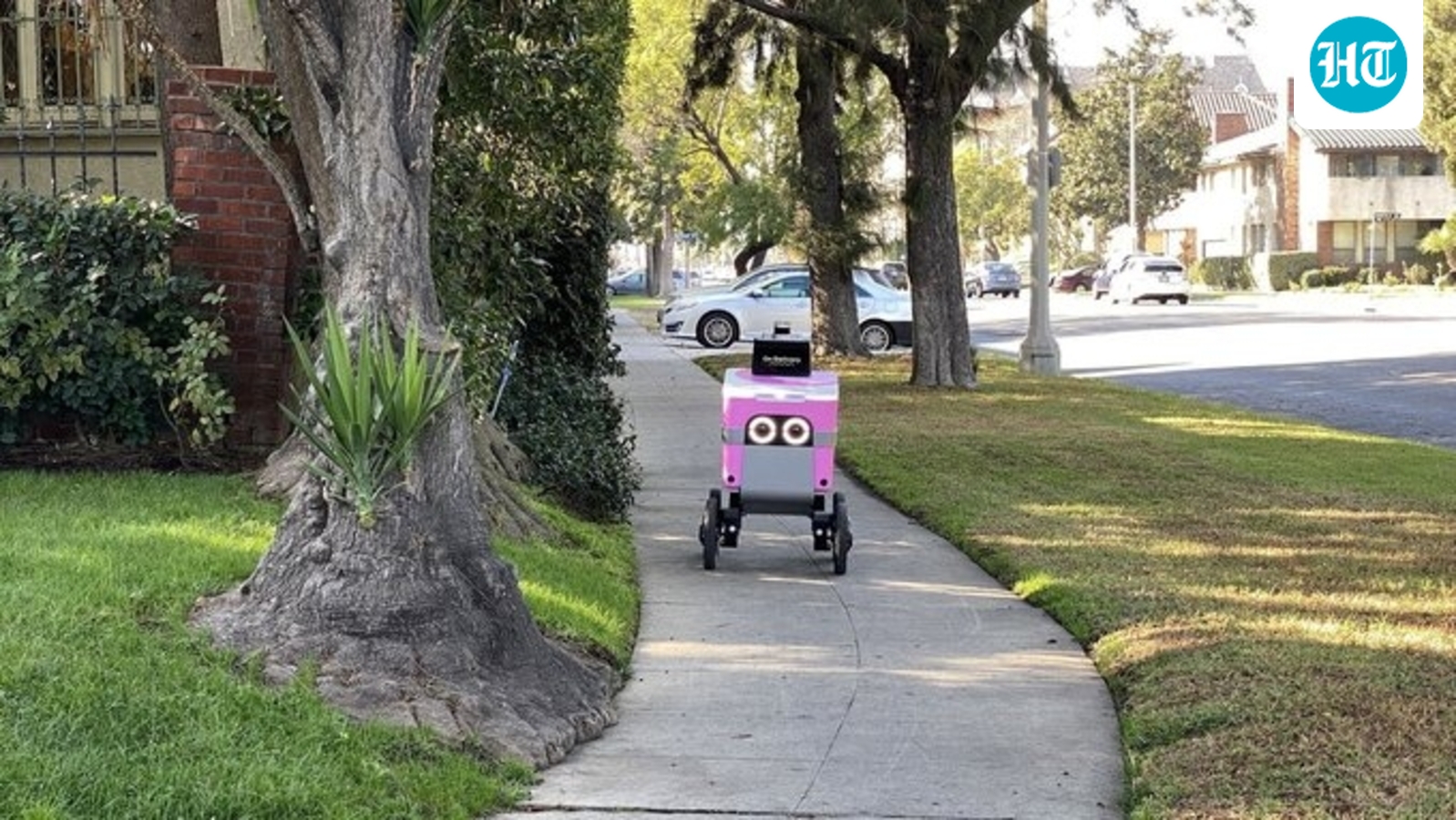
Deja, Jiwon, Mu, Niska and Pelin draw attention on the sidewalk of a busy Atlanta street. Their eyes slowly lit up as they looked straight ahead. Inside Gusto, the salad-and-wraps restaurant they encounter, the staff notices. “It looks like we’re seeing each other,” said one. At any moment the platoon would burst into action—slinging away to pick up and deliver late-night munchies to college kids studying in the dorms or sushi diners to fund the fraternity. These are no ordinary couriers. They are machines.
Thousands of cool-looking food delivery robots are now roaming the streets of America. At the start of last year, Serv Robotics, the maker of Dejar Pose, had just 100 bots. (Getty Images.)Thousands of cool-looking food delivery robots are now roaming the streets of America. At the start of last year, Serv Robotics, the maker of Dejar Pose, had just 100 bots. It has since deployed 2,000 to 20 cities. Cocoa has a fleet of 1,000 and Starship Technologies has 2,000. The machines map their surroundings using the same cameras and sensors as self-driving cars. Then artificial intelligence helps them decide how to cross roads, runners and scale snowbanks. Thanks to deals with Uber Eats, DoorDash and Grubhub, they’re among the most visible examples of AI taking human jobs.
Bots promise efficiency. “Carrying a two-pound burrito in a two-ton car doesn’t make much sense,” said Ali Kashani, Serv’s boss. Roughly a quarter of American car trips, he notes, are “last-mile” runs to work and shopping. These journeys not only clog the roads but are also expensive: Why would a good transfer from Chinatown cost $10 when shipping from China might cost $2? Smaller robots carrying more takeaways could also boost local economies. Thunder Said Energy, a consultancy, discovered that a starship bot is 100 times more energy-efficient than a motorcycle.
The only gripe? People seem to hate them. Videos of pedestrians being assaulted have gone viral on social media. Some seem to be ditching them for pad thai; Others are expressing anger by tipping over the poor thing. One clip shows a Miami man trying to check a bot from a bridge. Anger is turning into activism. 3,300 residents in Chicago have signed a petition asking their city to ban bots. The editorial board of the University of Notre Dame called on students to boycott them: “Why should we tolerate mechanical groovy robots terrorizing our walkways?”
This hatred of robots is not new—especially in America. In 2014-15 HitchBOT, a full-body robot, successfully hitchhiked across Canada, Germany and the Netherlands. Two weeks into its American trek, however, it was found stripped, dismembered and decapitated in Philadelphia. Years later a security robot patrolling San Francisco’s Mission District was discovered “mangled with bar-b-que sauce” and “mangled with feces,” according to a news report. A recent survey by the Pew Research Center found that Americans are far more concerned about AI intrusion into daily life than people in other wealthy countries.
To quell the backlash, Serv gave his machine names and puppy-dog eyes. The company trains the bots to be “polite” and “pleasant”—slowing down near pedestrians and turning their wheels to signal where they want to go before taking off. Mr Kashani says online outrage is high: 99.8% of his robots successfully complete their trip. He hopes to widen their remit to sort pharmaceuticals and return purchases. To do that, robots have to adapt to the real world, he said with a laugh. “And the real world is a hard place.”