

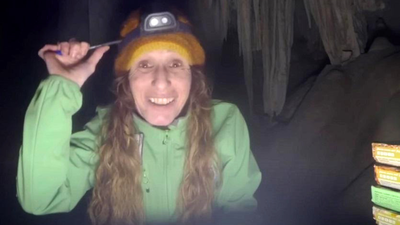
Spanish endurance athlete and mountaineer Beatrice Flamini spent 500 days alone inside a cave 230 feet underground without sunlight, watches or direct human contact, all in the name of science.
The unprecedented experiment was designed to understand how prolonged isolation affects the human brain, body and perception of time. Cut off from the outside world since November 2021, Flamini lived in complete isolation until she emerged in April 2023. What astonished her and the researchers was not her ability to survive the ordeal but rather her distorted sense of time. Flamini believed she had only spent about 160 days underground, unaware that 500 days had already passed.
Inside the 230-foot-deep cave where 500 days changed everything
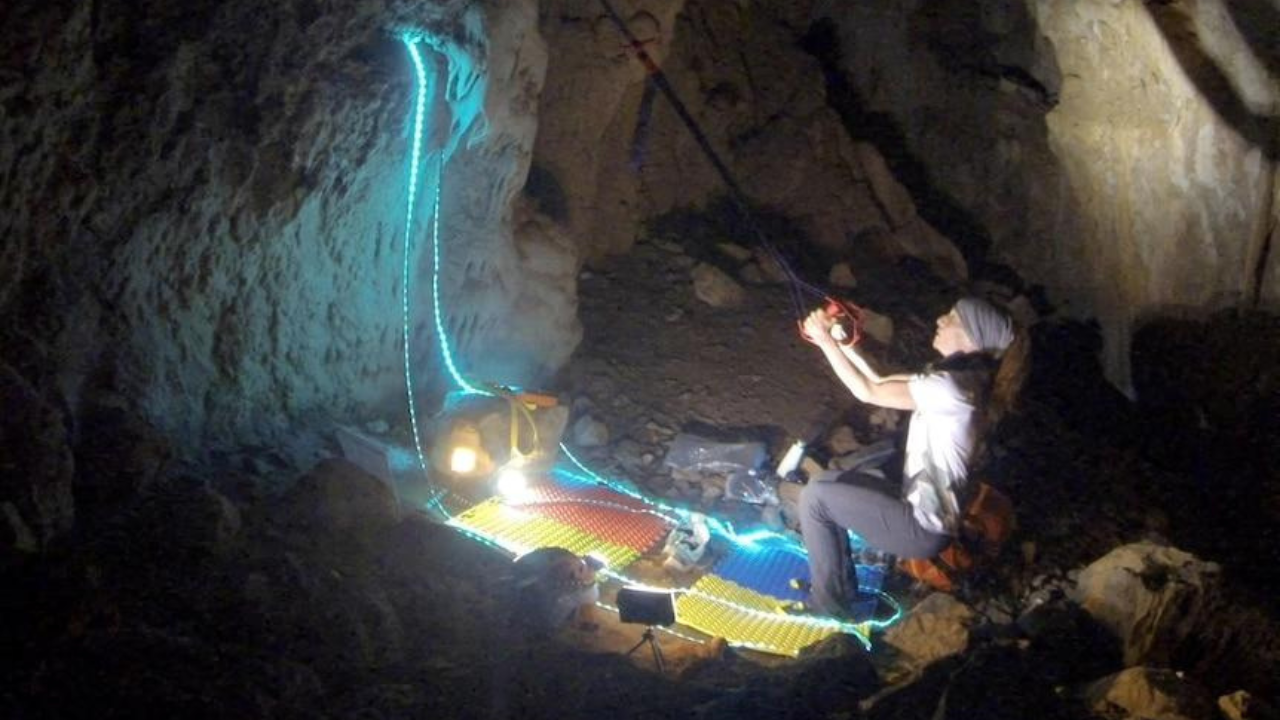
Hidden nearly 230 feet underground near Motril in the Granada province of Spain, the cave that became Beatrice Flamini’s home was unlike any ordinary living space. There was no sunlight, no windows, and no changing weather to indicate the passing of the day. The temperature remained relatively constant, while silence and darkness surrounded it for months at a time. There was a modest living area containing food, drinking water, books, cooking equipment, and cameras to record their daily activities, but no clocks, calendars, televisions, cell phones, or Internet access.
Every meal, every hour of sleep, and every waking moment passes without any thought of the outside world.Flamini entered the cave on November 21, 2021, as part of the Timecave Project, one of the world’s most ambitious studies of prolonged human isolation. For about 17 months, the cave became her home and a veritable laboratory where researchers examined how the mind adapts when completely disconnected from everyday life.
Why did scientists want someone to live underground?
The project brought together psychologists, neuroscientists, chronobiologists and cave specialists from several Spanish institutions to explore how extreme isolation affects memory, emotions, sleep and decision-making.The researchers wanted to understand how the brain works when everyday reference points disappear. Without daylight, routine, or regular social interaction, they hoped to observe how people adapt to an environment in which the normal perception of time gradually fades.
The findings could help scientists better prepare people working in highly isolated environments, from deep-sea missions to future missions into space.
A life devoid of contact with the outside world
Life inside the cave followed no schedule except the one Flamini herself created.She had no access to a mobile phone, television, internet, radio or newspapers, leaving her completely disconnected from current events. Food was periodically delivered to a designated point by support staff without face-to-face interaction, maintaining the integrity of the experience.
Aside from emergency contacts if needed, she didn’t see anyone else throughout the entire 500-day challenge.Over time, daily routines such as reading, exercising, and preparing meals became the only structure she had.
How she kept herself busy for 500 days
Instead of just waiting for the experiment to end, Flamini maintained a disciplined routine. She exercised regularly, read dozens of books, knitted, cooked, cleaned her living space, and kept a detailed diary.
She also recorded video diaries that researchers later analyzed to better understand how prolonged isolation affected her behavior and emotional well-being.One unusual habit she has developed is that she rarely speaks out loud. She later explained that she had come to appreciate silence, and allowed herself to be fully immersed in the isolated environment.
The notable reason is that she believes that only 160 days have passed
The biggest surprise came when Flamini emerged from the cave on April 14, 2023.She expected the experiment to last longer, so she was astonished when she learned that 500 days had passed. I really thought she only spent about 160 to 170 days underground.Its dramatically variable sense of time demonstrates how dependent the human mind is on external references, the researchers said. Without the usual cues that separated one day from the next, her perception of time gradually deviated from reality, making the months seem much shorter than they actually were.
The psychological effects of living completely alone
Contrary to what many people expected, Flamini later said that loneliness was not the hardest part of the experience.She experienced occasional confusion and auditory hallucinations, where her brain seemed to make sounds in the overwhelming silence. Surprisingly, she found insects entering parts of the cave more frustrating than the isolation itself.Despite these moments, she described her experience as peaceful, saying that she gradually adapted to her surroundings and stopped thinking about the time she spent underground.
A world that kept moving without her
While Flamini lived underground, life outside continued at its usual pace.She has appeared after missing major world events, including the death of Queen Elizabeth II, rapid advances in artificial intelligence such as ChatGPT, and countless political, sporting, and cultural developments that have dominated headlines during her absence.Returning to the surface means catching up on nearly a year and a half of world events in the space of a few days.
She even wanted to stay longer
One of the most unexpected discoveries came after Flamini completed the experiment.Instead of expressing relief, she admitted that she was disappointed that it was over. Speaking to reporters, she said she had become comfortable living underground, and even joked that she could have stayed another 500 days.Her reaction surprised researchers and highlighted how adaptable the human mind is when faced with unusual circumstances.
The importance of experience
Beatrice Flamini’s cave experiment has become one of the most prominent studies ever conducted on prolonged human isolation. Beyond demonstrating extraordinary physical and mental endurance, it has provided scientists with valuable insights into how people adapt when removed from the rhythms of everyday life.As researchers continue to explore the limits of human resilience, Flamini’s 500-day expedition offers a rare real-world case study in how the mind copes with extreme isolation. Her experience has expanded scientific understanding of isolation, revealing how malleable human perception is when every familiar point of reference is gone.