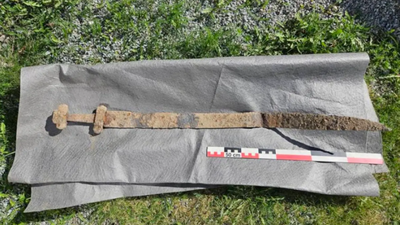
Photo: Kulturarv i Innlandet
What could have been an ordinary visit to school in Norway turned into an amazing adventure for archaeologists thanks to six-year-old Henrik Refsnes Mortvedt, who discovered a 1,300-year-old sword while digging through some dirt in a field in Inlandet County.
The boy made the discovery in a field near Brandbow and Hadland on a class trip. According to experts, the sword is a rare artifact that has only one sophisticated edge. It is believed to have been made in the latter part of the Merovingian period, which preceded the Vikings. Experts consider this discovery to be of great importance for understanding Norway in the early Middle Ages, the wars that took place there, and the emergence of the Vikings.
The sword has already been transferred to the Museum of Cultural History in Oslo for preservation and study.
An ancient Viking sword was discovered by a six-year-old boy in Norway
Students usually return home after their school trips carrying dirty pictures or shoes. However, six-year-old Henrik Refsnes Mortvedt found something even more extraordinary: the remains of an ancient sword, estimated to be around 1,300 years old.Henrik, a first-grader, found an artifact while walking through a plowed field in Brandbo, Inlandet, Norway.
At first glance, the rusty object sticking out of the ground looked like scrap metal. However, it soon became clear that the boy had made an amazing archaeological discovery.As local heritage experts say, the sword belongs to the Late Merovingian Period, dating back to around 550-800 AD, just before the beginning of the Viking Age. Designed to be one-handed, the sword was a popular type of sword in Scandinavia on the eve of the Viking period.Instead of trying to extract the sword, Henrik’s teachers immediately contacted archaeologists; This has been appreciated by experts in public statements.“We are very proud of the children who were able to see the sword in the field. Well done! And we are very happy that they did everything right: they contacted an archaeologist,” local archaeologists said, according to Ancient Origins.
Why is the Viking Age sword historically important?
Archaeologists believe the discovery could provide insight into Norway’s early medieval history. According to the University of Bergen, Faculty of Science and Technology, Department of Earth Sciences, the Hadland area, where the sword was found, has long been associated with Iron Age settlements, burial mounds and Viking activity.Historians point out that the name “Hadland” is traditionally associated with warrior culture, making the discovery even more appropriate. The sword itself resembles what experts describe as “F” type Viking swords, classified in Norwegian archaeological studies more than a century ago. Despite its severe corrosion, the weapon is now being preserved and examined at the Museum of Cultural History in Oslo, the BBC reported. Researchers are expected to use X-rays and mineralogical analyzes to study how the sword was crafted, how it was used, and who carried it centuries ago. Experts believe the sword may have belonged to a warrior or an individual of high social status during a turbulent period in Scandinavian history.
Norway’s growing fascination with Viking discoveries
Many amazing relics from the Viking period have been discovered in Norway and neighboring Scandinavia, most of them in surprising places. Over the past years, some of these artifacts have been discovered by reindeer hunters, hikers and even children due to the cold weather that prevails in the area.In a previous incident, an eight-year-old Swedish girl found a sword dating back to before the Viking Age while playing around a lake during a drought in 2018.This is exactly like what happened two years ago when ten-year-old Fionntian Hughes discovered a prehistoric Viking sword after searching with a metal detector he received for his birthday.Like other discoveries, Henrik’s discovery will arouse interest among people.
The discovery of a prehistoric artifact accidentally by a child adds excitement to any such discovery.However, beyond this excitement, archaeologists will be thrilled because it will remind them of what is still buried beneath Europe. As restoration work continues in Oslo, historians hope this sword will provide insight into how the Vikings operated before conquering other European lands.