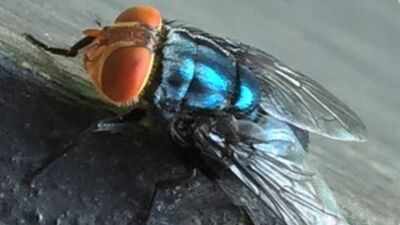
A research project that involves studying the stench may literally help protect livestock, pets and wildlife from one of the most destructive parasites in the Americas. At Colorado State University, professor Jessica Metcalf is investigating the smelly chemical signals that attract the New World screwworm, a carnivorous fly whose return to the United States has alarmed animal health officials.
The parasite was eradicated in the United States more than 50 years ago, but was discovered again in Texas in early June, making better detection tools more urgent than ever, according to Phys.org.At the heart of Metcalfe’s work is a simple but powerful question: What exactly does this fly smell like when it finds an open wound? The answer could help scientists design more effective traps and prevent the parasite from spreading further throughout the region.
Why smell is important
Most people associate unpleasant odors with danger, and for good reason. When a wound starts to smell, it may be full of bacteria. These bacteria release chemical byproducts that humans find unpleasant; But the New World worm finds it irresistible.Metcalfe explains that people use these bacterial signals as warnings, helping them avoid spoiled foods and other unsafe items. But the fly uses the same signals for a completely different purpose.
For screwworms, the smell of bacteria means a potential place to lay eggs, and this open wound becomes the perfect target.New World screwworms do not feed on dead tissue. Instead, the adult fly lays its eggs in wounds or body openings, and the hatched larvae feed on living flesh. This is what makes the parasite so dangerous. It can infect any warm-blooded animal, including cattle, sheep, goats, pets, and even humans, although it is dangerous to humans in the United States.
stays low. If left untreated, the infection can become fatal, according to the CDC.
Representative image
She also shared that as of July 23, the parasite had been detected in cattle, sheep, goats, and two dogs in Texas, and in one dog in New Mexico. This spread has led to intensified efforts to improve monitoring and prevent the pest from moving north.
Challenge with existing traps
Detecting the parasite early is one of the most important steps in controlling it. But that is easier said than done.
One of the most widely used baits in today’s traps is based on odors emanating from rotting meat, which means it tends to attract a closely related fly called the secondary screwworm, a species that feeds on dead flesh.This creates a big problem. Traps can quickly fill with the more common secondary screwworm, making it difficult to spot the more dangerous New World screwworm. In other words, the trap is crowded with the wrong visitor.Metcalfe’s goal is to change that by building a more specific bait for the New World screwworm. Instead of rotting meat odors, her team is focusing on bacterial odors associated with wounds. These odors are known as volatile organic compounds, or VOCs, which are chemical compounds that evaporate easily and are carried through the air as odor.
What the team is studying
The research team will compare the volatile organic compounds that attract New World annelids with those that attract secondary annelids.
A key question is whether the flesh-eating parasite is attracted to a different set of odors compared to the decomposing species, which prefer dead tissue.The study also looks at bacteria carried by both types of flies. These insects do not work alone; They carry microbial partners that can help them communicate and select suitable hosts. In some cases, the bacteria themselves signal to other flies the presence of an object or wound, which can worsen the infestation.By identifying the bacteria present in the New World screwworm and the secondary screwworm, Metcalfe and her collaborators hope to design better monitoring tools. The same knowledge could eventually be used not only to catch the pest, but also to redirect it away from live animals.
From the science of decomposition to animal protection
Metcalfe’s work may seem unusual, but it is based on years of careful study. She says her team has spent 15 years studying the relationship between insects, bacteria and animal decomposition.
Because the New World screwworm evolved from a decomposing insect, her lab was already ready to examine it.This background also gives the project a second layer of value. Metcalf’s decomposition research has applications in forensics as well. Her team has shown that microbes on the body can help determine time of death, which is useful in criminal investigations.In this sense, the same science that helps solve forensic cases can also help protect agriculture.
The basic idea is the same: If you understand how insects and bacteria interact around decaying or damaged tissue, you can use that knowledge to build practical tools for monitoring and control.
A broader effort to stop the spread
The risks are high because screwworm is not just a local nuisance. It is part of a broader regional outbreak that has moved through Central America to Mexico, where US officials have warned that the risk remains concentrated in affected areas.
The USDA reported the first animal case in the current U.S. outbreak on June 3, 2026, and ongoing detections have kept animal health agencies on alert.That’s why research like Metcalfe’s is important. Better traps mean better monitoring, and better monitoring means faster response. In a pest outbreak, where every delay counts, being able to identify the right fly at the right time can make a big difference.Metcalf’s project will be carried out with CSU colleagues Kayla Burton and Kelly Wrighton, using advanced genetic and chemical analysis tools through the Colorado State Microbiome Network, or CoSMic.
Do you support funding research on innovative pest traps?
More than 3 thousand users shared their opinion today
More than 5 thousand users voted today
Share your opinion
Why this research stands out
What makes this study particularly interesting is its unusual logic: The key to stopping the parasite may lie in understanding which scent it likes best. The same bacteria-driven odor that warns humans of infection may be the same signal that screwworms use to find animals in danger.If Metcalfe’s team succeeds, the result could be a smarter generation of traps, improved surveillance, and perhaps even new strategies for directing the parasite away from living hosts. This would be a huge win for livestock producers, veterinarians, wildlife managers and public health officials alike.Right now, work may stink. But if it helps prevent carnivorous parasites from spreading, the science behind them could be invaluable.