

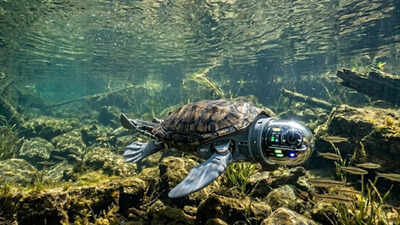
 It included high-quality cameras and machine learning models to detect invasive species and coral bleaching with a detection accuracy rate of up to 96 per cent, as noted by the Canadian Broadcasting Corporation (CBC). Evan has leveraged affordable devices and biomimetics with advanced data collection methods, paving the way for ordinary people to actively participate in protecting the environment and combating climate change.
the Underwater mechanism mechanism The Invention of the Turtle by Evan Budds
Evan Budds, a 15-year-old from Dundas, Ontario, has created an “underwater robotic turtle” called BURT. He got the idea while camping in the Great Lakes and watching turtles move smoothly and efficiently. Unlike traditional underwater drones that have noisy propellers, which can harm marine life, Ivan’s invention offers a gentler approach. His robot mimics nature using soft fin technology, so it moves quietly through the water.
This design allows areas with delicate aquatic life and coral reefs to be explored without disturbing or damaging them.
How BURT tracks environmental risks
BURT’s main mission is to detect environmental hazards, which is possible thanks to advanced sensors and artificial intelligence. Budz added a machine learning model directly to the robot, teaching it how to spot problems like coral bleaching, plastic waste, and invasive species with an astonishing 96% accuracy. Once this system works on its own, researchers collect important information about underwater threats as they occur. This high level of accuracy is essential for conservationists who must respond quickly to reduce the impacts of climate change and human activities on sensitive freshwater and marine environments.
Recognizing BURT’s advanced monitoring capabilities
Evan Budds has made waves internationally, representing Canada in the European Union Young Scientists (EUCYS) competition. He stood out among hundreds of global competitors with a project that won acclaim for its practical use in environmental science and engineering.
At a young age, Budds’ achievements underscore the increasing importance of student-led innovations in addressing complex global issues. EUCYS recognized his work as evidence of the advanced technical design of the electronic turtle and its potential impact on large-scale environmental monitoring.
BERT changes environmental science
The Electronic Turtle is more than what it can do now; It is a move toward cheaper, environmentally friendly tools for studying the oceans. Budz created a prototype with off-the-shelf components and accessible materials, showing that you don’t always need to spend millions on important scientific work. In the future, this young inventor wants to improve the robot by adding features that allow it to operate on its own and collect more data.
His project serves as a guide to environmental monitoring, demonstrating how using biomimetic principles can help protect our planet’s most vulnerable underwater areas and wildlife.