

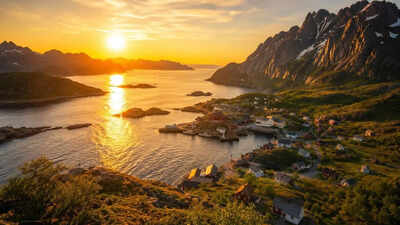
Most people measure the day without really thinking about it. Morning comes, afternoon follows, and eventually the sky begins to darken. The pattern is so familiar that it seems permanent.
However, there are parts of the world where summer interrupts this routine completely. For weeks, and in some cases months, sunsets simply do not happen.This phenomenon is known as the midnight sun. This occurs in areas near the poles when the Earth’s tilt keeps the sun above the horizon long after it naturally disappears. The effect is strange at first glance. The streets remain bright until late in the evening. Mountains cast shadows at midnight.
A quick glance through a window at 2 a.m. can look remarkably similar to one taken during the afternoon. Throughout the Arctic and Antarctic regions, many places experience this unusual season every year.According to WorldAtlas, check out this list of places on Earth where the sun never sets.
Places where the sun never sets
1. NorwayNorway is often the country most associated with the midnight sun. Its northern coast extends deep into the Arctic latitudes, and places like Svalbard spend long periods of time under continuous daylight.
Light behaves differently here. Instead of dipping below the horizon, the sun drifts around, remaining visible throughout the night. The result is a landscape that appears suspended between day and evening for weeks at a time.2. AlaskaUnited States of AmericaFar northern Alaska follows a similar pattern. As summer progresses, communities above the Arctic Circle begin to experience days that refuse to end.For residents, this represents a definite seasonal shift after months of darkness and cold weather.
Visitors often remark how difficult it is to judge a watch by looking from the outside. The sky remains bright enough to blur the distinction between midnight and midday.3. NorilskRussiaFew cities are as far north as Norilsk. Built in a remote corner of Siberia, it witnesses both extremes of the Arctic calendar.Summer brings uninterrupted daylight. Winter brings the opposite. During the brighter months, the sun remains visible around the clock, creating a sharp contrast to the long periods of darkness that arrive later in the year.4. FinlandIn northern Finland, summer changes the appearance of the landscape as much as winter. Lakes reflect sunlight deep into the night while forests remain visible long after evening.The northern regions of the country experience some of the longest days in Europe. The darkness becomes brief and, in certain areas, completely disappears for a period of the season.5. SwedenCrossing into northern Sweden reveals a similar rhythm. The midnight sun becomes a part of daily life across large swathes of Lapland, where daylight lasts throughout the night.Instead of a sudden sunrise and then sunset, the light changes gradually. The sun descends toward the horizon, moves along it, and begins to rise again without completely disappearing from view.6. IcelandIceland lies just below the Arctic Circle, yet most of the country still experiences unusually bright summer nights.Darkness rarely stays for long. Coastal cliffs, volcanic plains and waterfalls remain visible under a pale glow that can last until morning.
In many parts of the country, the night appears shorter rather than absent, although the effect is still striking.7. GreenlandGreenland’s settlements are concentrated along its coast, where summer brings weeks of long daylight. Surrounding ice and water often amplify the effect, reflecting sunlight across the landscape.Despite its vast area, much of Greenland shares the same seasonal pattern found elsewhere in the Arctic.
The sun remains almost constantly present during the warmer months before eventually giving way to the opposite extreme.8. Northern CanadaCanada’s northern regions, including Yukon, Nunavut and the Northwest Territories, also experience the midnight sun. Communities spread across these regions see daylight extending far beyond what most people consider normal.Here, the changing seasons are measured by light such as temperature.
Summer brings bright nights and unusually long days, while winter follows a completely different path.9. AntarcticaThe midnight sun is not limited to the Northern Hemisphere. Antarctica experiences its own period of continuous daylight during the austral summer.Research stations operate under skies that remain bright for months. The sun orbits over the frozen continent without setting, creating one of the most unusual lighting conditions found anywhere on Earth.