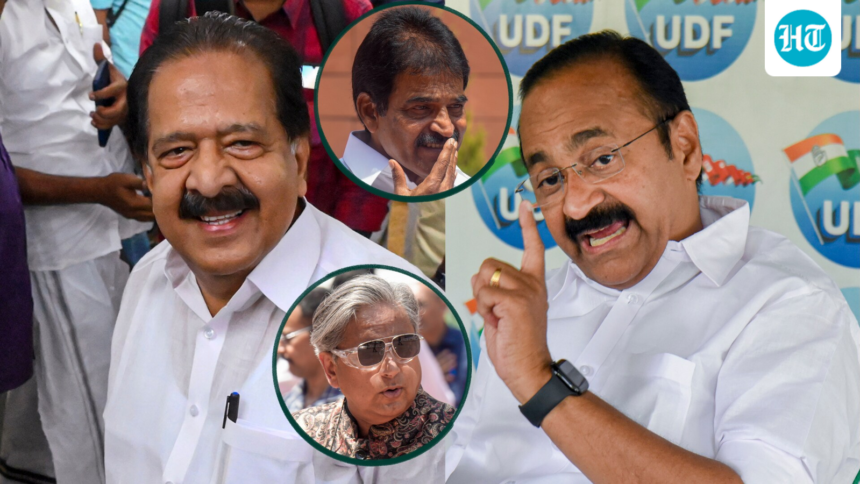
Three senior leaders are participating in the race: VD Sathisan, Ramesh Chennithala and KC Venugopal. All three are in Delhi as of Saturday.

Congress-led United Democratic Front (The United Democratic Front’s sweep of the Kerala Assembly elections – 102 seats in the 140-member lower house – ended a decade of Left Democratic Front rule, but the euphoria of victory soon gave way to a fierce, messy and very public battle over who becomes the state’s next chief minister.

Three senior leaders are participating in the race: VD Sathisan, Ramesh Chennithala and KC Venugopal. All three are in Delhi as of Saturday; The senior leadership of Congress was meeting throughout the week; The final decision is expected to be issued within 24 hours.
The Congress last held power in Kerala was under Oommen Chandy, whose government ended in 2016. Chandy, who died in July 2024, remains perhaps the most revered figure in modern Kerala Congress history — made all the more disturbing this week when a flexible board bearing his image, along with that of KC Venugopal, was torn down and doused in black oil by rival supporters.
The competition extended to the streets of Kerala. Sathisan’s supporters held rallies from the Palayam Martyrs’ Memorial in Thiruvananthapuram. Posters of Venugopal have appeared along Trivandrum Road. Chennithala’s supporters put up billboards in Idukki.

The destruction of Venugopal’s flexible board has drawn angry reactions from senior leaders across the party.
“The people who destroyed Venugopal’s painting, which had pictures of other leaders including Chandy, cannot be considered part of the Congress,” Congress MP Rajmohan Unnithan said. PJ Coren was equally frank: “The position of Prime Minister cannot be determined by pressure tactics.” MLA T Siddique described the public attacks on senior leaders as a source of “deep pain and disappointment”, adding that leaders who have dedicated their lives to public service “should not be publicly humiliated”.
A fourth name – Shashi Tharoor – has also been circulating mostly in Delhi circles, though he is widely seen as a figure in central politics and not in the state administration as of now.
What is the congressional process?
Officially, the decision now rests entirely with the leadership of the All India Congress Committee. At the state Congress party’s legislative party meeting in Thiruvananthapuram earlier this week, all newly elected party members passed a resolution authorizing the high command to choose the leader. AICC Controller Mukul Wasnik, who attended the meeting along with Ajay Maken, confirmed that: “A detailed report will be submitted to the party leadership.”
Sathisan, Chennithala and Kerala Pradesh Congress Committee president Sunny Joseph traveled to Delhi on Friday evening. Venugopal, who is based in the capital, was already there. Congress observers submitted their report to party president Mallikarjun Kharge. A meeting including top leaders of Kerala is scheduled to be held at Kharg residence on Saturday afternoon.
Senior leader K Muraleedharan, speaking to reporters in Thiruvananthapuram, said the final decision was likely to come within 24 hours, but cautioned that “seniority is not the only criterion” and that the views of alliance partners would also matter. ““It is a coalition government,” he said.

Get to know the competitors
VD Sathisan, 61, is widely considered the favourite. A five-time MLA from Peravur in Ernakulam district, he has spent the last five years as leader of the opposition and built his reputation as the most visible face of the anti-LDF charge in the Assembly. Syed Sadiq Ali Shihab Thangal, president of the UDF-aligned International Islamic Liberation Union in Kerala, has also publicly supported him.
Congress leader KP Naushad also made the case in his favour, saying, “VD Sathisan’s contribution has been significant as leader of the opposition and president of the United Democratic Front, which naturally made him the front runner.”

Ramesh Chennithala, 69, who won from Haripad in Alappuzha, is a former leader of the opposition and national president of the Congress student wing NSUI. Thus, it has strong organizational roots within Kerala and across the party at the national level.
He met Sonia Gandhi in Delhi earlier this week as consultations accelerated. But the 2021 defeat occurred under his leadership, a fact that the camps of his rivals in the high command have not forgotten.
KC Venugopal, 63, carries a different weight – he is the national general secretary (organization) of the Congress and enjoys the confidence of both Kharge and Rahul Gandhi. However, his coronation as Prime Minister would create a huge vacuum at the national level. He also did not contest the Assembly elections, which may count against him if the high command decides that the chief minister should come from the elected MLAs. He can, legally, win and enter the council within six months if he is appointed prime minister.
Meeting Tharoor amidst this
Tharoor’s meeting with Kargi on Friday, where the Thiruvananthapuram MP said he went to “exchange impressions about the situation in Kerala”, added a layer of curiosity.
His name has been bandied about as a dark horse, especially in Delhi circles, though analysts and party insiders consistently point out that he has long been seen as a figure for central policy rather than state administration.
He did not publicly support any of the three main contenders, and positioned himself as a statesman above the factional conflict.
What will happen next?
The Congress leadership holds all the cards now; Karg and Rahul Gandhi will decide.
Muralidharan expressed confidence that unity will follow whoever is named. He stressed that there will be no revolution in the party.

Arish Chhabra is an associate editor on the Hindustan Times online team, where he writes news reports and explanatory features, as well as overseeing the site’s coverage. His career spans nearly two decades across India’s most respected newsrooms in print, digital and broadcast. He said He reports, writes, and edits across formats—from breaking news and live election coverage, to analytical long-reads and cultural commentary—building a body of work that reflects editorial rigor and a deep curiosity about the community he writes for. Areesh studied English Literature, Sociology and History along with Journalism at Punjab University in Chandigarh, and began his career in that city, eventually moving to Delhi. He is also the author of Little Big City: What Life is Like from Chandigarh, a collection of critical essays originally published as a weekly column in the Hindustan Times, which examines the culture and politics of a city that is much more than just its famous architecture – and in doing so, holds up a mirror to modern India. During his stints at BBC, The Indian Express, NDTV and Jagran New Media, he has worked across formats and languages; Mainly English, as well as Hindi and Punjabi. He was part of the crack team for the BBC Explainer project which was replicated around the world by the broadcaster. At Jagran, he developed editorial guides and trained journalists on integrity and quality content. He has also worked at the intersection of journalism and education. At the Indian School of Business (ISB) in Hyderabad, he developed a website to streamline academic research in management. At Bennett University’s Times School of Media in Noida, he taught students the craft of digital journalism: from newsgathering and writing to social media strategy and video storytelling. Having moved from small town to larger town to megalopolis for education and work, his intellectual passions lie at the intersection of society, politics, and popular culture—a perspective that guides his writing and worldview. When he’s not working, he’s constantly reading long-form journalism or watching cerebral content, sometimes both at the same time.Read more