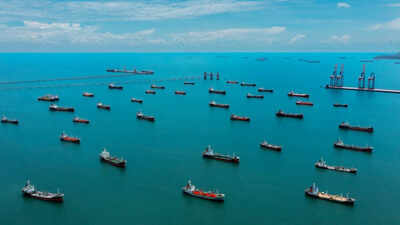
(Representational image) Image source: Getty Images
After escalating into open hostilities on February 28, 2026, the current war between the United States and Iran has been ongoing for nearly five months. During this period, the Strait of Hormuz, the only outlet into the open ocean for major producers such as Saudi Arabia, Iran, Iraq, Kuwait and the United Arab Emirates, was choked.
The Strait is the world’s most important marine energy corridor, facilitating the passage of nearly $600 billion in energy trade annually. According to estimates, there are about 1,500 ships stuck in the Arabian Gulf, and several hundred more stuck in the neighboring Gulf of Oman.Now, according to new research, something growing on the hulls of these ships could spread around the world when trade resumes. The study, published in the journal Biological Invasions, was led by an international team of 24 marine scientists, led by the University of Maryland Center for Environmental Science (UMCES), and including the Woods Hole Oceanographic Institution (WHOI).The team warned that thousands of commercial ships stranded for months in the Persian/Arabian Gulf following the closure of the Strait of Hormuz could inadvertently trigger a massive marine invasive species event. The study, titled “Closing the Strait of Hormuz may trigger a superspreader bioinvasion event,” highlights how long periods at anchor allow ship hulls to accumulate dense communities of marine organisms including algae, barnacles, mussels and other invertebrates that could be transported across the world when trade resumes.
A “super spreader” event.
This phenomenon is known in the marine industry as “biofouling,” which is the accumulation of marine organisms on submerged surfaces such as ship hulls and propellers. It begins with a thin layer of microorganisms and slime before developing into algae, barnacles, small marine crustaceans, and the organisms that form the shell.The authors describe the unprecedented grounding of more than 1,500 vessels as creating the conditions for a “super-spreader” event of a potential global marine biological invasion.
Caroline Thibault, a WHO biologist whose research focuses on the evolution and spread of marine invasive species, has contributed her expertise on how globally distributed biota are rapidly adapting to new environmental conditions.“Invasive marine species have profound ecological and economic impacts on coasts around the world, and are extremely difficult, if not impossible, to eradicate once they become established,” Thibault explained.
This disruption to global shipping has many repercussions and has more quietly created ideal conditions for the spread of warm-water species to new ports.
A looming threat
The International Maritime Organization advises that ships that remain grounded for more than 30 days require immediate intervention to manage biofouling before sailing, yet these ships have been stranded for approximately four months during the peak growth and breeding season of marine organisms.
According to research cited by the International Maritime Organization (IMO), even a thin layer of mud can increase greenhouse gas emissions by 20-25 percent, while the growth of light barnacles can increase fuel consumption and emissions by more than 50 percent.
The International Maritime Organization estimates that about 10 percent of the shipping industry’s fuel use is spent on overcoming drag associated with biofouling.The authors also noted that modern shipping has long been recognized as a major pathway for marine invasive species.
They also warned that the scale and duration of the ship’s recent stoppage is unlike anything previously documented, creating an unprecedented but daunting global biosecurity challenge. In recent decades, the spread of invasive species through biofouling, including from the Gulf region, has caused severe damage in many regions around the world.
In one such outbreak, species of shellfish and worms that spread into the Atlantic and Pacific Oceans displaced native species and destroyed port infrastructure.Biofouling also impairs the mobility of ships due to its effect on the drag that ships experience while navigating the water. As a result, ships are forced to consume additional energy, which leads to increased use of polluting fuel. One notable example of the environmental impact is the Asian green-lipped mussel, which is a particularly aggressive invasive species. This mussel, which originates in the tropical regions of the Indo-Pacific and is also common in the Gulf, has spread to the Caribbean and South Atlantic, causing environmental damage by displacing native mussel species.The team called on ship operators, port authorities, regulators and environmental managers to strengthen ship biofouling management, expand surveillance in high-risk ports, improve forecasting of ship movements and coordinate international rapid response efforts. According to the authors, “in-water cleaning” of ships to remove biofouling before departure can be very effective in mitigating invasion risks.According to recent reports, divers are being deployed across Gulf ports to scrape ship hulls and propellers before ships can resume commercial operations. Cleaning fees for a single vessel could rise by as much as 60%, to about $8,000 per vessel, as operators rush to leave the Gulf.According to Justus Heinrich, who leads marine underwriting at Allianz, this event has completely revolutionized the way the business community views the risks associated with choke points. “It has always been realistic disaster scenarios. But now, we have seen a real disaster scenario, which means that the theoretical risks have turned into practical risks.”