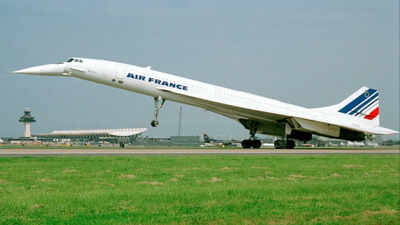
Concorde flew at such high altitudes that it had to carry a radiometer to track dangerous cosmic storms
The British-French supersonic Concorde flew so close to the edge of space that it had to carry a special radiometer to detect dangerous cosmic storms. If a cockpit instrument sounds an alarm, the only way pilots can protect wealthy passengers from high levels of space radiation is to leave Mach 2 behind and land in the thicker air below.
For context: Mach 1 ≈ 1,235 km/h (767 mph) Mach 2 ≈ 2,470 km/h (1,535 mph).The British-French plane flew at an altitude of 60,000 feet, nearly twice the altitude of regular passenger aircraft, and operated above about 95 percent of the Earth’s atmosphere. Passengers enjoyed views of the planet’s curve against a dark sky, but the plane’s four Olympus engines propelled it beyond the speed of sound. However, the thin air at this altitude left the plane more vulnerable to high-energy charged particles from outside the solar system and sudden powerful explosions from the Sun.
Watch space weather
European aviation rules require aircraft flying above 15,000 meters (about 49,000 feet) to carry equipment that monitors ionizing radiation. Since Concorde regularly flies at between 50,000 and 60,000 feet, tracking space weather has become mandatory for every transatlantic flight.Radiation levels changed depending on altitude, location and solar activity. The Earth’s magnetic field acts as a natural shield by pushing charged particles towards the poles, meaning that Concorde’s higher latitude routes, such as London or Paris to Washington, were exposed to more background radiation than the tropical routes to Rio de Janeiro and Caracas.
Before takeoff, British Airways and Air France crews received reports of space weather, but the onboard radiometer was designed to detect sudden and unexpected solar particle events.According to flight crew reports, if the sensor detects radiation levels approaching a dangerous point, it issues a visual and audio warning in the cockpit. The pilots then followed a checklist with one main goal: to get below 47,000 feet.
Sacrificing speed for safety
Descending to 47,000 feet meant giving up the performance that made Concorde famous. The speed of the aircraft depends greatly on the altitude. To maintain Mach 2, it needed the thin air found at 50,000 feet and above. As the fuel was burned off and the plane became lighter, the Concorde slowly climbed higher during its flight, eventually reaching 60,000 feet.The aircraft’s official maximum airspeed was Mach 2.04 (2,180 km/h).
At 47,000 feet, the air was too thick to maintain that speed. If a radiation warning forced the plane to land, Concorde would have difficulty traveling faster than Mach 1.7 or Mach 1.9.Following the emergency procedure meant moving into the thicker, more protected lower atmosphere, but it also forced the world’s fastest passenger plane to slow down. Concorde’s speed has always been a delicate balance with the laws of physics.
On warm days, air resistance can push the plane’s nose toward the maximum temperature of 127 degrees Celsius, forcing pilots to reduce speed to Mach 2.0 or Mach 1.96. Cosmic radiation has become another invisible factor affecting processes.
Measuring radiation levels for Concorde
Although Concorde carried a radiation warning device, normal flights were not considered dangerous. The plane faced a strange situation: Because it flew much higher than regular planes, it picked up radiation faster, but it also spent much less time in the air.A French study conducted between 1996 and 1997 found that Concorde received about 9.7 units of radiation exposure per hour. This was higher than other aircraft tested. For comparison, a normal long-haul flight from Paris to Tokyo received about 6.6 units per hour, while a low-altitude flight from Paris to Buenos Aires received only about 3 units per hour.Previous records showed similar results. In 1976, Air France measured Concorde flights and found an average exposure of about 9.9 units per hour across 772 flights.
Flights to Washington had the highest levels, at about 14.9 units per hour, while warmer routes closer to the equator were lower at about 7.8 units per hour.Although Concorde passengers were receiving more radiation per hour than people on regular planes, the plane crossed the Atlantic much faster. Concorde’s flight from London to New York took less than three and a half hours. The total radiation exposure was about 30 units, roughly equivalent to a chest X-ray.Because regular passenger planes take about twice as long to cross the Atlantic Ocean, passengers spend more time exposed to radiation. A regular transatlantic flight today could result in a total exposure of about 50 to 80 units, depending on the route and conditions in space.
Are there any limits to flying in the stratosphere?
Radiation levels remained within safe limits for people who regularly fly Concorde. Crew members working on board typically receive between 2 and 5 units of radiation exposure each year.Long-term checks by British Airways showed that Concorde pilots and crew never exceeded 6 units per year. This was well below the legal safety limit of 20 units per year, and was similar to the exposure received by crew members on regular long-haul flights, who spent much more time in the air.Today, passenger aircraft do not carry radiation alarms in the cockpit. Airlines instead use computer systems, previous flight information and space weather reports to estimate radiation exposure.
Concorde was unique in that it operated at the edge of the atmosphere. For a plane designed to transcend time, its best protection from the storm of solar radiation was simple: slow down and fly low.Concorde operated commercially from 1976 to 2003 and all passenger services ended in 2003 after the aircraft was retired.Concorde stopped flying due to a combination of factors, including rising costs, falling demand, and safety concerns.
The 2000 crash of Air France Flight 4590, which killed all 109 people on board and four people on the ground, damaged public confidence in the aircraft. Although safety improvements were later made, demand for expensive supersonic travel declined, especially after the attacks of September 11, 2001, which caused a significant decline in global air travel.
Concorde was also expensive to operate because it used large amounts of fuel, required expensive maintenance, and its older aircraft became difficult to support. In addition, strict noise rules limited where it could fly due to its loud sonic boom.