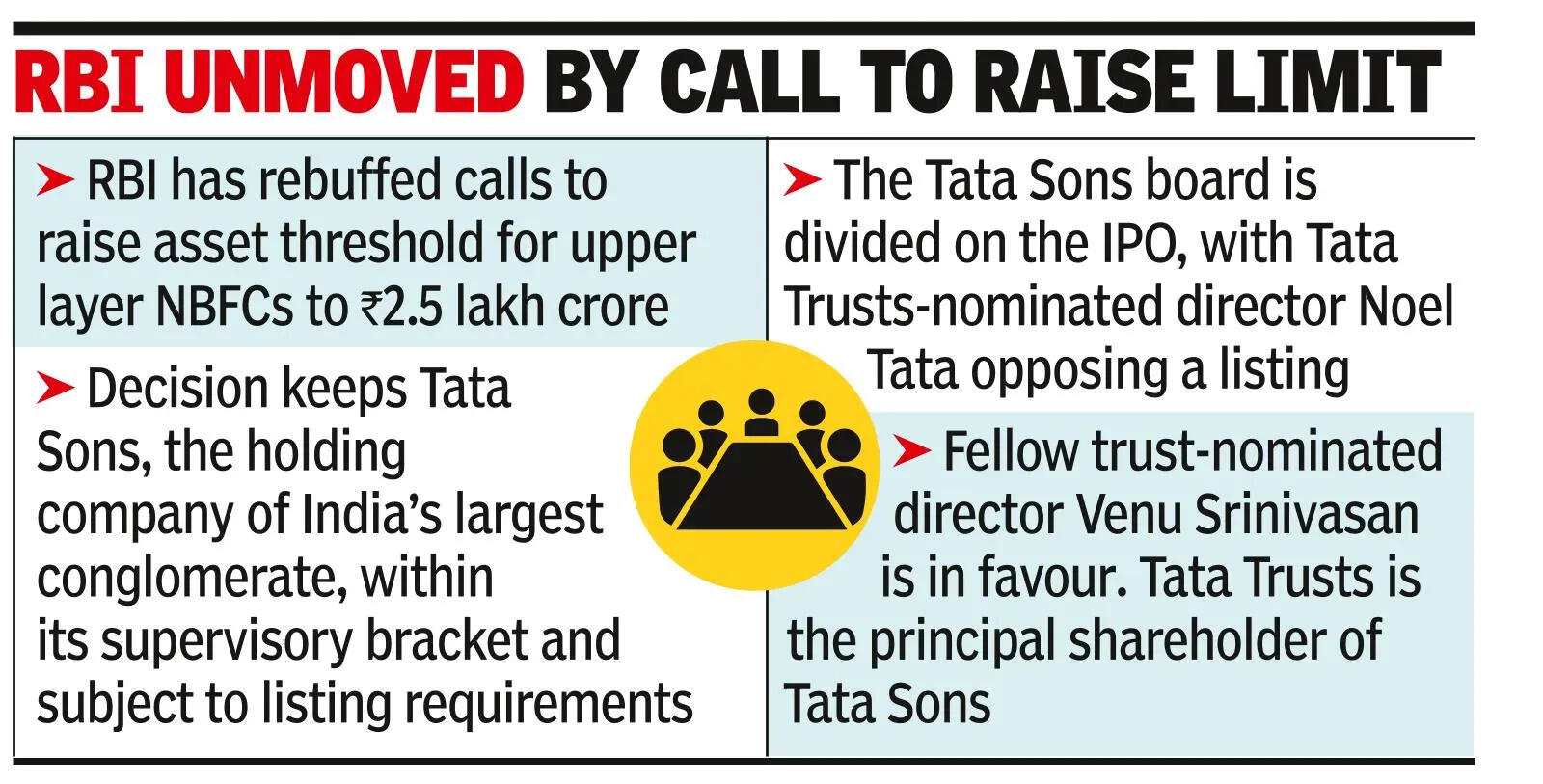
MUMBAI: The Reserve Bank of India has rejected calls to raise the asset limit for top-tier non-banking financial companies to Rs 2.5 lakh crore, sticking to the Rs 1 lakh crore threshold – a decision that keeps Tata Sons, the holding company of India’s largest conglomerate, firmly within its supervisory category and subject to listing requirements.Industry stakeholders have argued that the threshold should be set at Rs 2.5 lakh crore or higher, with complementary objective measures of profitability and asset quality to better reflect systemic importance. Had the higher benchmark prevailed, Tata Sons — which had standalone assets of Rs 1.75 lakh crore in FY26 — would have fallen out of the top tier rankings altogether.The Reserve Bank of India was not affected. The threshold of Rs 1 lakh crore and above has been determined based on the existing profile of the NBFC sector and analysis of the financial profile of existing top tier entities, it said.
Rejecting the argument that asset size alone may not fully capture systemic importance, the RBI said its analysis showed size remains a “reasonably good proxy” for systemic importance, adding that the Rs 1 lakh crore threshold better captures non-banking financial companies whose failure could threaten financial stability amid sector growth.However, it says the designation will not be automatic and will follow the Reserve Bank of India (RBI) which identifies the top tier of NBFCs from companies that meet this threshold.
The central bank has clarified that compliance requirements for top-tier non-banking financial companies will only be activated from the date on which it notifies this list. Tata Sons was first designated as a UL-NBFC by the Reserve Bank of India in September 2022, triggering the listing requirements. The company has since repaid the debt and applied to waive its NBFC registration to avoid listing – an application that is still under review by the Reserve Bank of India.Tata Sons’ board is divided over the IPO, with Tata Trusts-nominated director Noel Tata opposing the listing, while fellow Tata Trust-nominated director Venu Srinivasan is in favor of it.
Tata Trusts is the majority shareholder of Tata Sons.The RBI also reiterated that operationalization of the rating will be applied strictly on the basis of the independently audited balance sheet, and not on the group’s consolidated accounts, strengthening the entity-level supervision approach. It also said it would reduce the minimum review cycle from five years to three years, signaling a more dynamic calibration process as NBFC balance sheets grow and financial linkages deepen.The RBI also stated that “case-specific exemptions are inconsistent with a principles-based regulatory regime” – a comment made in relation to PSU NBFCs, but one that experts believe could have ramifications on Tata Sons’ request to waive its NBFC registration.