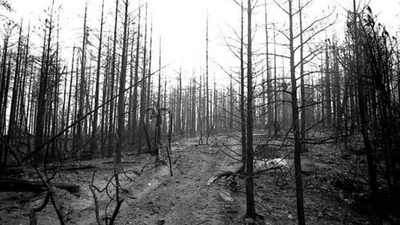
Deep in the rugged hills outside Ojai, California, a lonely bridge and winding mountain road has become the setting for one of the state’s most enduring ghost stories. For decades, locals have spoken of the Char Man, a hideously burned figure said to emerge from the surrounding forests after dark, terrorizing anyone who dares to enter its territory.
According to legend, the mysterious character was born in the wake of a devastating wildfire that swept through the region in 1948. While the tale has frightened generations of campers and thrill-seekers, historians say the truth behind Char-Man is far more complex than the legend suggests.
How the legend of the Shar Man began in California
Most versions of the story trace Char-Man’s origins to the Wheeler Fire of 1948, a massive wildfire that burned thousands of acres in Ventura County near Ojai.
The fire destroyed homes, burned forests, and left a permanent scar on the local community.According to the most widespread version of the legend, rescuers searching the scorched landscape discovered a remote cabin where a horrific scene awaited them. The story claims that a man was skinned and hanged, while his badly burned son, driven mad by the horrors of the fire, disappeared into the surrounding wilderness.
From that moment on, locals believed the burned survivor wandered the forests, becoming the terrifying figure known as Char Man.However, despite its popularity, there is no historical evidence that this incident ever occurred. Researchers have found no contemporary newspaper reports, police records, or official documents confirming the murder or the existence of the Burning Man described in the legend.
The devastating wildfires that inspired the story
Although the supernatural tale has yet to be verified, the Wheeler fire itself was very real.
The fire tore through the mountains above Ojai in 1948, consuming vast swaths of forest and forcing firefighters to confront difficult terrain and harsh conditions.Like many major disasters, wildfires have become woven into local memory. Folklore experts point out that traumatic events often inspire ghost stories as communities try to make sense of the tragedy. Over time, memories of the devastating fire merged with rumour, imagination and oral narrative, gradually developing into the legend of the Shar Man.
Why are there so many different versions
One of the reasons Char-Man has endured for decades is because no two versions of the story are exactly the same.Some say that Shar Man was a young boy whose father died in a forest fire. Others claim he was a husband who watched his family burn to death before losing his mind. Another version suggests he survived a horrific car fire, while some believe he was once a firefighter who was left permanently disfigured by the flames.There’s even a local explanation that the legend may have been inspired by a real man with severe burn scars or an advanced skin disease who would sometimes wander the area, unwittingly scaring away visitors.
None of these accounts have been verified, but together they help keep the mystery alive.
Charman Bridge and Haunted Road
The legend is closely associated with the San Antonio Creek Bridge, known locally as Char Man Bridge, located along the isolated Creek Road outside Ojai.For generations, teenagers have traveled to the bridge after sunset in hopes of experiencing something supernatural. Local folklore claims that calling Char-Man’s name or screaming for help near a bridge may summon the burning form from the surrounding forest.Visitors have reported hearing unexplained noises, smelling smoke, or feeling like someone is watching them. Others describe seeing shadowy figures moving between the trees. Despite these accounts, there has been no reliable evidence confirming the presence of supernatural activity on the bridge.
Separating fact from folklore
Historians and folklore researchers generally agree that Char-Man is best understood as an urban legend rather than a documented historical figure.Although the Wheeler Fire undoubtedly happened, the backstories of murder, madness, and the burning ghost seem to have developed over decades of storytelling. Similar legends exist throughout the United States, often appearing in places associated with tragedy, deserted roads, or historical disasters.The researchers point out that the lack of contemporary press reports or official investigations strongly indicates that the legend arose through oral tradition and not through real criminal events.
Why does the legend refuse to die?
Char-Man has endured because it combines many of the elements that make myths so memorable: a real-life historical catastrophe, an isolated location, horrific imagery, and the possibility of a supernatural encounter. Each generation added new details, making the story richer and more mysterious while maintaining its central theme.The legend has also spread through campfire stories, local folklore, books, television shows, paranormal websites, and social media, introducing Char-Man to audiences beyond Southern California. Every year, curious visitors continue to travel the winding roads outside Ojai, hoping to catch a glimpse of the burning figure said to haunt the forests. Whether viewed as a ghost story, a cautionary tale, or simply a fascinating piece of California folklore, the legend of the Sharman remains one of America’s most haunting domestic mysteries.