

After the Sydney Harbor Bridge There were 40 or so ebikes in the crowd And e-motorcycles On Wednesday, the Australian government said the country faced a “genuine emergency”.
“[Illegal ebikes] There is absolute danger on the road,” Health Minister Mark Butler said on Friday.
“Kids have done stupid things on bikes since penny-farting [but] The injuries coming into our hospital emergency departments are absolutely devastating.
“We have to make sure that these things stop coming into the country [and] The police are given powers to suppress, take away, suppress and destroy them.
Ebikes have been hailed as a climate-friendly solution to city traffic congestion, transport emissions and youth social media addiction, offering a way for Australians to get more exercise and save money.
But they came at a cost — and took lives.
The state of New South Wales recorded 226 injuries related to ebikes in 2024. In the first seven months of 2025, that has already increased to 233 injuries and four deaths.
The rest of Australia faced a similar problem, with legal IBCs involved in 239 crashes in Queensland in 2025, four of which were fatal, according to preliminary police data.
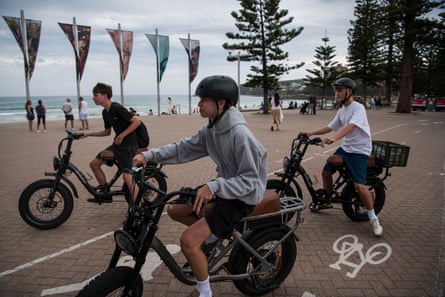
For teenagers like Ben Boucher, 16, ebikes have become a source of independence. Boucher bought him out in late 2025 with savings from a part-time job. Many in his grade started walking to school, cutting commutes to just 10 minutes, he said.
“It’s very easy to get around,” the Manly student said. Suddenly everyone seems to have one: “[there’s] Too much hype”, he said.
But he was also aware of the dangers. “I see these little kids riding them and I think it’s dangerous because they don’t understand the rules of the road or anything,” Boucher said.
Francisco Furman, owner of Manly Bikes in Sydney’s north, says sales will begin to pick up in 2022. But after another death in December, this time on a rental-share ebike, the normally busy Christmas period went quietly.
“We’ve had a lot of cancellations, which really affects our business in a big way, we’re low on stock,” he said.
‘Close the barn door’
The NSW Premier, Chris Minnes, said governments were “trying to close the barn door” on the ebike boom, with nearly a million of the machines already on Sydney’s streets.
Industry experts attributed the boom in part to the federal government’s relaxation of import standards in 2021. Those standards were tightened again in late 2025, meaning road-legal ebikes must have motors that are only activated when the rider is pedaling and are limited to speeds of 2/h0 and 25ktm. NSW, which allowed up to 500 watts of electricity, reduced it to 250 watts.
But retailers such as Tadana Maruta, owner of Pedal Bikes in inner Sydney, doubt the energy restrictions will have much of an impact.
“You brought drugs into society and now people have a taste for it and now you want to get it out,” Maruta said. “It’s too late.”
He said ebikes can be tuned to drive at high speeds similar to cars, regardless of their engine wattage.
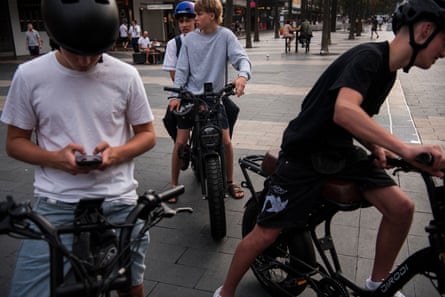
“All it takes is one smart kid, and there’s always a smart kid who can do it,” he said.
Customers can also continue to buy ebikes, which are illegal on public roads but allowed on private property: these go at speeds above 25km/h and don’t have high-powered throttles or pedals.
Such products exceed the 25km/h road-safe versions, Maruta said. Retailers warned consumers not to take to the streets, but those warnings were widely ignored.
Illegal bikes and e-motorbikes have joined the Harbor Bridge raidout and made up more than half of the ebikes intercepted in a Melbourne police operation in August.
Victoria Police Assistant Commissioner Glenn Weir said at the time, “There was either a clear lack of awareness or a blatant disregard for awareness.
Implementation and education
Calls have also grown to crack down on “rideouts” on the Harbor Bridge, on a north Sydney golf course and through Melbourne’s Docklands district.
Amidst the covid epidemic Group cycling events are popular in Australian cities, often aimed at urban youth and promoted on social media. Attendance grew from dozens to hundreds.
Natalie Ward, NSW’s opposition deputy leader, demanded that “ebikie gangs” be prevented from taking to the streets.
Regular riders like Brookvale couple Kieran and Elle sympathize with this view.
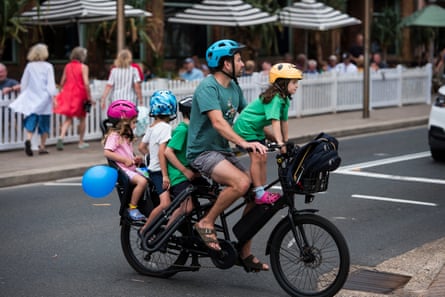
“They’re giving us a bad name,” said Kieran as he drove to lunch with his four- and one-year-old children in child seats.
“We never go more than 20 km/h, we want to go down for a Friday night cruise.”
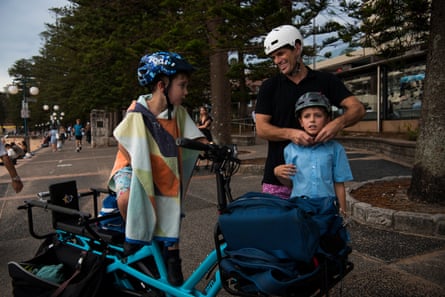
Daz, who is working with rideout organizer Bike Life Australia, said police have started neighborhood meetings to issue move-on orders and fines en masse.
“There’s an energy when you ride in a pack like that, doing tricks with your friends,” said Daz, who declined to share his last name. “Guys need it, it helps them come out.”
Daz said Bike Life is working to coordinate more closely with the police.
Heavy-handed enforcement should be a last resort, according to Cycle NSW, which has called for young people, parents and retailers to be taught the laws. The advocacy organization is trialling the education program in hundreds of schools with the goal of expanding statewide.
Max*, a 15-year-old Sydney student, recalls a class where he cracked one egg with a model helmet, then another, and noticed the difference.
“I was like, ‘Man, I don’t want that to be my head,'” said Max, who asked to remain anonymous.
He unlocked his DiroDi Gen 4 fat tire bike in January, but says he doesn’t ride at high speeds for his safety.
He said few of his classmates or their parents share the concern.
“I wonder, do these people’s parents know they are giving their 14-year-old a bike that can go over 50 km/h?” He said.
* Not his real name