


Image source: Harvard Alumni
TOI correspondent from Washington: Nirmal Narvekar, the Indian-American financier who spent nearly a decade reshaping the investment machinery behind Harvard University’s massive $57 billion endowment, is preparing to retire, closing one of the most important — and most controversial — chapters in modern university finance.Narvekar, known on Wall Street and in Ivy League circles as “Narv,” has reportedly informed Harvard’s board of directors that he will step down in 2027 after giving the university time to prepare a succession plan. His departure comes as Harvard’s $57 billion fund — the world’s largest university fund, 3.5 times larger than India’s central education budget — is at the center of a political and financial firestorm sparked by the Trump administration’s cuts in federal funding.
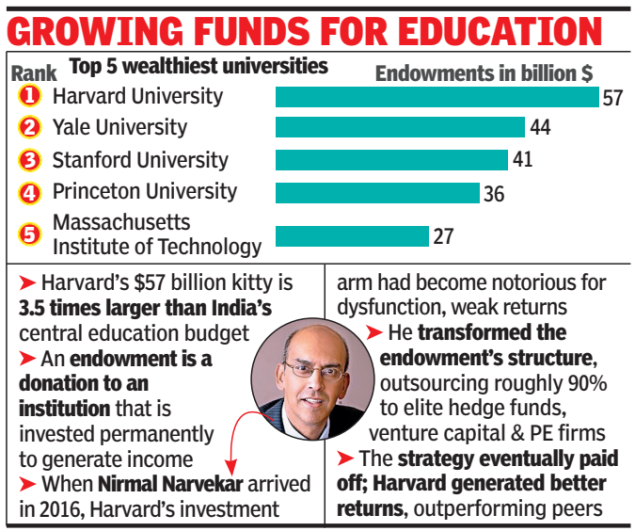
Narvekar’s career has drawn attention to the extraordinary scope of American university scholarship—a concept that remains relatively underdeveloped in India. Harvard’s $57 billion fund makes the finances of university systems and entire education budgets in most countries look minuscule. In the United States, endowments serve as permanent investment engines. Universities spend only a small portion of their annual revenue while preserving capital for future generations.
Historically, India has developed a very different model. Most public universities relied heavily on government funding, while private institutions relied on tuition or charitable funds rather than professionally managed investments. Only recently have institutions such as IIT Mumbai, IIT Delhi, and Ashoka University seriously begun to cultivate alumni-led endowments. Yet Indian endowments remain small by US standards and face restrictive investment rules that limit exposure to venture capital and alternative assets.Narvekar’s rise also reflects a broader rise of Indians into elite American institutions. At one point, the Harvard ecosystem included several leaders of Indian origin, including Harvard Business School Dean Nitin Nohria and Harvard College Dean Rakesh Khurana. Yale’s endowment itself traces its origins symbolically to colonial India: the university was named after Elihu Yale, the East India Company’s governor in Madras who donated goods and money to the fledgling institution in the early 18th century.Narvekar arrived at Harvard in 2016 after running Columbia University’s endowment and inheriting what many viewed as a troubled investment empire. Harvard’s investment arm became notorious for internal dysfunction, poor returns, and volatile leadership after suffering a devastating 27% loss during the 2008 financial crisis, forcing it to sell private equity stakes at distressed prices.Over the next decade, he transformed the structure of the endowment, going from managing about 40 percent of its assets internally to outsourcing it to about 90 percent to elite hedge funds, venture capital firms, and private equity managers.
He also embraced the so-called “Yale Model” created by legendary Yale investor David Swensen, who revolutionized university investing by shifting away from traditional stocks and bonds toward alternative assets such as venture capital, hedge funds, and real estate.Under Narvekar, Harvard doubled its exposure to private equity, sharply increased hedge fund investments, and gained access to coveted investments in companies like SpaceX and Stripe.
This strategy eventually paid off. Harvard University has achieved annual returns of 8.1% over the past three years, beating Yale and Princeton and placing it among the best-performing major university endowments in America, some of which are larger than the education budgets of most countries.However, Narvekar’s tenure has also attracted intense criticism, especially from conservative commentators and some Harvard insiders who have alleged that he has made the university dangerously dependent on illiquid assets such as hedge funds and private equity.
Former Treasury Secretary and Harvard University President Lawrence Summers once pointedly remarked that if Harvard had matched the performance of its Ivy League counterparts, the university would be about $20 billion richer.
Although many finance experts consider such criticisms exaggerated, they nonetheless reflect broader concerns about whether elite American universities have become overly reliant on murky, Wall Street-style investing.Narvekar himself remained publicity-shy throughout his career. Born into an Indian family and educated at Haverford College before earning an MBA from Wharton, he built his reputation not as a celebrity investor but as a disciplined institutional distributor.