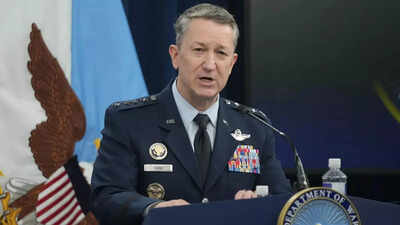
File photo: Gen. Dan Keane, Chairman of the Joint Chiefs of Staff
Iran is launching far fewer missiles and drones than it was at the start of the war on Saturday, the most senior US military officer said on Saturday, even as Washington signaled an expansion of its offensive deep into Iranian territory.“We will now begin gradually expanding internal strikes deep into Iranian territory, providing additional freedom of maneuver for American forces,” General Dan Keane, chairman of the Joint Chiefs of Staff, told reporters at the Pentagon.
A sharp decline in Iranian firepower
Kane said the number of ballistic missiles launched by Iran was down 86% from Saturday levels, with a 23% drop in launches in the past 24 hours. He added that launches of attack drones in one direction have also declined by 73% since the early days of the conflict, according to the Associated Press.
However, some experts believe that Iran may be retaining its weapons to prolong the conflict.The escalating war has killed more than 1,000 people in Iran, more than 50 in Lebanon, and about a dozen in Israel, according to officials in those countries.
The United States “wins the war”: Hegseth
US Defense Secretary Pete Hegseth said that the United States was the victor in the conflict, even as he confirmed that six American soldiers had been killed so far.Hegseth said, according to what was reported by Reuters, “The United States will outlast Iran.”
He also confirmed that an American submarine sank an Iranian warship off the coast of Sri Lanka, describing this as the first sinking of an enemy ship by a torpedo since World War II.“An Iranian warship that it thought was safe in international waters was sunk by a US submarine. Instead, it was sunk by a torpedo. A quiet death,” Hegseth said.Kane later noted that a US Navy fast attack submarine used a single Mark 48 torpedo in the attack.
A US official confirmed that the ship was the Iranian warship Dina.
The war extends beyond Iran
The conflict has expanded throughout the region. Israel bombed targets in Tehran and struck the Iran-backed Hezbollah group in Lebanon, while Iran fired missiles at Bahrain, Kuwait and Israel.Türkiye said NATO defenses intercepted a ballistic missile launched from Iran before it entered Turkish airspace. Meanwhile, the UK’s Maritime Trade Operations Agency reported that a Maltese-flagged merchant ship had been bombed in the Strait of Hormuz, and that its crew had been rescued by the Omani Navy.Iranian President Masoud Pezeshkian said that Tehran followed diplomacy but was forced to defend itself in the wake of the American and Israeli attacks.“We respect your sovereignty,” Pezeshkian said on Channel X in a message to neighboring countries, adding that regional stability must come through collective efforts.
Civilian toll and economic shocks
The Lebanese authorities and UNICEF said that the war has caused a mass exodus in Lebanon, with more than 83,000 people displaced, and nearly 60,000 people displaced in the past 24 hours alone, including about 18,000 children.In Tehran, residents described empty streets, thick smoke and intermittent anti-aircraft fire as the strikes intensified.Oil prices rose in the wake of Iranian attacks on traffic through the Strait of Hormuz, and global stock markets were shaken amid fears that rising energy costs could slow the global economy.Despite the escalation in violence, the White House said there are currently no plans to deploy US ground forces in Iran. “It’s not part of the current plan, but I wouldn’t take away an option for the president that’s on the table,” White House press secretary Carolyn Leavitt said.