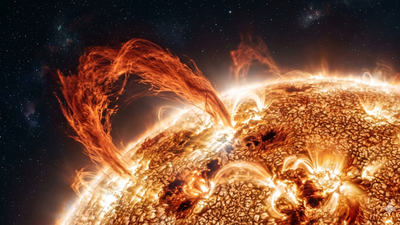
Have you ever found yourself thinking about the size of the sun? On the surface, it seems like a rather strange thing to think about because space doesn’t produce any sound waves that we can hear.
However, there is actually a great deal of evidence that shows that the Sun is not as silent as one might expect. Studies of the Sun’s vibrations and pressure waves have shown that the Sun is incredibly loud and it would be impossible for us to hear it if we could somehow hear it. The roar of trillions of planes would pale in comparison.
The sun’s sound is louder than 100 trillion jet engines, but you’ll never hear it
The creation of sound occurs due to the turbulence and boiling of gases in and out of the Sun.
The turbulence generates pressure waves, which behave like sound waves that occur on Earth. The only problem here is that there is no medium for sound waves in space due to the vacuum.NASA found that “sound waves can be used as probes” using a technique referred to as helioseismology to understand the internal structure of the Sun through the vibrations that occur in it.When measuring the loudness of the sound, researchers believe it may reach about 100 decibels on the surface of the sun.
But given the density of solar matter, the energy used would be huge; So much so that when theoretically compared to the Earth’s atmosphere, it is equivalent to the roar produced by trillions of jet engines working together.
Why is space silent despite the noise of the sun?
Although the sun produces a great deal of noise, there is nothing we can hear from it. This is because sound needs a medium for its transmission, such as air or water. However, the space is mostly empty.Sound waves need a medium through which to move, and space lacks such a medium. Therefore, despite the active phenomena occurring in space, it remains silent.In other words, although the Sun produces a great deal of sound energy, it is limited to its own plasma layer, which cannot travel to Earth.
The sound of the sun compared to trillions of jet engines
It becomes necessary to explain this concept through something tangible, as its intensity is simply too great for anyone to comprehend.
For example, as described in CRS magazine, one can imagine there being 10,00,00,00,00,00,000 jet engines operating simultaneously.While this analogy may seem simplistic enough, it gives us an idea of the enormous power of the energy produced. The sun not only emits light and heat every second, but also produces vibrations within itself.What is particularly amazing is the fact that these vibrations were recorded and can be heard through special headphones.
They turned out to be very deep, resonant tones that cannot be compared to anything sharp at all.As solar scientists have shown, they are very useful when studying the nature, behavior and life stages of the Sun. In a sense, this type of monitoring can be likened to medical ultrasound when studying humans.Ultimately, one can easily appreciate the tremendous energy of our nearest celestial body through this analogy, knowing that nothing can compare to the “roar” of the sun.