Less than a year before Punjab goes to the polls, Congress is embroiled in a struggle over who should lead the party to those elections – a fight that its central leadership still insists does not exist.

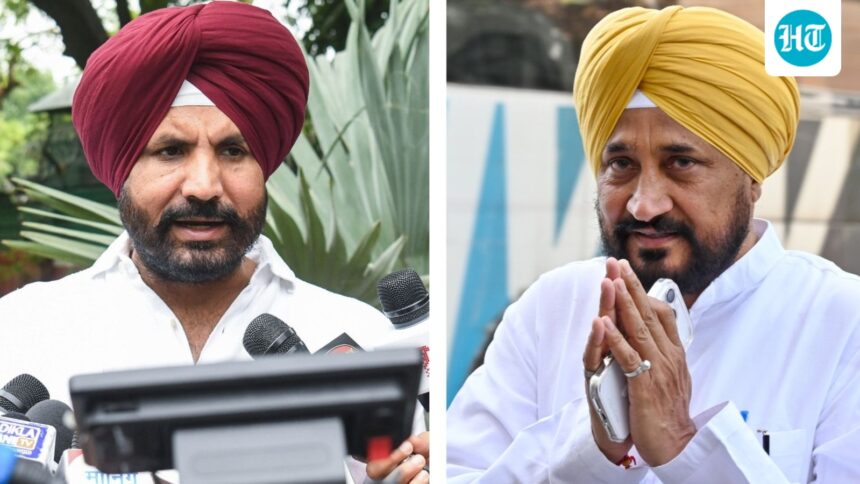
The dispute centers around two men: Amarinder Singh Raja Waring, the Punjab Congress president who is supported by the high command, and Charanjit Singh Channi, the former prime minister and Jalandhar MP who is leading the challenge.
The risks are high. The Congress was reduced to 18 seats in Punjab in 2022, its worst ever result in the state, as the Aam Aadmi Party (AAP) came to power with 92 seats. The party saw the 2027 elections – scheduled for early next year – as its chance to recover, which is exactly why factions within it are fighting over who will lead that campaign.
Read also: Rahul Gandhi’s policy of fruitless opportunism
How the rift unfolded
The controversy began over the regulatory amendment, or rather the lack thereof. On 1 July, the Congress announced that Waring would continue as Punjab unit chief, and Chani was appointed chairman of the party’s election campaign committee. Some read the decision as a snub because a section of leaders were pushing for Chani to get the top post of the party unit.
In the days that followed, a number of current and former MLAs publicly urged the party to reconsider Chani’s candidacy for the post of Punjab Pradesh Congress Committee (PPCC) president. Then, on July 3, nearly two dozen current and former lawmakers, several former ministers, and party workers gathered at Chani’s residence in Morinda—in what was seen as the first organized show of opposition.
Those gathered formed a committee to convey their concerns to senior leadership and authorized Chaney to decide on the future course of action on their behalf, issuing a seven-day ultimatum to the leadership to reconsider its decision.
On Monday, when Bhupesh Baghel – the Congress general secretary in charge of Punjab – arrived in the state for a five-day visit, the group met again, now in Mohali and again in Chani’s presence. There, she decided to boycott Waring’s programs and intensify pressure on the senior leadership for immediate change.
Participants include former Deputy Prime Minister and newly appointed Core Committee Chairman Sukhjinder Singh Randhawa and former ministers Rana Gurjit Singh, Pargat Singh, Razia Sultana, Tript Rajinder Singh Bajwa, Bharat Bhushan Ashu and Gurpreet Singh Kangar, besides MLAs Kuldeep Singh Dhillon and Kushaldeep Singh Dhillon.
Their case for replacing Waring rests on the argument that the party cannot return to power in Punjab under his leadership. They claim that his leadership has damaged the Congress at the grassroots level, and the party has witnessed successive electoral setbacks, the latest of which was poor results in the civic elections, including in traditional strongholds.
They say Congress needs a new face before 2027, and that Chaney is more popular among workers.
Since the Mohali meeting, Chani has clearly moved away from Baghel’s engagements with Punjab leaders.
Chani did not attend Tuesday’s dinner hosted by Rana Kanwarpal Singh, and Wednesday’s meeting at former minister Kaka Randeep Singh’s residence. Both rallies attracted senior leaders, but no one from Chaney’s camp was there. By Wednesday, it was the third day in a row that Chaney had skipped Pagel’s engagements.
A former minister in Chaney’s camp said the group had no intention of changing course. “We are not against the party, but we want someone at the head of the party who can lead the party towards victory,” he said, adding that he had already told Baghel over the phone that party workers wanted change and decisive leadership.
He said that the camp leaders would not meet Baghel completely and would raise their case directly to the high command. “We will finalize our strategy soon,” he said.
The senior leadership, in turn, demonstrated its willingness to discipline open dissent. Former MLA Madan Lal Jalalpur was issued a showcause notice this week, after he criticized Congress general secretary KC Venugopal and Baghel over Waring’s continuation as state president.
Central command position
The position of the central command did not move. Their support for Waring is based on three reasons – avoiding instability as preparations for 2027 intensify, preventing further factionalism by reopening leadership issues, and the belief that change now would weaken the party organization rather than strengthen it.
Pagel was the most vocal. He said the three working presidents of the Punjab Congress and other senior leaders welcomed the new arrangement during his meetings with them. By Wednesday – the third day of his visit, and with Chaney already skipping two rounds of engagements – Baghel moved to shut down such speculation, telling reporters in Chandigarh that the high command’s decisions were not “child’s play”.
“Once the high command takes a decision, it does not change. Koi gudda-guddi ka khel hai kya ke baar-baar nirnay badla jayega,” he said.
Pagel said he also spoke to Chaney on the phone. The Secretary-General said that Chani told him that he would stay out of the city for two or three days, and that he would meet him as soon as he returned. They did not meet face to face at any time during the visit. Meanwhile, Waring was seen at Baghel’s engagements.
Read also: Keeping up with UP: Congress and the quest for Dalit votes ahead of the 2027 elections
United, they persist
Neither camp publicly described this incident as a revolution.
Waring has framed the recent flurry of meetings held by the Chaney camp as an organizational strengthening. “The Congress party is united. Every leader and worker is committed to ensuring the party’s victory in Punjab. Chani and all senior leaders will come together on a common platform,” he said.
“What would be wrong if Chaney called a meeting of congressional leaders? Everyone who attended spoke in favor of the party,” he added, describing Chaney as “like a big brother.”
Regarding his position, he said: “The party has assigned me a responsibility, and I will continue to carry it out with all sincerity, as the party comes before everything.”
Pagel struck the same note. “There is no discontent in the Congress party. There is no need to reconsider the decisions taken by the high command, and the party will not change them. Everything in the Punjab Congress is absolutely fine… Our only goal is to form a Congress government in Punjab after the 2027 Lok Sabha elections,” he said.
“There is no dissidence and any minor issues will be resolved. Everyone belongs to the Congress party. Rahul Gandhi and Mallikarjun Kharge are our leaders. We will fight the elections united,” he added this week.
Leaders in Chaney’s camp followed the same line. “We are not indulging in dissidence. We are simply conveying the sentiments of the workers, who want Chani to play a greater leadership role. We are confident that the high command will resolve the issue,” Tript Rajinder Singh Bajwa said.
Chaney, who was addressing the media at his residence for the first time since the row began, declined to comment on the party rift but said Rahul Gandhi “was its leader and always will be.” He added that he would adhere to any strategy decided by the party.
Publicly, the party has tried to move beyond the dispute by shifting focus to 2027 preparations, including a state-level campaign called ‘MGNREGA Bachao Sangram’. Insiders say the campaign will also help keep rival factions occupied with a common political platform rather than pitted against each other.