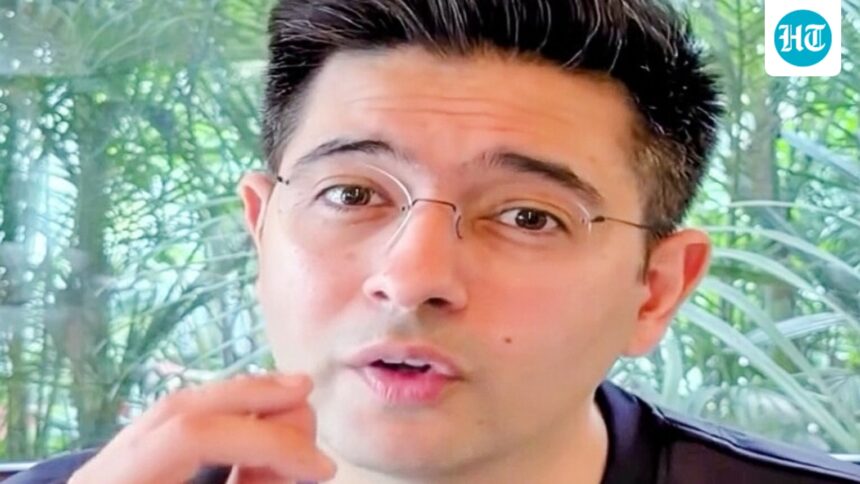
The defection of seven AAP MPs was made possible by the same provision that Chad once sought to amend – the 2/3 threshold under the existing anti-defection law

In August 2022, Raghav Chadha stood in the Rajya Sabha as a newly elected MP for Punjab and introduced a Private Member’s Bill calling for tougher anti-defection laws. He spoke out against what he called “the outrageous overreach by legislators in complete disregard for the democratic wishes of the voters who returned them.”

He said he wanted to see “preventing compromises” between elected legislators, and said tightening the 10th Schedule of the Constitution would erase “the stain on our democracy”.
“The law that was brought in to end the politics of defection is currently facilitating defection,” he said in the Rajya Sabha then.
Less than four years later, on April 25, 2026, Chadha led six Aam Aadmi Rajya Sabha MPs in switching to the Bharatiya Janata Party (BJP).
The defection was made possible by the very provision he once sought to amend – the two-thirds threshold under the current anti-defection law.
Read also | AAP ‘marriage’ mocked after ‘toxic’ Chadha charge: ‘Because this party made you an MP’
Two-thirds to four-three: what Chadha wanted
Under current law, a group of lawmakers wanting to switch parties must number at least two-thirds of their party’s strength in the House of Representatives to avoid disqualification.
In the case of the AAP’s 10 Rajya Sabha MPs, the threshold was seven. Chadha, along with six others, achieved exactly that number.
In his 2022 draft law, Chadha proposed raising this threshold from two-thirds to three-quarters.
Under this proposed amendment, the minimum requirement to defect without disqualification is eight — one more than the seven who have already converted.
The draft law also proposes preventing dissident MPs from running in elections for a period of six years. The bill was never passed.
Read also | Harsh criticism of ‘Kothi No 50’ flies after BJP turns on Raghav Chadha, Punjab AAP MPs point out powers he wielded
He cited statements of switching to the BJP
Chadha also suggested that dissident lawmakers should be asked to appear before the Speaker within a week of withdrawing support from their original party.
He cited data from transparency organization League for Democratic Reforms showing that more than 100 MPs and MLAs joined the BJP between 2016 and 2021, including Congress leader Jyotiraditya Scindia, whose change led to the downfall of the Congress government in Madhya Pradesh.

AAP wanted ‘recall’, and Chadha wanted a law for that too
AAP said it would seek the disqualification of the seven MPs, but the Rajya Sabha Speaker has already accepted the “merger” demand.
The party’s remaining legal option will be to pursue the matter in court.
Punjab Chief Minister Bhagwant Mann separately sought an appointment with the President of India to demand the “recall” of the six elected dissidents from the state.
The request is based on a mechanism Chadha himself introduced in Parliament in February 2026, just two months before he defected.
In this context, Chadha argued that voters should have the right to remove inactive elected representatives before the end of their term. “Five years is a very long time. There’s no profession where you can underperform for five years without any consequences,” he said.
For Rajya Sabha MPs, the term is actually six years, which is longer than that for Lok Sabha MPs and Members of Parliament.
However, former Solicitor General of Punjab, Ashok Agarwal, said there is no such provision in the Constitution. He said, “Withdrawal of confidence is not an available provision in the Constitution under any timetable at all. There is no room for withdrawal of confidence.”
The AAP, founded in 2012, has now been reduced to six MPs after the defection – three MPs in each house.
The party faces Punjab Assembly elections next year, as Bhagwant Mann’s government seeks to win a second term. Six of the MPs who changed sides are from Punjab, and the party now has a lone MP from the state.
Chadha, who was the AAP’s official spokesperson, is now said to be on the verge of getting a union ministerial berth with the BJP, according to some reports.
As for the draft laws he presented regarding a higher threshold for defection and the right to withdraw confidence, they were not voted on. Private members’ bills rarely do.

Arish Chhabra is an associate editor on the Hindustan Times online team, where he writes news reports and explanatory features, as well as overseeing the site’s coverage. His career spans nearly two decades across India’s most respected newsrooms in print, digital and broadcast. He has reported, written, and edited across formats—from breaking news and live election coverage, to analytical long-reads and cultural commentary—building a body of work that reflects editorial rigor and a deep curiosity about the community for which he writes. Areesh studied English Literature, Sociology and History along with Journalism at Punjab University in Chandigarh, and began his career in that city, eventually moving to Delhi. He is also the author of Little Big City: What Life is Like from Chandigarh, a collection of critical essays originally published as a weekly column in the Hindustan Times, which examines the culture and politics of a city that is much more than just its famous architecture – and in doing so, holds up a mirror to modern India. During his stints at BBC, The Indian Express, NDTV and Jagran New Media, he has worked across formats and languages; Mainly English, as well as Hindi and Punjabi. He was part of the crack team for the BBC Explainer project which was replicated around the world by the broadcaster. At Jagran, he developed editorial guides and trained journalists on integrity and quality content. He has also worked at the intersection of journalism and education. At the Indian School of Business (ISB) in Hyderabad, he developed a website to streamline academic research in management. At Bennett University’s Times School of Media in Noida, he taught students the craft of digital journalism: from newsgathering and writing to social media strategy and video storytelling. Having moved from small town to larger town to megalopolis for education and work, his intellectual passions lie at the intersection of society, politics, and popular culture—a perspective that guides his writing and worldview. When he’s not working, he’s constantly reading long-form journalism or watching cerebral content, sometimes both at the same time.Read more