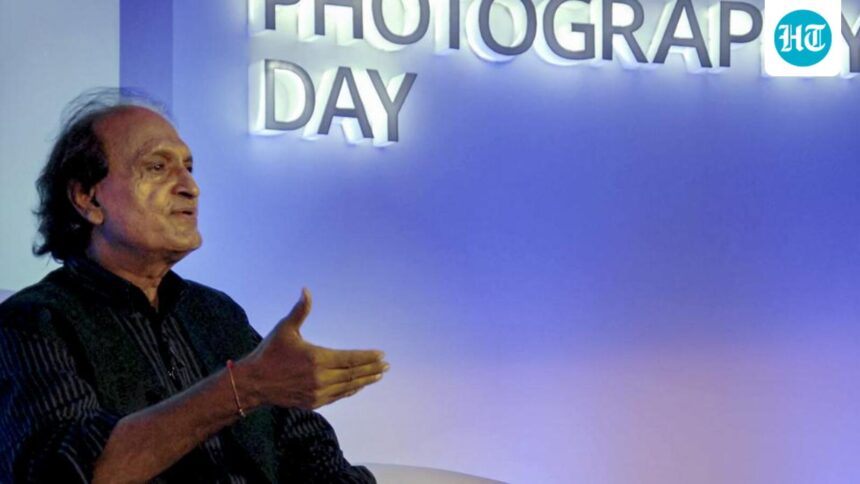
Raghu Rai, one of South Asia’s leading photographers, died in New Delhi on April 26 after a battle with cancer. He was 83 years old. Writing about it now is like adapting to the passage of a certain photographic ritual. Rai belongs to a generation for whom the camera was a witness to the unfinished nation-building project.

His unique vision was shaped through photojournalism.
Ray was born in 1942 in Jhang, and comes from a family marked by the Partition. His older brother, photographer S. Paul, introduced him to the medium. Ray joined The Statesman in 1966, and later worked with Sunday, and then with India Today, where he helped shape the magazine’s formative years. The newsroom gave him speed, reach, proximity, and most importantly, a front-row seat to unfolding history.
For photographer Prashant Panjiar, whom Ray later brought into India Today’s photo department, these grammars were a form of formation. When Panjiar’s photographs of the anti-Dacoit campaign in the early 1980s, under the then chief minister of Uttar Pradesh, V.P. Singh, reached India Today, Rai called him up. “He took me into the darkroom and made the prints himself,” Panjiar recalls. “Here was Raghu Rai whose photographs dominated the Indian scene for decades, producing prints for one.” Ray’s compositions were printed in that magazine’s darkroom with loud Hindustani classical music always playing in the background.
One has hardly seen Raghu Rai in public without a camera. At openings, talks, photo festivals, and runways, Ray seemed unable, or perhaps unwilling, to separate himself from the machine. He once wanted to be a musician, but the camera became the instrument he finally settled on.
Also Read: Remembering Raghu Rai through a personal lens
Few photographers moved instinctively between state power and public unrest.
Former Prime Minister Indira Gandhi often appeared in Ray’s photographs as a force captured by her choreography. Yet he also brought her back to the human level: in his frames, she was tired, amused, guarded, vulnerable, captured in the split second of his camera’s shutter. In contrast, social activist and freedom fighter Jayaprakash Narayan was always on the move. In Ray’s photographs, we see him in Bihar, among agitated students and wounded public faith. These images speak of a time when leaders were still met with critical eyes, before image management turned the camera into another prop and accessory of power.
Bangladesh and Bhopal remain poles of Ray’s moral imagination. In 1971, he photographed refugees, hunger and displacement during the Indo-Pakistani war to liberate Bangladesh for which he was awarded the Padma Shri. In 1984, after the Bhopal Union Carbide gas leak, it entered a city changed by corporate negligence. Pablo Bartholomew’s color photo of the same burial went global and won the World Press Photo of the Year award, but Ray’s black-and-white photo, the burial of an unknown child, “that little face half buried in the mud,” “entered India’s visual consciousness,” Panjiar said.
“We have lost the great Raghu Rai,” said Bill Shapiro, former editor-in-chief of LIFE magazine. “Raghu, widely considered the father of Indian photography, was an accomplished photographer… He was also incredibly wise and taught me a lot about how the camera and the heart work together.” Shapiro interviewed Ray and his daughter Avani for Oprah Daily in 2022.
In 2024, the Kiran Nadar Art Museum in Delhi mounted a retrospective of Ray’s work titled ‘A Thousand Lives: Photographs from 1965-2005’. Bringing together forty years of analogue work, he shows that Ray not only photographed India for more than five decades, but constructed India through photography: crowds and spots, procession and bureaucracy, wound and pageant, faith and theatre. In this show, one could sense what Henri Cartier-Bresson, often described as the father of modern photography, realized when he nominated Ray for Magnum Photo magazine, which Ray joined as an assistant in 1977.
Most visual artists debate whether Ray inherited Bresson’s famous “decisive moment.” What matters is what he did to her. Bresson’s moment was the knife-edge of the image’s composition, its geometry, its grace, its serendipity, the world briefly unraveling itself. Ray, on the other hand, translated it into an Indian register where the moment remained suspended, rarely resolving itself. Mother Teresa sleeping among her loved ones. The Dalai Lama watches the Mahabharata on television. Photojournalist Kaushik Ramaswamy recalls Ray’s photograph of Pandit Mallikarjun Mansoor, dying of lung cancer, asking his son for a last cigarette.
Compared to another photographic artist Raghubir Singh (born in the same year as Ray, in 1942, and Singh died in 1999), who made color a philosophical argument for India, in Ray’s panoramic imagination, ordinary life has expanded until it becomes almost civilized. “Raghu Rai was a romantic at heart,” Panjiar said. “He saw his images on an epic scale, almost as an extension of Indian myths and epics.” “We are the same: you, in Brazil, and me, in India,” Ray once told photojournalist Sebastião Salgado, Panjiar recalled. These were the words of an artist whose images have dominated Indian visual memory for decades, and who has come to trust the size of his eye. Over the course of more than fifty years, he has moved from black-and-white 35mm reportage to panoramic formats, from analogue color to digital, and from photojournalism to photobook.
Mourning opinion means mourning a certain belief in photography, a belief that one can walk down the street with a camera and come back with evidence, contradiction, mystery, and sometimes grace. Gil Ray understood that the image was not intended to flatter history, but to disturb it. Rai’s India arrived through event, speed and connection.
Rai is survived by his wife Gurmeet, son Nitin and daughters Lajan, Avani and Poorvai.
(Akshay Mahajan is an artist, photographer and writer based in India)