
The ancient Appalachian Mountains may hide one of the most important untapped natural resources in the United States. According to new research by the US Geological Survey (USGS), the mountain range contains an estimated 2.5 million tons of lithium, enough to manufacture about 500 billion smartphones, 180 billion laptops, or 130 million electric cars.
This discovery highlights the enormous potential of one of North America’s oldest mountain systems at a time of growing demand for battery materials. The researchers say the vast reserves could play an important role in boosting domestic supplies in the future, although their development will be accompanied by major technical and environmental challenges.
How much lithium is hidden under the Appalachian Mountains?
Researchers estimate that the Appalachian Mountains, stretching from Alabama to Maine, contain about 2.5 million tons (2.3 million metric tons) of lithium trapped within coarse-grained igneous rocks known as pegmatites.
According to the USGS, the resource would be enough to replace US lithium imports for approximately 328 years if imports remain at last year’s level.This estimate comes from two studies covering the northern and southern Appalachians, representing the USGS’s first comprehensive assessment of lithium resources throughout the region. To reach their findings, the scientists analyzed geological maps, geochemical and geophysical data, records of known mineralogical events and the tectonic history of the area.
They also used a global dataset of lithium-bearing pegmatites to model the potential distribution and size of undiscovered deposits.
The two studies were published in the Journal of Natural Resources Research.
Where the largest deposits are located
The Northern Appalachian region, which includes parts of Maine, New Hampshire, Vermont, New York, Massachusetts, Connecticut, Rhode Island, Pennsylvania, New Jersey and Delaware, is estimated to contain about 990,000 tons of lithium.
Many deposits in Maine, including the Plumbago North pegmatite, contain spodumene, the world’s primary hard rock source of lithium due to its high lithium concentration and well-established extraction process.Meanwhile, the Southern Appalachians, which span parts of Maryland, Virginia, North Carolina, South Carolina, Georgia, Tennessee and Alabama, are believed to contain about 1.57 million tons of lithium.
North Carolina and South Carolina were once the backbone of the U.S. lithium industry, supplying much of the country’s production between the 1940s and 1990s before low-cost imports shifted mining activity offshore.
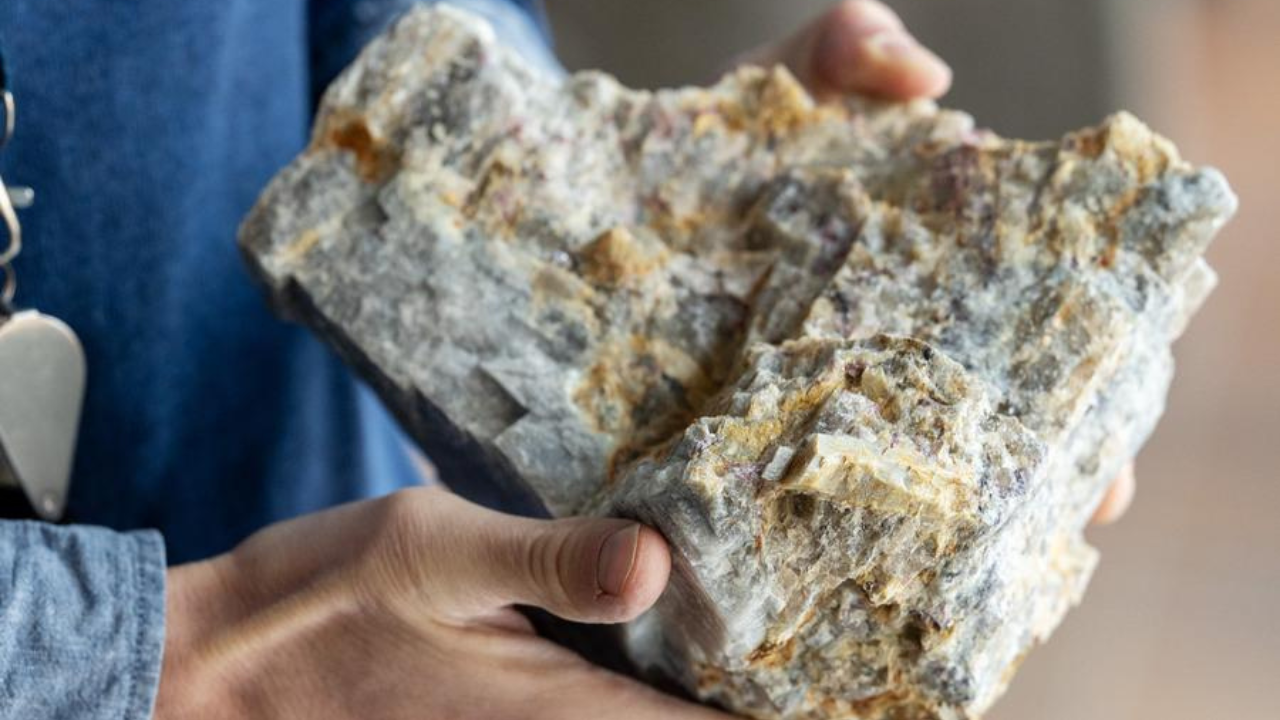
Lithium-bearing pegmatite containing spodumene, one of the world’s most important hard rock sources of lithium.
Why has lithium become one of the most valuable metals in the world?
Lithium is a vital component of the rechargeable batteries that power smartphones, laptops, electric vehicles, and large-scale energy storage systems that support renewable electricity grids.
It is also used in aerospace alloys, military equipment, industrial lubricants, and prescription medications for certain mood disorders.The rapid expansion of electric vehicles and renewable energy technologies has turned lithium into one of the world’s most sought-after raw materials. Governments and manufacturers are racing to secure stable supplies as battery production continues to grow around the world.
Why is this discovery important to the United States?
Although the United States has significant lithium resources, domestic production remains limited.
The country currently has only one lithium mine, located in Clayton Valley, Nevada, while much of the lithium used by American manufacturers is imported either as raw materials or inside batteries and electronic products assembled abroad.Expanding domestic production could strengthen supply chains, improve energy security and support the country’s growing battery manufacturing sector as demand continues to rise, researchers say.
Lithium mining will not be easy
Unlike lithium extracted from underground brines, pegmatite deposits require hard rock mining, which involves blasting, drilling and crushing large amounts of rock before chemically processing the lithium. This process is energy intensive and requires large amounts of water and infrastructure.Scientists warn that large-scale mining could disturb wildlife habitats, reshape mountainous landscapes, and generate waste capable of contaminating nearby soil and waterways if not carefully managed.
Future projects will also need to undergo extensive environmental reviews and obtain permits before commencing commercial production.
A valuable resource with difficult choices ahead
The USGS assessment provides one of the clearest pictures yet of the Appalachian Mountains’ lithium potential, but researchers stress that designating the resource does not automatically make it economically recoverable. Extraction costs, environmental regulations, infrastructure, land ownership, and community support will determine whether these deposits are ultimately developed.However, the findings underscore the strategic importance of the ancient mountain range as countries compete to secure battery materials needed for the transition to clean energy. If developed responsibly, the Appalachian Mountains could become a significant contributor to America’s future lithium supply while helping to meet growing demand for next-generation technologies.