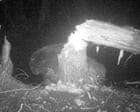
No one knows where they came from or how they ended up in Norfolk. But one thing is certain: now, there are two of them.
Until last week, experts believed only one wild beaver lived in Pensthorpe Nature Reserve, 20 miles outside Norwich. But on Valentine’s Day, the two went for a late-night swim together and were caught on camera making out with each other by the river.
The pair were the first wild couple to settle in Norfolk from the early 16th century. “We didn’t know for sure if they were a breeding pair until the camera showed them having kits, but they are very bonded and they live together and behave as a family unit,” reserve manager Richard Spogage said. “They’re obviously wild animals. They’re not interacting with us at all, they’re completely alienating us.”
Footage of a lone beaver setting up lodge in the reserve made headlines in December when the Guardian revealed the beaver was the first free-ranging creature recorded in Norfolk for more than 500 years.
Spogage now suspects that two beavers built a “family-size” lodge, but only one was caught on camera. “Beavers are very difficult to catch on camera, especially as a pair.”
The native species has been re-establishing itself in the English countryside since 2015 when a litter of wild kits was born in Devon, but how a pair of beavers managed to reach Norfolk remains a mystery.
It has been almost a year since the government decided to grant licenses for wild beaver releases, but only two pairs and one family have been legally released so far in Cornwall and Somerset earlier this month.
Spogage is suspected of illegally releasing beavers last year, known as “beaver bombing,” which is not supported by the reserve. “We don’t condone it, but our view is that now that these animals are here, playing a role in the ecosystem that’s missing from our river, it’s our responsibility to protect them.”
He said he was relieved to learn there was a second beaver, whose age and gender were not yet known. “Beavers live in family groups. They are not raised as solitary animals.”
In just three months, the animals have cleared the rubbish from the river without affecting the water levels, Spogge said: “Now you can see a beautiful river bed starting to reappear at the sand and gravel base, which is really amazing. They are opening small glades along the river’s edge, where they have removed the willows and birches. The fisheries must be improved.
Professor George Holmes, who sits on the government’s advisory group for the reintroduction of the species, said there was “a lot of discouragement” among people who wanted to release beavers because they felt the licensing application process was unnecessarily costly and time-consuming.
Beavers dams cause flooding and their burrows can undermine the banks of rivers and streams, and once a beaver is released into the wild, it is classified as a common resident species in the UK, with protected status. “Introducing a species is not straightforward and can go very wrong.”
But he added: “In a nature reserve, that is [the beaver] Doesn’t cause too many problems.”
Spogage would like to see the legal introduction of other beavers into the Wensome River. “Genetically, you shouldn’t have just one pair of beavers on a river,” he said. “This is an opportunity to return an animal to our river system that has been missing for 500 years.”
Natural England, the government’s advisory body, said it was investigating reports of beavers at Pensthorpe and was “working closely” with the reserve on the matter.
As well as Cornwall, Somerset, Devon and Kent, wild beavers can also be found in Hampshire, Wiltshire and Herefordshire in England, according to the Beaver Trust, a charity which aims to restore beavers to restore landscapes. A Guardian reader also reported seeing one in his garden in Berkshire.
From 2021, the Scottish Government officially allows the movement and release of beavers, and the population there is estimated at 1,500. A wild beaver was also spotted on the Dyfy River near Machynlleth in Wales.