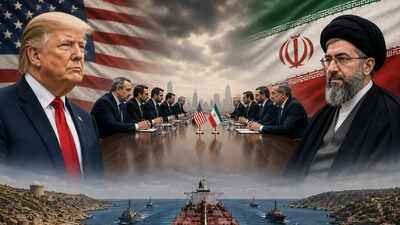
The US-Iran peace deal offers Tehran a comprehensive financial package that includes immediate oil export waivers, a $300 billion private investment fund, and eventual access to more than $100 billion in frozen assets held in several countries, according to draft documents and officials familiar with the negotiations.This framework, which is scheduled to be officially signed on Friday in Switzerland, has emerged as one of the most important financial agreements between the two countries since the 1979 revolution. It also directly contradicts US President Donald Trump’s public claims that the United States does not contribute to any reconstruction fund.
Private investment fund worth $300 billion
A source familiar with the agreement told Reuters that the framework agreement between the United States and Iran stipulates the establishment of a fund worth $300 billion, and that more than half of this amount, more than $150 billion, has already been committed.The source said that the fund is a private investment tool, not a reconstruction or compensation program, and does not contain government funds or grants. The source said that companies based in the United States, the Arab Gulf states, Asia, South America and Africa agreed to commit to financing that includes energy, logistics, manufacturing and transportation.The source said that the fund aims to give both sides an economic incentive to reach a final agreement to end the war.
It will not be operational until a final and satisfactory agreement is reached.A senior Iranian source told Reuters that Iran originally requested $400 billion in compensation for war damage from the United States, but Washington refused. Then the idea of the fund appeared.The draft memorandum of understanding seen by Bloomberg confirms that the United States and its regional partners will establish a “reconstruction and economic development program” for Iran with financing of “no less than $300 billion.”President Trump publicly denied on Truth Social that the United States would pay Iran $300 billion, writing: “The story that the United States is paying Iran $300 million is Fake News, spread by the Democrats!!!” However, the draft only states that the United States and its partners will guarantee the financing of this amount, not that it will come from the coffers of the US government.Vice President J.D. Vance confirmed this possibility in an interview with CBS News, saying that Iran could receive such benefits “as long as it honors its end of the commitment.”
Iran’s frozen assets: where is the money?
Under the deal, Iran will be able to access its frozen funds based on “progress” in negotiations over the next 60 days, according to a draft memorandum seen by Bloomberg. The United States pledges that these funds “will be fully released and made available” without specifying a specific timetable.US officials have now confirmed that Iran will get full access to a total of $100 billion in frozen funds, according to the Wall Street Journal.The blocked funds are mostly payments for Iranian oil sales to countries that defaulted when Trump withdrew from the 2015 nuclear deal in 2018. The assets are held across multiple countries, with a rough breakdown as follows:
| nation | Estimated frozen assets |
| China India Iraq Qatar/South Korea we European Union (Luxembourg and others) Japan | $20 billion+ ~$7 billion ~6 billion dollars ~6 billion dollars ~ 2 billion dollars ~$1.6 billion ~$1.5 billion |
Total estimates range from about $50 billion to more than $100 billion (Wall Street Journal, Reuters).
Esfandyar Batmanghelidj, CEO of the Bourse & Bazaar Foundation, said Iran’s priority is to release an initial $24 billion in phases, which will allow its leaders to increase the value of the country’s currency and reduce inflation.
Immediate oil exemptions and sanctions relief
Under the terms of the draft memorandum of understanding, the US Treasury will issue “exemptions for exports of Iranian crude oil, petrochemical products, and their derivatives” immediately upon signing the memorandum.The United States will lift its naval blockade, and the two countries will work to ensure that traffic in the Strait of Hormuz returns to its pre-war level within thirty days. The United States will also commit to gradually lifting all sanctions on Iran, including UN Security Council resolutions and International Atomic Energy Agency Board of Governors resolutions, although no timeline has been set.Iran will maintain the status quo regarding its nuclear program for the next 60 days, and the United States will not impose new sanctions on Iran or strengthen its forces in the region during that period.
What the deal doesn’t cover
The draft memorandum seen by Bloomberg does not directly address the status of Iran’s stockpile of enriched uranium. It only says that the fate of Iran’s enriched uranium “will be appropriately addressed in a final agreement” along with all other nuclear issues.It also does not mention Iran’s conventional military forces, including its arsenal of ballistic missiles, which Trump entered the war and described as a threat to the United States, according to Middle East Eye.The memo also says the ceasefire includes “all fronts, including Lebanon,” underscoring a key Iranian demand that could anger Israel, a US ally.Mark Dubowitz, CEO of the Foundation for Defense of Democracies, wrote on X that the Trump administration “has managed to unite both supporters and detractors against a yet-to-be-announced deal.”
“So far it doesn’t look promising.”“If this is true, Iran wins. There should be no sanctions relief on day one,” former US Ambassador to the UN Nikki Haley said on Channel X.The United States and Iran intend to officially sign the memorandum of understanding on June 19 in Switzerland, in the Bürgenstock mountain resort overlooking Lake Lucerne.Vice President J.D. Vance is expected to lead the US delegation, while Iran is likely to be represented by Parliament Speaker Mohammad Bagher Qalibaf.The signing will pave the way for 60 days of talks aimed at ending the war once and for all and placing tough new restrictions on Iran’s nuclear program.