

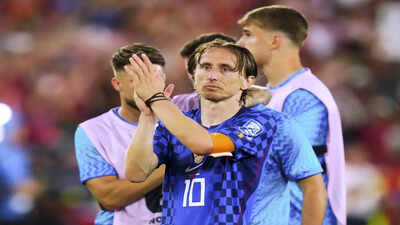
Croatian Luka Modric (AP/PTI)
Luka Modric’s exit from the World Cup stage, and with it international football as well, was not the ideal lover or the ideal number 10, a number he has created with admiration and seduction over the years. But the end was dramatic and cruel. While Croatia thought Jusko Gvardiol’s late equalizer against Portugal was enough to defy the inevitable, VAR came in with its usual sophistication to turn it into a cause célèbre. Modric appeared detached from the chaos around him, his face reflecting a matter-of-fact resignation to fate, and he was slowly enveloped in a warm embrace from Cristiano Ronaldo. It was a moment of catharsis. Of the two middle-aged men, Ronaldo will now go deeper into the tournament, but Modric’s fifth attempt at the top prize will remain elusive.
“I’ve played with Luka for many years. We’re almost the same age. He’s a football legend, and he’s still a football legend because he continues to play so well and with such great quality. It’s unbelievable,” Ronaldo later announced his feelings to the world. The 40-year-old Croatian – often regarded as the greatest player from the proud little central European nation – brings down the curtain on his World Cup career with a silver and bronze medal, as well as the Ballon d’Or and Bronze Ball.
An athlete’s eternal thirst to complete an endeavor often comes with its supposed value and reassuring system, but judging Modric by that perception is little more than a traditional farewell. Because pathos was never a requirement to generate emotion in his playing, because the football he played always pulsated with its life-affirming nature. This is where it is unique, and perhaps offers a more humane depiction of the sports hero. If Davor Suker – a goal machine par excellence – represented a symbol of hope and happiness for newly independent Croatia by helping them finish third at the 1998 World Cup, Modric extended that legacy, acting as a bridge between the country’s astonishing arrival and its new 21st-century identity as a football power. Modric himself was one of the children of Croatia’s battle for independence, and his early years turned him into a refugee moving from place to place in search of survival.
Fortunately, instead of taking up arms, he found calm in the midst of chaos in football. Since then, his football has sought to bring order to chaos, and this has helped him rise above mediocrity. In his delightfully charismatic presence, in those stately off-the-shoe flicks or crosses, beauty lay as something beyond elegance, like Roger Federer’s backhand – evoking the mystery of how to turn defense into attack, and attack into a winner before opponents can even comprehend it. Like every No. 10, he was a dreamer with the ball. Tottenham gave him the platform to announce his arrival, and at Real Madrid he found his dramatic stage to realize his dream, mixing his style with an unwavering oratorical imagination. It was never stereotypical, it was a symphony of pure joy. Its rise as the heartbeat of the Spanish club coincided with Croatia’s most successful period in international football, finishing second in the 2018 World Cup and third four years later in Qatar. In his final dance on the world stage, he could have fallen like an old king, but not before impressing the audience. Football will feel a bit empty now, but Modric’s legacy will be lasting.