

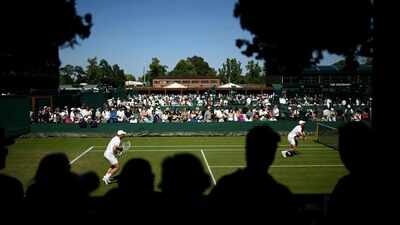
A general view during the first round match in men’s doubles between Sander Arends and David Bell of the Netherlands and Talon Grieksboer and Botek van de Zandschulp of the Netherlands on day four of the Wimbledon Championships on July 02, 2026 in London, England. (Photo/Getty Images)
Wimbledon’s outdoor courts are packed with doubles matches midway through the opening week. Spectators with ground tickets, which in SW19 cost around £30, flock to these entertaining contests, drinking Pimm’s and watching tennis.If the ATP leadership achieves its goal, doubles draws at tour-level events will begin to shrink by 2028, as will prize money for the two-man tag team event, which has already dropped to an 80-20 split with singles. Discontent within the player community, read as singles players, intensified when some of them, despite being ranked in the top 40, received less prize money than the top-ranked doubles players at the end of the season.One of the biggest challenges facing men’s doubles is its increasing separation from the singles game. The WTA Tour, which is not currently considering similar changes, has more crossover between the singles and doubles rankings. Five of the top 10 women in the doubles rankings – Taylor Townsend, Katerina Siniakova, Elise Mertens, Zhang Shuai and Jenna Ostapenko – are also highly ranked in singles. By contrast, among men, only four of the ATP’s top 100 singles players also appear in the doubles top 100, namely Ben Shilton, Lorenzo Musetti, Lorenzo Sonego, and Rinki Hijikata.
It’s a completely different group of players in the two categories never before seen by the Bryan brothers, twins Mike and Bob Bryan, who started out as doubles specialists. And that is exactly what the ATP seems intent on curbing, players who are primarily developing as doubles specialists from the start.The plan aims to reduce draw sizes, which currently stand at 16 for doubles and 28 for singles in ATP 250 events. At the 500 level, they are 16 for doubles and 32 for singles, while the Masters 1000 tournament includes 16 for doubles and 32 for singles.
This could be reduced to eight teams at the ATP 250 and 500 tournaments, and 16 teams at the Masters 1000 level.Besides, the prize money distribution could shift more towards singles, potentially moving to a 90-10 split, which is only a marginal change from what Grand Slam tournaments already operate with.By 2028, the expected prize money for the doubles is likely to reach around $60 million. The round is not intended to cut overall spending, but rather to reallocate funds, with up to $20 million potentially being redirected toward early individual payments by 2028.Maybe that will affect the Indians, who have nine players in the top 200, including only three in the top 100 and one, Yuki Bhambri, in the top 50.Earlier this week, the doubles players met with their representatives on the Players Council, Marcelo Arévalo and Andrea Vavasori, to discuss the scenario facing them. Balaji, ranked 59th in the singles doubles rankings, told TOI, “If they make this change, half of us will not play tennis anymore. I have to find another job. If they reduce the draw to eight, of which there will be two wild cards, what will be left?”The Indians were unlucky in the men’s doubles at Wimbledon on Thursday as US Open semi-finalists Yuki Bhambri and Michael Venus lost to substitutes Jean-Julien Roger and Theodor Vinegar 6-3, 6-4. Earlier, Sriram Balaji and his Brazilian partner Marcelo Demoliner failed to benefit from a strong start, losing 6-3, 6-7 (2), 4-6 to Sander Gil and Sim Verbeek.Substitutes Anirudh Chandrasekar and Japanese Takeru Yuzuki defeated Ignacio Bossi and Marco Trunglietti 4-6, 7-6 (3), 6-7 (7).