Days after confirming a trade deal, India and the US appear to be moving together in another way – the Critical Minerals Ministerial, aimed at Countering China’s Global Hegemony. External Affairs Minister S Jaishankar attended the Critical Minerals Summit where India was among the 54 countries hosted by the Trump administration.
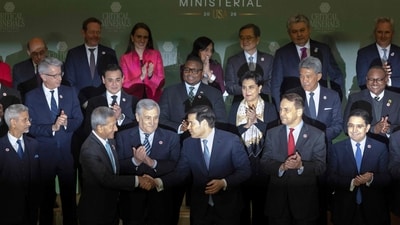
US Secretary of State Marco Rubio (C) shakes hands after posing for a “family photo” with 55 government officials, including EAM S Jaishankar. (Getty Images via AFP)US Secretary of State Marco Rubio convened the summit and US Vice-President JD Vance also outlined plans for a new trading zone. “Over time, our goal within that region is to create diverse centers of production, stable investment conditions and supply chains that are immune to the kinds of external disruptions we’ve already talked about,” Vance said.
Later during a media interaction, Jaishankar said that the conference was the main reason for his US visit. He also said that India is supporting the Forum on Resources, Geostrategic Engagement (FORGE), an initiative that was unveiled at the Critical Minerals Summit.
“The discussion was very good, critical minerals is a very important issue, the US has been a partner for years,” Jaishankar was quoted as saying by news agency ANI.
Also read: $500 billion deal, not Russian oil, 18% tariff: Inside India-US trade dealHe also addressed the summit in Washington DC where he highlighted the risks of overconcentration and the importance of de-risking supply chains through international cooperation.
More Read
What are important mineral trading blocks?The 2026 Critical Minerals Ministerial is a Trump administration initiative aimed at reshaping the global market for critical minerals and rare earths, an area in which China currently finds great dominance.
China leads the production of 30 minerals designated as critical by the US Geological Survey and accounts for nearly 70% of global rare earth mining and over 90% of processing capacity.
“Critical minerals and rare earths are essential to our most advanced technologies, and AI, robotics, batteries and autonomous devices will only become more important in transforming our economy,” the US State Department said in a release.
More Read

Through this bloc, the United States and its partner countries whose representatives were hosted at the Critical Minerals Conference will strive to build secure and resilient critical minerals supply chains.
India’s latest foray into rare earthsThe Trump administration’s move comes days after India announced plans to offer one Encouraging its government’s rare earth projects. While presenting the Union Budget 2026-27 on February 1, Finance Minister Nirmala Sitharaman said the government would help mineral-rich states such as Andhra Pradesh, Kerala, Tamil Nadu and Odisha develop dedicated rare earth corridors.
He also announced the Indian Semiconductor Mission 2.0, which aimed to expand the country’s semiconductor mission and give a tough fight to China’s competitive semiconductor industry and break its monopoly.
Even when Jaishankar addressed a ministerial meeting in the US, he highlighted India’s efforts in the critical minerals domain through initiatives including the National Critical Minerals Mission and the Rare Rath Corridor.
India’s support for the latest US initiative to counter China’s global dominance in critical minerals is also significant as it comes days after New Delhi and Washington sealed a trade deal. As part of the agreement, the existing US tariff on Indian imports has been reduced from 50% to 18%.