New Delhi

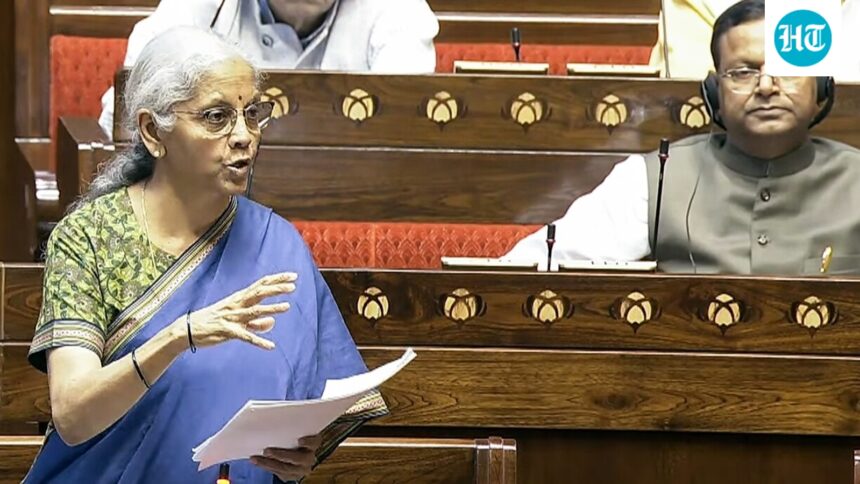
The government will achieve the fiscal deficit target of 4.3% in 2026-27 despite a sharp cut in central excise duty on petrol and diesel on Friday by efficiently managing revenue and expenditure, including non-tax revenue, Union Finance Minister Nirmala Sitharaman on Friday told the Rajya Sabha.
Responding to the debate on the Finance Bill 2026, the Minister said: “Federal excise duty is one of several sources of revenue for the government and contributes less than 10% of the total tax revenue, which is expected to be collected in the next financial year. So, mobilizing additional resources, prioritizing growth-driven spending, better targeting of welfare expenditure, as well as increasing transparency in fiscal operations, has been the hallmark of our government, and I believe we will do that.” [be] Following the same pattern.”
“We will be able to carefully manage the government’s fiscal position. There will also be efforts to achieve greater mobilization through non-tax revenues,” she said while responding to Trinamool Congress leader Saket Gokhale’s query. Non-tax revenues are indirect revenues (such as income tax) and indirect taxes (such as goods and services tax). It includes returns from disinvestment, interest earnings and dividends.
Parliament on Friday approved the Finance Bill 2026 with the Rajya Sabha returning the bill to the Lok Sabha by voice vote, completing the budget exercise for the next financial year starting April 1. The Lok Sabha passed the bill on Wednesday.
Central Board of Indirect Taxes and Customs (CBIC) Chairman Vivek Chaturvedi said $The 10 reduction in Special Additional Excise Duty (SAED) on gasoline and diesel due to global energy supply disruptions due to the war in West Asia will be reviewed every two weeks. It will have an estimated revenue loss of $7000 crores in two weeks.
According to expert estimates, if the situation continues like this throughout FY2027, the impact on revenues will be there $1,70,000 crore in a full financial year. However, Chaturvedi added that imposing the tax on refiners for exports of diesel and aviation turbine fuel (ATF) would bring in an estimated Rs. $1,500 crores in two weeks.
Reacting to Congress leader Shaktisinh Gohil’s comments that the new GDP series would understate the previous numbers, Sitharaman said: “There are routine practices of the government. I’m telling you how many times the government of India has done this, not randomly, it is done systematically… There have been nine reviews since independence.”
“The first base year 1948-49 was issued in 1956 under the Congress government of Prime Minister Nehru, followed by 1960-61, which was issued in 1967, and the base year 1970-71 was issued in 1978 under the Janata Party government under the leadership of Shri Morarji Desai,” it said. “The Rajiv Gandhi-led Congress government issued the base year series 1980-81 in 1988 and Shri Atal Bihari Vajpayee under the NDA government issued the new series in 1999 with the base year 1993-94,” she added.
It also provided details of the latest reviews. “Dr. Manmohan Singh conducted two reviews and released new series in 2006 and 2010. The current 2011-12 series issued in 2015 was released under Prime Minister Narendra Modi, and now the 2022-23 series has already been released. Not every previous review was done to lampoon previous governments. This happens under every government,” she said.
In this new series, several new and improved data sources are being used to achieve accuracy, precision and reliability of the estimates, the Finance Minister said. More than 300 data sources and approximately 1,400 variables will be used in this GDP series. She added that it also captures informal sector information because it now uses the Annual Survey of Single Sector Enterprises (ASUSE).
“Also, we now have the advantage of GST data that shows where companies are operating and whose production is being allocated to precisely the right cases. So, the data is now more comprehensive, more vibrant and more true to the time from which the data is being mined,” she said.
The Secretary of State said that real-time data from the Public Financial Management System (PFMS) actually reduces errors, avoids delays and makes GDP estimates more accurate. “We also use e-Vahan data, rail and air transportation services and fuel-related data so that we can estimate better value for goods and services,” she added.