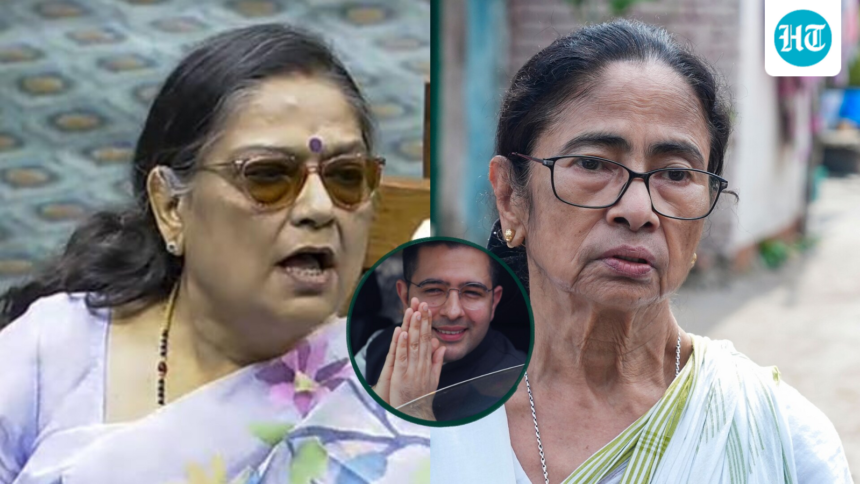
In her rebellion within the Trinamool Congress, Kakoli Ghosh Dastidar keeps coming back to a number – she says she has “nearly 20 MPs” with her, against party founder Mamata Banerjee. However, the really important number is 19. It decides whether the rebels will be able to switch sides and retain their Lok Sabha seats, or lose them.

It echoes the move made by AAP’s Raghav Chadha a few months ago.
Here’s how it works.
What the law says, what Chadha used
The anti-defection law, set out in the Tenth Schedule of the Constitution, aims to prevent elected members from jumping parties for power or money, or essentially switching loyalties when voters elect them on a particular party symbol. The basic rule is that if you are elected on a party symbol and then leave that party or vote against its instructions (‘whip’, as it is called in the parliamentary lexicon), you can be disqualified.
If at least two-thirds of one party’s lawmakers agree to merge with another party, they are protected, one provision states. It used to be that there would be an easier way out for such a “split”, that is, if only a third split. Parliament abolished this in 2003, and today only one exception remains, namely the two-thirds “merger”.
This is the same calculation used by Raghav Chadha. In April, Chadha and six other Aam Aadmi Rajya Sabha members — Sandeep Pathak, Ashok Mittal, Swati Maliwal, Harbhajan Singh, Vikramjit Singh Sahni and Rajender Gupta — announced their merger with the BJP. Seven of the AAP’s 10 senators got two-thirds, and Chadha openly argued that that made them safe.
The Rajya Sabha Chairman accepted their reasoning. They have retained their seats and are now seen on records as BJP members. The AAP, through one of its MPs in the Rajya Sabha Parliament, Sanjay Singh, filed a petition for their disqualification.
The TMC rebels in the Lok Sabha are now seeking the same legal leverage.
There are still warnings for the Kakoli group
But using this formula is harder than it looks, and Kakoli’s group faces three problems.
- First, the exception only protects you if you merge with another party. “We sought (from the secession) separate seating arrangements as a separate bloc,” Kakoli said. Former Lok Sabha secretary general PDT Achary told HT that the two-thirds requirement applies “to merger only”, adding that “there is no way the Speaker can recognize them as a separate group in the Lok Sabha”.
- Second, even the path to integration is disputed. After Chadha’s change, senior advocate and MP Kapil Sibal argued that it was not a true merger at all — his point being that the two parties had to merge first before lawmakers could act, which did not happen. This issue is expected to be settled by the Supreme Court in an ongoing case over Goa, for example.
- Third, and most importantly, as of the afternoon of June 9, the numbers became controversial. “Nearly 20 members of the TMC, including me, decided to support the NDA,” Kakoli insists. Mamata Banerjee loyalists say this number is exaggerated. Bardhaman-Durgapur MP Kirti Azad termed it “the fake and fabricated narrative of the BJP’s dirty tricks department”, saying that only 13 MPs – 12 from Lok Sabha and one from Rajya Sabha – attended the rebel meeting, and “no one else signed on the dotted line except these”. Dum Dum MP Saujata Roy, who says he rejected an offer to switch, predicted the rebels would find it “extremely difficult” to get two-thirds.
Loyalists opposed the switch even if the number was reached. Krishnanagar MP Mahua Moitra said the rebels won in 2024 on a TMC ticket. “The mandate was not in favor of the NDA,” she wrote on X, urging them to “resign from their seats and contest on a BJP ticket.” In her characteristic use of colorful language, she described them as “traitors with yellow-stained trousers.”
Kakoli Ghosh has been defiant, though she has yet to show a letter bearing the names and signatures she claims to have. “Mera saar kateja likin jokija nahi [My head may be severed, but it will not bow]“She insisted that she had ‘fought for Bengal’ for 40 years and was acting in the interests of the state, not her own,” she added.
How do numbers move in an assembly?
There is an irony in all this, which relates to Chadha again. Back in 2022, as the youngest member of the Rajya Sabha and still loyal to Arvind Kejriwal, Chadha himself introduced a bill seeking to make defection more difficult. He called for raising the integration barrier from two-thirds to three-quarters, and preventing dissidents from competing for six years. This was a private member’s bill, which rarely goes beyond simply putting it on the table.
However, there is a more recent precedent, that of Mamata Banerjee, whose party is disintegrating within weeks of losing power to the BJP after 15 years of ruling West Bengal. It is facing a state-level insurgency as well, and in the assembly, the rebels already have the numbers that the parliamentary group lacks.
The TMC has 80 MLAs there, so the two-thirds – the merger exception bar – comes to 54. The 58 legislators who broke away to support the expelled Ritabrata Banerjee would have crossed that line and were therefore enough to install him as leader of the opposition over the leadership candidate.