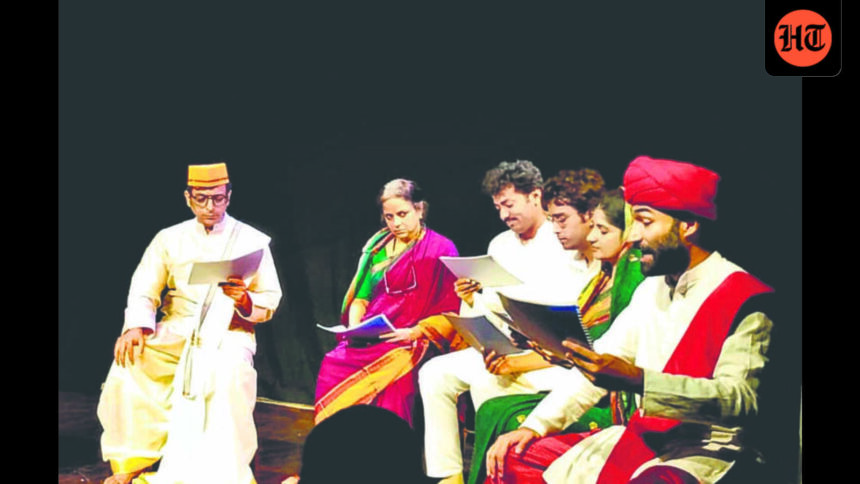
MUMBAI: We recently gathered at Tamasha Studio to read the novel ‘Trutya Ratna’ (The Third Eye or Third Jewel) by Jyotiba Phule. This play written 150 years ago has been translated into English by Rohini Mukashi Punekar and published by Orient BlackSwan. The reading, directed by Sharmishta Saha, celebrated the work (and words) of Phule, the 19th-century social reformer from Pune.
To read “Trutiya Ratna” today, more than 150 years after it was written, is to realize that the play’s polemic about education resonates with the student protests in the capital and across the country this week. The argument remains the same: whose education is it anyway? It’s not just about arguments about what constitutes a “valid” curriculum or who leaks the exam paper. Bean asks a basic question. “A hymn in a very old book says that Brahmins come from the mouth, while Shudras come from the feet.” When Bean read this, he asked who exactly had measured.
Politics The play celebrates literacy for all. This includes every girl born in the country. It’s not easy now. It wasn’t easy then. Bean opened a girls’ school in 1848, and with this single radical act, she incurred the wrath of Orthodox theologians. Phule married a woman, taught her to read, and she became the first female teacher in India. People threw stones at her on her way to class. Savitrabai continued walking. Eventually the stones got tired.
There’s a motto from Bean’s life that seems to resonate in this climate of campus activism: “Don’t argue about theology. Instead, open a school (preferably a school with a library).” It is a call that today’s student protesters should heed. Bean did not expend his energy trying to renovate a house that was built to keep him away from home; He built a completely new structure. Before the revolution of 1857, the Brahmins, Peshwas and Badraloks held the supreme power. After 1857, the common people and the new artisan class began to play a role in the development of the social order. As the Volians saw it, the liberation of the old order.
However, the questions raised by Bean remain fundamental. In Trutya Ratna, he used dialogue as a vehicle for his reform project, asserting that the modernist project of colonial India was essentially a “dialogue project”. This, as well as Phule’s brilliance, lay in his conceptual innovations, his invention of the Shudra-Ati-Shudra category, a union of the working and oppressed classes that defied class fragmentation. He trained his wife, Savitribai, in teaching, ensuring that the rebellion was not just an individual act but a generational act. Together, the Vols embodied lower-class protest in nineteenth-century West India. They introduced peasants (and even barbers) as a class. Phule was the first Indian to introduce peasants as a class in his writings.
What makes ‘Trutiya Ratna’ so relevant in 2026 is that the blocking of literacy has simply changed its form. The priest in Bean’s play does not need violence. He just needs to make sure the poor farmer is not accepted into the school. This has been the complaint of a large number of young people occupying squares, college gates and protest sites across the country, arguing not about scripture but about fee structures, seat quotas and the minutiae of scholarship disbursement that seem to have been designed and crafted by the cosmopolitan Shitji Bhatji.
It’s worth pausing on the specific villain chosen by Bean. He is part of the Sethji-Bhatt Ji clan. Bean did not write a play in which a farmer is cheated by a foreign army, famine, or bad weather. He doesn’t let the audience off the hook. It makes the audience (especially the savarna audience) very uncomfortable. He has written a play in which a farmer is deceived by his priest, a man of his community, who works within the bounds of custom and law, and only uses the farmer’s illiteracy as his tool. Bean’s argument is that the most enduring forms of exploitation rarely need to break any rules. They only need one party to the transaction to not be able to read the rules that are already in place.
As a new youth movement was born in the country, it is worth noting that after Phule’s death in 1891, his allies began to split along sub-class lines which he hoped his movement would disintegrate. Five years after his death, the Satyashodak Samaj voted to exclude the Dalits whom he had spent his life training as writers and organizers. This part of Bean’s story resists inspirational treatment. It also serves as a cautionary tale for students (and political parties in West Bengal and Maharashtra) planning their next demonstration: movements do not remain pure just because they have a good founder. It requires constant, unattractive maintenance, just the kind that Phool performs by training Gopal Baba and Angkar to write and speak softly, without expecting a statue.
Which finally brings us to the statues. In 1924, the Pune Municipality erected statues of Bal Gangadhar Tilak and Vishnu Shastri Chiblankar. Meanwhile, a proposal to do the same for Phule was met with fierce resistance from the same Brahminical faith that the two statues celebrated. A young writer named Dinkarrao Jawalkar responded with a post so incendiary that it led to a libel suit and a prison sentence. A young lawyer named B. R. Ambedkar, who had just graduated from his doctorate, took the case to appeal and won.
No statue of Phule was raised in Pune that year. It has been installed in other places and in other forms. The delay is the lesson learned, or one of them: recognition, like literacy, is rarely freely given to those who have transformed the terms on which it is granted. We must fight for it. As Bean taught us, no fight is complete without grassroots activism.
As I walked outside after listening to the play, two things were clear: the insight of Jyotrao Phule and how the play, dismissed by many as a relic, should be part of the textbook curriculum on Indian democracy.
Ramu Ramanathan is a Mumbai-based journalist, playwright and poet.