The police officer in Indian cinema, who has always been a mythical, heroic or vigilante, is now also a figure that India protects like its own aggrieved child. Or does the Central Board of Film Certification (CBFC), famous for censoring more than just certification, take that dialogue around Inspector Vijay’s nocturnal avatar in Tinu Anand’s Shahenshah (1988) – “Rishtey mein toh hum tumhare baap lagte hain” – so seriously that it feels compelled to protect the police?

This year alone, two films came into the spotlight when it was decided that Indian audiences would not be able to watch them because the police seemed unappealing in the story. The first is Sandhya Suri’s debut film Santosh, which The Guardian describes as “an unflinchingly fictionalized portrayal of the darker side of India’s police force, depicting deep-rooted misogyny, discrimination against Dalits – India’s lowest caste, once known as untouchables – and the normalization of mistreatment and torture at the hands of police officers.”
The second film, Honey Trehan’s Satluj, was banned on Zee5 after remaining on the OTT platform for two days last week, prolonging a long censorship battle that was based on a vague assumption that a general release of the film could create a “law and order situation” in Punjab.
The CBFC did not ban the film. In fact, he did not grant her the required certificate. An OTT release certainly does not require CBFC certification and Zee5’s release of Satluj seemed like a final step. Two days later, Zee5 banned the film, saying it would not be available in India “until further notice” due to “current developments”.
The film is being examined by the Inter-Departmental Committee (IDC), under the Ministry of Information and Broadcasting (MIB), constituted under Rule 14 of the Information Technology (Intermediary Guidelines and Digital Media Code of Ethics) Rules, 2021. The committee forms part of the government’s oversight mechanism on OTT platforms and digital publishers and can make recommendations to the Center on complaints related to online content.
The movie
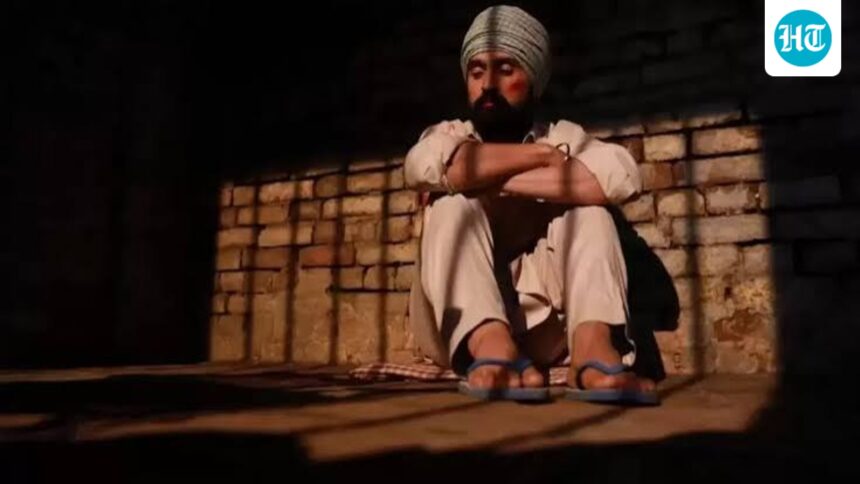
Satluj depicts the life of human rights activist Jaswant Singh Khalra, who was kidnapped and murdered by the Punjab Police during the height of the insurgency in Punjab in the mid-1990s.
Punjab 95 was later named Satluj because the title was one of several issues the CBFC had with the film – it wanted 127 takes, which, says Trehan, included all references to the words ‘Punjab’, ‘Punjab Police’, the name of the protagonist, visuals of the Indian flag and scenes of police brutality.
“We said no because with these cuts, the film we made based on so much research, wouldn’t be a film at all, forget the film we believed in,” Trehan told me weeks before Zee5’s release.
For Trehan, a director – and director of many Bollywood films – this was a topic with deep personal resonance. He grew up in Tarn Taran district, and witnessed how Punjab police, in the name of protecting the state from insurgents demanding a separate state in Khalistan, unleashed violence on Punjabi youth.
Throughout Punjab, young men were rounded up, brutalized, murdered, and their bodies surreptitiously burned. Some bodies drowned in the Sutlej River and other rivers. “We worked closely with the Khalra family, as the film was shot at the primary school in Tarn Taran where I myself studied,” says Trehan. “It is a very immersive project on a personal level.”
After completing the film, Trehan found support from the Khalra family (his wife Parmjit, daughter Navkiran and son Janet), community groups in the state, and Rajvinder Singh Bains, the lawyer who fought the case.
Trehan vividly remembers the silence that followed the film screening at Baines’ home. “He was speechless at first because it was a story very close to him,” says Trehan. “Then he thanked us for doing justice to the story.”
Cast
Satluj’s hero is not exceptional in the sense of having any special power. Having decided to take up the case of missing Punjabi men in the 1980s and 1990s, he spent most of his life with papers and files.
Trehan’s film has some great acting by Diljit Dosanjh as Khalra, Arjun Rampal as a CBI officer, Geetika Vaidya Ulyan as Paramjit Kaur Khalra, Kanwaljeet Singh as senior police officer DGP Beta, and Suvinder Vicky as a morally bankrupt and cheerful police officer.
The narrative is emotionally charged and dangerously invested in the injustice of random brutality against the people of the state. Some of its narrative devices are Macbethian.
Even the Mumbai Film Society found Satluj absurdly out of touch. Bollywood insiders say that when several directors and actors were invited to attend the screening scheduled in 2023, the film makers received threatening calls.
Trehan does not verify these claims. “All I can say is that it’s been a tough journey, and I’m willing to fight for it if it takes my whole life,” Trehan says.
“box office”
Meanwhile, the movie was downloaded and re-downloaded. The link has gone viral on social media and WhatsApp. One of the actresses, Vicky, who plays a brutal cop, told the media that people are organizing screenings of the film across Punjab in gurdwaras and community halls. Social media is already full of videos and testimonials about the emotional impact it had on people who inherited the burden of the massacre for which Khalra wanted justice.
Dosanjh, who has a huge social media following and fans across the world, shared a video soon after the film was banned on Zee5. “My love and respect to you all. What I was actually expecting is exactly what happened. I thought the movie might be banned when [government] The offices opened on Monday, but I didn’t know it would happen this early Sunday evening. This particular reel sparked widespread sharing of the downloaded movie.
CBFC and Film Censorship in India
For a government body known for its increasing grip on Indian cinema over the ages and under governments with different ideologies and political parties since independence, the Indian Film Commission has remained silent in response to Satluj.
The usual approach taken by the CBFC is to get ahead of crime. Andy (1975) was likened to the then Prime Minister Indira Gandhi and her decision to impose a state of emergency; It has been blocked. In 1994, Shekhar Kapoor faced several challenges from the CBFC when his film Bandit Queen was to be released on the grounds of nudity, rape and political violence.
Deepa Mehta’s Nar (1996) was banned in India because it was about a romantic relationship between two women. Anurag Kashyap’s Black Friday (2004), Alankrita Srivastava’s Lipstick Under My Burkha (2016), Abhishek Chaubey’s Udta Punjab (2016), in which Trehan was the director and second unit director – all these films, and many others across Indian languages, were CBFC targets.
Film censorship in India is not new. While it had meant unidirectional state coercion during British rule, after independence, with the establishment of the Film Censorship Commission in 1951, censorship was transformed into a powerful multilateral body, acting as an arbiter and manipulator of popular perceptions about cinema.
Many things, including sexuality and politics, are censored. Recently, the spirit of moral contempt and the vigilante force represented by the Financial Gates Oversight Commission has been particularly acute. Satluj has become a stranger. It has managed to bypass the CBFC challenge, turning it into curious and viral downloads. It is now an icon, more than just a movie.