As countries gathered in the Azerbaijani capital Baku for the World Urban Forum (WUF), discussions on the global housing crisis were shaped by stark contrasts between development-focused solutions and the lived realities of war-affected countries, with representatives of conflict-affected areas highlighting widespread displacement, housing destruction, and urgent humanitarian challenges, stressing that reconstruction efforts remain far from adequate amid funding gaps and ongoing conflicts.

“Resiliency begins with the right to survive,” said the slogan painted on the Palestinian pavilion at the Urban Exhibition of the thirteenth session of the World Urban Forum, where 66 countries showcased their experiences and innovations in the field of housing.
At the Minab 168 booth, located in another lane of the sprawling urban gallery, school bags on display bore the memory of the 168 victims, including 138 students, who were killed in the bombing of Shajarat Taiba Primary School in Iran last February. Their information booklet explained that Thebes Tree means “a tree with roots, living and growing.”
At their pavilion, Ukrainians announced their intention to rebuild “The Future at Home” with a model of an apartment building destroyed in the bombing and a restored version next to it. A symbolic installation of an underground school to protect their children from bombing was also displayed, and a thoughtfully designed playground above it for days when the sky is clear.
This existential crisis finds echoes of terms such as “house killing” and “urban killing” – the deliberate destruction of homes or city spaces, leading to the loss of memories and identity – used in UN-Habitat’s flagship World Cities Report at the Forum.
In the panel discussions, experts asked some key questions: Why is housing not the primary response in crises, even as protracted military conflicts rage on such an unprecedented scale? What will it take to rebuild at this scale and speed?
Living among the ruins
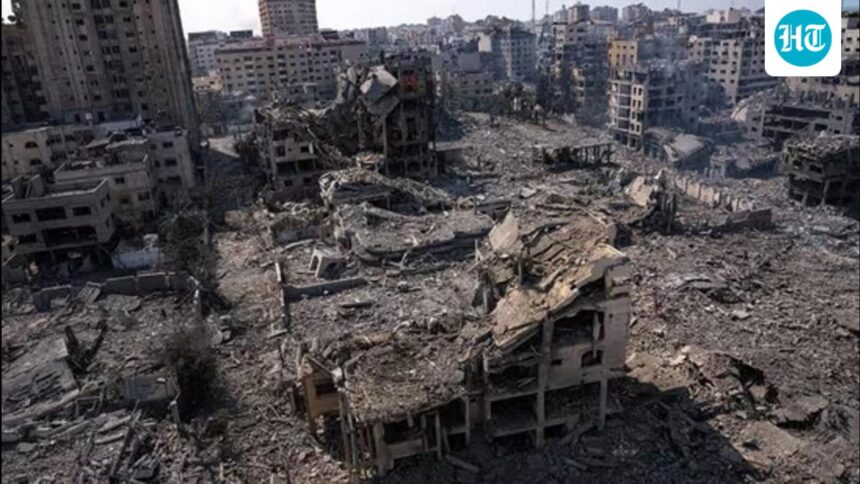
Ohoud Enaya, director of programs and policies at the Union of Palestinian Local Authorities, said it is very difficult. With the heavy bombardment of Gaza, there is a lot of rubble – by some estimates, 39 million tons – and bodies buried underneath.
By early 2026, almost the entire population was internally displaced, many displaced multiple times, according to the World Cities Report, with an estimated 83% of buildings damaged or destroyed.
Municipalities, such as Khan Yunis, which was not completely destroyed, are receiving people at five times their capacity. The official landfill is located behind the yellow prohibitory line, so municipal waste is disposed of close to where people live. Anaya said there is a rodent problem and skin diseases are common.
Some areas have less than 5% of their water system capacity. Up to 70% of sewage systems are destroyed. With no reserves and revenues, there is a 42% decrease in the number of municipal employees.
Electricity and fuel have long been scarce due to the 17-year-old siege, so they use solar energy to charge their phones and pump water from wells. Now, there is no fuel to power the few garbage trucks available. She added that municipalities use donkeys to transport waste from one place to another.
Enaya said that US President Donald Trump’s plan, “which resembles the Las Vegas plan” in the post-war period, “has no connection to the culture, history, and memories of Gazans about their homeland.” After the ceasefire between Israel and Hamas in October 2025, the next step was to open the borders to import construction materials for aid. She added that unfortunately, everything seems to be on hold now because of the Iran problem.
In Iran, new conflict has temporarily displaced up to 3.2 million Iranians by March 2026, according to the World Cities report. Iran’s ambassador to Azerbaijan, Mojtaba Demircilo, said that more than 100,000 homes were damaged, some of which were completely destroyed. He added, “Rebuilding requires time and a large budget, and until then, the government is providing temporary support.”
The UN report stated that since 2022, the war has displaced about 3.8 million people in Ukraine, leaving 2.5 million families without adequate shelter. Damage from drones, bombs and missiles has made towns and villages on the front lines uninhabitable.
For Syria, it is a “double burden” of more than 13 years of conflict (the civil war that began in 2011) and accelerating climate change that has destroyed 31% of its housing stock, said Felicity Cain, UN-Habitat Deputy Country Director for Syria, in her presentation at a session on resilient Arab cities. The 2023 earthquake increased damage to foundations.
There is no money to rebuild
Rebuilding requires money. But there is a major mismatch between humanitarian and development funding, noted Annaclaudia Rosbach, Executive Director of the United Nations Human Settlements Programme. She added that the majority of development funds come from development banks, but within the portfolios of these banks, housing constitutes a small component.
For example, the United Nations, European Union, and World Bank estimated the total cost of rebuilding Gaza at more than $70 billion over a decade. But international donations are not arriving.
The Guardian reported on May 20 that of the $7 billion pledged by nine countries (and an additional $10 billion promised by Trump) for “Gaza relief” at the first meeting of Trump’s peace council, only the United Arab Emirates and Morocco had sent money. On May 26, a Financial Times report said that after four months, the Council Fund set up by the World Bank had not received any money.
Enaya said: “We hear big pledges in Davos and Geneva, but in Gaza, families are still living among the rubble, without water or a roof. Donors say they are waiting for political progress, but our children cannot wait. Money has been pledged, but we are not seeing any of it. This is not diplomacy. This is abandonment.”
Shelter vs. home
It is the gaps between the needs of displaced people and the willingness of agencies to implement such plans that Sultan Barakat, a professor of public policy at Hamad Bin Khalifa University, affiliated with the Qatar Foundation, has warned about.
“A displaced family will likely start thinking about reconstruction from the second day of displacement,” he said in one session. “So, in the beginning, just soft interventions that focus on people’s ability to organize, conserve their energy, and not be marginalized, will put them in a position to move forward.”
Even establishing property rights requires documents that are often destroyed or lost during these crises. Issues such as slow procedures complicate the resolution of property disputes, as we saw in Syria. Lubna Shaheen from the Palestine Office of the United Nations Human Settlements Programme, in her presentation at the forum, said that access to legal assistance in Palestine is limited, while Lebanon faces complex legal frameworks that can lead to evictions.
A year after the large-scale Russian invasion, the Ukrainian parliament passed a law in February 2023 on compensation for destroyed property. So far, more than 196,000 families have received relief.
Reconstruction is not limited to brick and mortar structures; It is mainly about rebuilding homes and people’s lives. Kharkiv, Ukraine’s second-largest city located near the Russian border, has launched a pilot reconstruction project according to its new master plan. Since 75% of the city’s population owns the homes they live in, the plan takes their needs into account. The document indicates that the comments of 16,000 citizens were included.