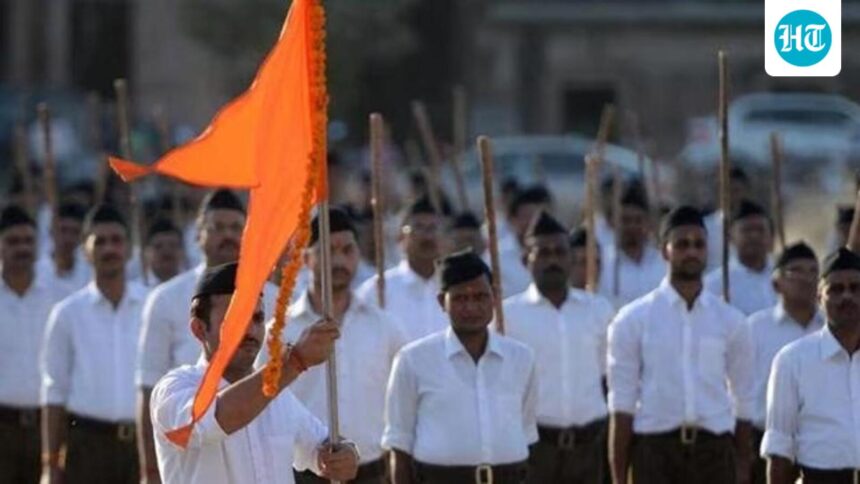
The Rashtriya Swayamsevak Sangh (RSS) concluded its annual Akhil Bharatiya Pratinidhi Sabha (ABPS) conference in Samalkha, Haryana, with nearly 1,500 delegates attending the three-day event.

The ABPS is described as the most important annual organizational event of the Sangh. Similar to a general body meeting, it reviews the activities of the various sections of the RSS and deliberates on the direction of the organization for the coming year. Few resolutions are passed, and there is sometimes a reshuffle of key leadership positions.
In comparison, the Akhil Bharatiya Karyakari Mandal (ABKM), usually held in September and October, is a much smaller gathering. Equivalent to the National Executive Council, the ABKM is a much stronger decision-making forum than the ABPS.
The RSS is celebrating its centenary this year, and the ABPS has focused sharply on organizational expansion and strengthening core activities. Current initiatives are known as Panch Parivartan, or the Five Transformations, including samajik samarasata (social harmony), kutumb prabodhan (family awakening), paryavaran (environmental responsibility), Swadeshi Jeevan Shaili (swadeshi lifestyle), and nagrik kartavya (civic awareness and duty).
RSS now has nearly 90,000 shakhas daily, Sarkaryawa or RSS general secretary Dattatreya Hosabale said while presenting the annual report, adding that its activities reach every corner of the country.
During the press interaction following the ABSS meeting, a query about the Sangh’s view on India’s view on the West Asian War was met with the answer that the Sangh had no role. “Whatever is in the best interest of the nation, they (Indian government) do. What they do is right,” Hosabale reportedly said, when asked if the ruling party’s ideological father had an opinion. He pointed to India’s message at the G20 summit, ‘One Land, One Family, One Future’, as an example of an ’emerging narrative of the civilizational spirit of Bharat that can contribute positively to the global discourse’. This is in keeping with the Sangh Parivar’s view of India as a Vishwaguru, or teacher of the world. However, it is noteworthy that the guardian of Hindutva ideology did not comment on the wars in its vicinity, which some senior American officials sought to portray in religious tones, evoking memories of the Crusades of the 11th, 12th and 13th centuries.
Construction and internal discussions
The ABSS meeting is preceded by a series of meetings and discussions, including small and large groups. Most of it remains classified, and only a small portion is reported during the ABPS. Even by RSS standards, discussions of politics and economics have become rare.
Contrast this with 2013, when Suresh Bhayaji Joshi, then Sarkaryawa, commented: “It is of great concern that multilateral trade agreements and free trade agreements have been constraining the government in making decisions in all areas that are in the national interest,” leaving it with no choice. He added: “The economic crisis has been exacerbated by the government’s short-sighted policies and neglect of agriculture and SSI [small scale industries]Other employment-oriented sectors are emerging as a serious cause of concern in the country.
He said the growth rate of the manufacturing sector had fallen to “the lowest level ever since independence.” He said that low growth was fueling unemployment, rising prices, and the trade deficit, and helping foreign companies dominate industry and trade in India, “which is pushing us into a serious economic crisis and dependence on foreign countries.”
After last year’s ABS conference, Joshi expressed concern about “increasing regionalism” and the growing “influence of regional political parties”. This observation is noteworthy, as the 2012 ABPS was held soon after the BJP lost the elections in Uttar Pradesh. Joshi said it did not mean that voters rejected Hindutva ideology.
No comments have emerged from the ABS this year on the two major trade deals India has struck – one with the US and the other with the EU. There was also no comment on political trends.
Voices within the Sangh
But internal discussions continue. In the run-up to this year’s ABPS, leaders of the Arthic Samoh or economic group – including the Bharatiya Mazdoor Sangh, Swadeshi Jagran Manch and Bharatiya Kisan Sangh – met in early March. The prevailing mood was one of caution and caution.
The meeting continues an initiative started last August under the leadership of Saha Sarkaryawa or Joint Secretary-General Krishna Gopal to analyze various aspects of the Indian economy and policies. The Sangh leadership, including Sarsangachalak Mohan Bhagwat, Sarkaryawah Hosabale, and all joint secretaries-general, were present. The inaugural conclave ended with a presentation by former Union minister and Sangh-BJP leader Murli Manohar Joshi on environmental destruction, especially in the Himalayas. The dark shadow of the Darali mudslides and the Kishtwar floods still looms over the country. Concerns included India’s declining per capita income, wealth inequality, and slowing growth.
The March 1-2 meeting concluded with another presentation by Joshi, this time analyzing the Iran war, India’s energy (in)security, technological dependence, and the risks of artificial intelligence. He said India has historically enjoyed deep ties with regions from Iran, Iraq and Syria in the northwest to Indonesia in the southeast, which have long been within India’s sphere of influence. Any conflict there should worry India.
Key Takeaways on Sovereignty
Joshi highlighted lessons learned from the conflict, noting that Iran effectively retaliated against US and Israeli attacks, but no major power publicly supported it. While Iran has manpower, locational advantage, and uranium mines, it lacks advanced technology, preventing it from emerging as a regional power.
He warned that India’s sovereignty was at stake. “The US has proven that it has no friends when it comes to technology and energy security. India must ramp up nuclear energy to get rid of oil dependence.”
Joshi argued that dependence on other countries for technology threatens India’s intellectual, political and economic sovereignty. Describing artificial intelligence as an anti-human technology, he said India views the universe as a single entity, while artificial intelligence, built on Western thinking, sees the world in parts.
“The dominance of big tech companies is a threat to India’s intellectual sovereignty. They view Indians as mere data labourers. I am raising this because it is a question of our existence. It is a question of control over our thought, our economy and our sovereignty,” he said.
“I say it again: sovereignty, sovereignty, sovereignty. Eternal vigilance is the price of freedom. We need to control technology to protect our sovereignty,” Joshi concluded.