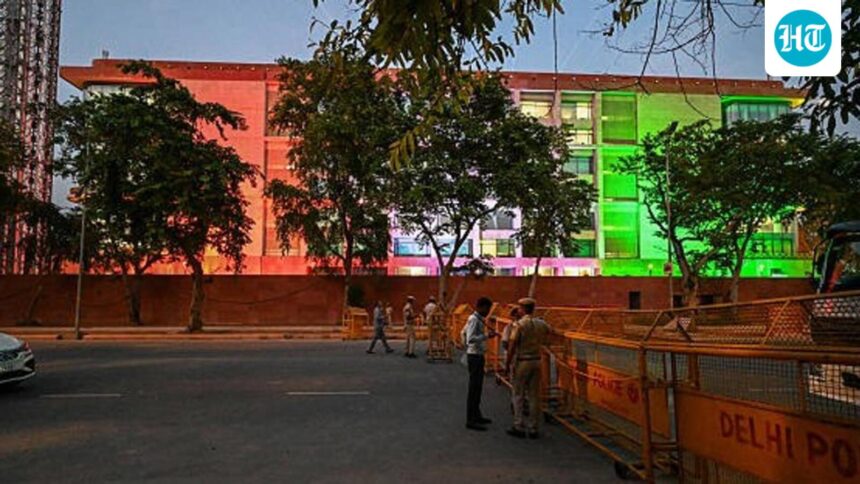
Work on a new parking facility for 1,146 two-wheelers and 234 four-wheelers is set to begin in the Central Vista area as the Center gears up for completion of all 10 Combined Central Secretariat (CCS) or Kartavia Bhawan buildings by April 2028 and a sharp increase in traffic in the heart of the capital.

“The parking facility will come up in the vacant land in front of CCS 1-3 buildings, which was earlier used as an office for the L&T site during the construction of those buildings,” said a Union Ministry of Housing and Urban Affairs (MoHUA) official, requesting anonymity.
the $The Rs 17.7 lakh crore project, recently awarded by the Central Public Works Department (CPWAD), is scheduled to be completed within five months. This specific project cost is largely driven by the value of civil infrastructure works $13.54 crore, including construction of parking area, storm water drains, cable trenches and associated site development.
Electrical and mechanical works, including CCTV surveillance systems and street lighting, are another factor $4.03 crore, while the landscaping and plantation works are estimated at Rs 4.03 crore $14 lakh. The first phase of this project, which includes civil works, drainage and street lighting, is expected to be completed within two months, while the remaining works, including steel fabrication, cable trenches and landscaping, are scheduled to be completed within five months. The facility will include CCTV monitoring, decorative streetlights, signage, stormwater drains and landscaped areas.
Read also: The Central Vista Project records a 43% loss in planted trees
A second MHA official said more such parking facilities may be set up as congestion is likely to increase with seven more carbon capture and storage structures expected to come up over the next two years. The first three buildings are already operational, while the fourth building, CCS-10, is expected to be ready in September at the site that previously housed Raksha Bhawan.
According to officials, all 10 CCS buildings are scheduled to be completed by April 2028, significantly increasing the concentration of government offices within the Central Vista area and bringing new challenges related to parking, traffic and access to public transportation.
This parking facility is part of a broader strategy to manage traffic and parking demand as more government offices come into operation in the redeveloped administrative area.
Instead of expensive or unconventional solutions such as taxis, the immediate focus remains on enhancing road traffic management by creating more one-way roads and improving public transport connectivity, officials said.
As part of demand management, the Ministry of Housing and Urban Affairs wants to discourage private vehicles and improve public transport and walkability in these new buildings and areas near the Kartavia Trail, and the upcoming Yogi Yugyen Bharat Museum, through improved bus and metro services, including four proposed metro stations in the wider Central Vista area. The Delhi Metro Rail Corporation (DMRC) is conducting a comprehensive study on how to improve pedestrian movement in the area and is also proposing a metro/underground to decongest areas like C-Hexagon, Man Singh Marg, Rafi Ahmad Kidwai Marg and Teen Murti Marg.
The second official said the government is also considering introducing artificial intelligence-based adaptive traffic signal systems.
This proposal, currently under consideration by the Ministry of Home Affairs, would use real-time traffic data from cameras and other sources to automatically change the timing of signals rather than relying on fixed traffic signal cycles.
While the AI-based signals were initially proposed only for the Central Vista area, the official said they are now being considered for a wider rollout across Delhi, and implementation is expected to begin in the Central Vista area.