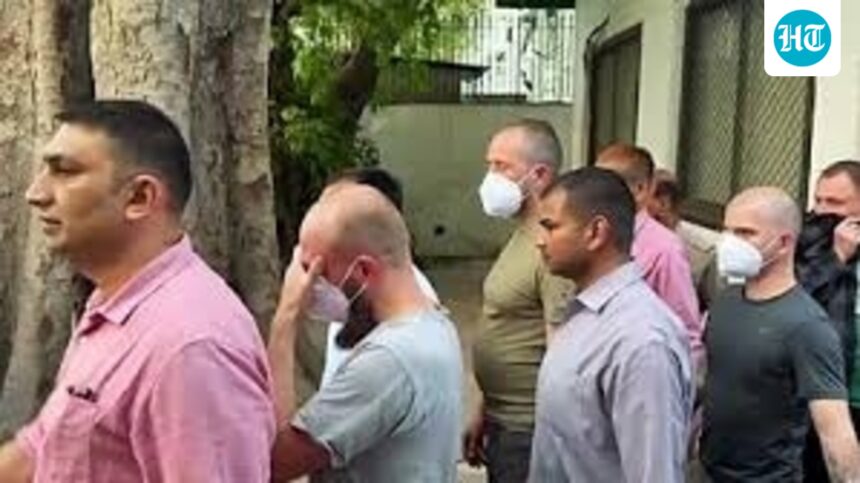
WASHINGTON: Months before the National Investigation Agency was arrested in Kolkata on charges of training ethnic militias in Myanmar, Matthew Aaron VanDyke was urging a colleague to visit that country. VanDyke said in a text message that the Kachin and Chin people seemed “really serious about Christianity” and were fighting the “majority Buddhist junta.” The Rev. Dr. William Devlin, a colleague who has kept in touch with the American freedom fighter, told HT he knew VanDyke was in Myanmar and was “not surprised” by news of his arrest.

“I knew he was there (Myanmar). I wasn’t quite sure what he was doing. He mentioned he was in Myanmar to train people,” added Devlin, who has known VanDyke for 10 years and visited Ukraine with him.
VanDyke and Sons of Liberty International (SOLI) have spent much of the past decade deployed in war zones, training Assyrian Christian communities in Iraq to resist ISIS, and working with Ukrainian civil defense units grappling with a Russian invasion of their country. During that time, VanDyke developed a public image that was part humanitarian, part revolutionary crusader.
HT spoke with VanDyke associates like Rev. Devlin and scholars who have studied SOLI to better understand the organization and the man behind it.
After graduating from Georgetown University, a training ground for America’s foreign policy and intelligence elite, VanDyke spent years traveling across West Asia and North Africa as a documentary filmmaker, a profession that gave him easy access to countries in the region. That changed in 2011 when popular protests and mass uprisings against authoritarian rule swept West Asia in what became known as the Arab Spring. With no military experience, VanDyke signed up to join armed Libyan rebel groups fighting to topple strongman Muammar Gaddafi, who ruled the country for more than 40 years.
“My ideological belief in freedom and democracy, formed over years in the region, combined with my strong friendships in Libya, compelled me to take up arms as a freedom fighter,” VanDyke wrote in 2012 about his reasons for joining there. “I would not have gone without my friends,” VanDyke wrote in 2012 about his reasons for joining there.
However, shortly after registering as a rebel fighter, VanDyke was captured by Libyan government forces and he spent nearly six months as a prisoner of war before eventually escaping from Abu Salim prison in August 2011. VanDyke later said that his time in prison also strengthened his Christian faith. A few months later, Gaddafi fell from power and VanDyke boarded a flight back to the United States.
But VanDyke’s arrest and subsequent escape in Libya gave him something extremely valuable: a public image. This is further enhanced by Point and Shoot, an award-winning 2014 documentary that tells the story of Libya and the turbulent months that led to the fall of the regime through VanDyke’s eyes.
VanDyke quickly became a familiar face on television news, invited as an expert on international security and conflicts in West Asia at a time when America entered a new conflict in the region to contain the rise of the Islamic State. In 2014, VanDyke announced that he was abandoning his career as a film director in order to form a “Christian army” in Iraq that would repel ISIS, which was making stunning military gains in Iraq and Syria at the time. That was the beginning of SOLI, which recruited former American military personnel to train Assyrian Christian communities to resist an ISIS attack. However, SOLI does its best to stress that it is not a mercenary group.
“Groups like SOLI are unusual organizations that fall somewhere between traditional humanitarian NGOs and private military companies,” says Pavol Kosnak, a researcher at the Slovak Academy of Sciences who has studied SOLI and interviewed Vandyke. “They present themselves as non-profit ‘combat charities;’ they raise money from donors, then use them to provide military training and advice to local forces they see as victims of aggression (for example, Assyrian Christian militias confronting ISIS in Iraq), rather than working from Payment deadline for state clients. In Iraq.
Unlike major private military contractors, SOLI has been registered as a tax-exempt nonprofit organization since January 2015. According to filings SOLI filed with the U.S. Internal Revenue Service, the group states that it receives all of its income through contributions and grants.
In Iraq, SOLI trained more than 300 personnel for the Nineveh Protection Unit (NPU), a small local militia composed of Assyrian Christians, who were recruited to resist ISIS at the height of its power in 2014. According to Kosnak, VanDyke and SOLI provided training equipment, protective gear, body armor, walkie-talkies and other military assistance to the NPU and the Nineveh Protection Force (NPF), another militia.
However, SOLI generated significant controversy during its time in Iraq.
The group never clarified whether it had obtained the relevant permissions from the US State Department to train foreign militia groups, which it was legally required to do. VanDyke told US media outlet Mother Jones that the State Department approved his activities in Iraq, a statement later contradicted by US diplomats in Iraq. A number of former US military trainers recruited by VanDyke have resigned amid concerns that they were working in Iraq illegally.
The Ministry of Foreign Affairs did not respond to an inquiry from Hizb ut-Tahrir about whether SOLI had obtained permission to train foreign military groups.
Despite these disagreements, VanDyke and Sully continued to work. VanDyke’s following has continued to grow, with his public social media profiles boasting nearly 1 million followers across platforms. Meanwhile, SOLI claims to have been active in Venezuela in 2018, raising money to overthrow the government of President Nicolas Maduro. After Russia’s invasion of Ukraine in 2022, VanDyke and SOLI deployed to Ukraine with a team of 10-12 instructors and initially provided military training to civil defense forces, including the use of “non-lethal equipment,” according to the group’s website. Now, SOLI says it is helping the Ukrainian Defense Forces develop prototypes of battlefield technology to aid them in their fight against Russia.
The SOLI founder, now in Indian custody, was driven by a desire to fight for the vulnerable, says Rev. Devlin.
“His motivation was always to serve the vulnerable as he did in Libya, Iraq and Kurdistan and as he did in Myanmar. He wanted to work alongside those struggling for freedom against brutal, oppressive governments.”
But it is also clear that VanDyke, and those who fund SOLI, are motivated by a desire to support Christian minorities globally.
“A lot of our supporters are people who care about Christian persecution and what happens to members of their faith,” VanDyke said in a 2016 documentary.
Devlin adds that Myanmar has attracted increasing attention from Christian advocacy groups in the United States as the country’s brutal civil war continues to rage. The US Commission on International Religious Freedom (USCIRF) alleged that Myanmar’s military authorities destroyed churches, forced Christians into forced labor, and occupied areas in Chin and Kachin states, where many Myanmar Christians live.
“The issue of Myanmar and the persecuted Christian minority there is always of interest to all the volunteers, which, sometimes, are not just NGOs and civil society organizations. We also have US government staff and State Department staff on the phone,” says Devlin.
Despite SOLI’s diverse operations globally, it is unclear whether the organization has the resources it needs. Documents SOLI filed with the IRS show the group suffered from inconsistent fundraising. For example, while the group received nearly $250,000 from donors in 2017 and 2022, that number dropped to about $62,000 in 2024, the most recent year for which data is available. Moreover, the group’s expenditures often exceeded donor contributions.
In 2024, SOLI expenses amounted to more than $104,000 leaving the organization with a deficit of more than $40,000. The same was true in 2023, when expenditures exceeded donor contributions by about $118,000. Devlin remembers VanDyke often saying he had little money.
We can say little with certainty about VanDyke’s relationship with the United States government. His arrest in Kolkata last week sparked some speculation that Indian authorities were concerned about possible espionage in northeastern India and Myanmar. Kosnak says he is not aware of SOLI’s ties to the US government.
“In Iraq, I found no evidence that SOLI was an arm of the US government or military. They operated in a gray area: US authorities were aware of them, but there was no sign of official sponsorship or leadership.
Nor did their resources or access indicate such support – they often struggled in areas one would think a sanctioned US operation would not have, such as access to local Kurdish authorities, getting materials through Erbil airport, financing, and so on. However, many things can change in 10 years, especially if US foreign policy has seen serious changes in the last few years,” Kosnak told HT.
However, VanDyke claimed to have been in contact with American diplomats. In a 2016 documentary, VanDyke was filmed arriving in Washington, D.C. for the ostensible purpose of meeting diplomats at the U.S. State Department.
Kosnak’s study of SOLI operations in Iraq also found that SOLI members accompanied Assyrian delegations to meetings with State Department officials on several occasions.
In response to HT’s inquiries about VanDyke’s arrest, a State Department spokesperson said Washington was aware of the situation but would not comment further due to privacy concerns.
In the absence of hard facts, concerns, controversy and questions about VanDyke and SOLI’s activities in Myanmar have grown since then.