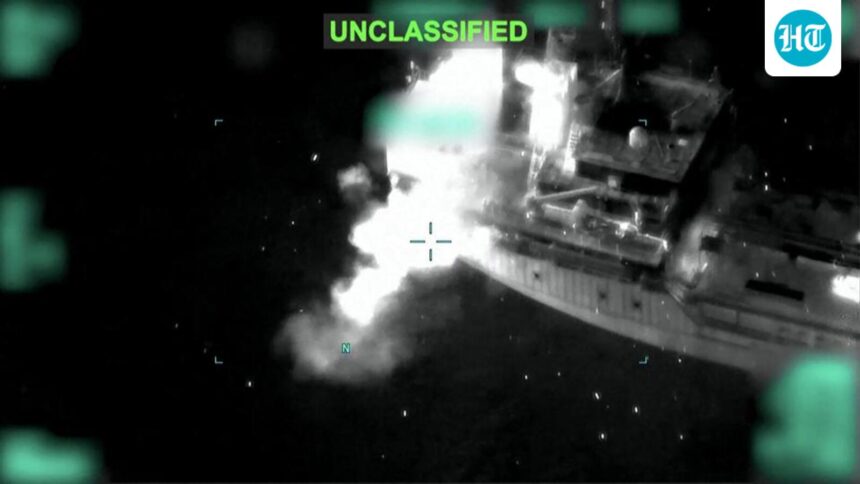
Indian Shipping Minister Sarbananda Sonowal said on Thursday that three Indian sailors, who were declared missing after a US attack on a tanker off the coast of Oman, were killed, hours after US forces targeted another commercial ship with 20 Indian crew members on board in the same area.

The three Indian sailors were reported missing after the Omani Armed Forces rescued 25 other crew members, including 21 Indians, from the Palau-flagged ship MT Settebello following an attack by a US aircraft on Wednesday.
“It is extremely unfortunate to learn of the tragic incident that occurred on board the Palau-flagged ship MT Settebello. Sadly, three Indian sailors who were initially reported missing have now been confirmed dead after their bodies were located and identified,” Sonowal said on social media.
Describing the deaths as a “huge loss to our marine family”, Sonowal said the government “stands firmly with the bereaved during this difficult hour and is fully committed to supporting their relatives”.
Sonowal said he had instructed officials to ensure immediate repatriation of the rescued crew members and speedy return of the bodies of the dead.
Asim Mahajan, Additional Secretary (Gulf) in the Ministry of External Affairs, said in a press conference that the ship MT Gulliver, flying the flag of Guinea Bissau and carrying 20 Indian crew members, was attacked off the port of Shinas in Oman on Thursday. “everyone [crew members] It is said to be safe. He said that our mission in Oman is closely monitoring the situation and coordinating with the Omani authorities for the safe evacuation of the Indian crew.
US Central Command said on social media that Gulliver was “incapacitated” when a fighter jet fired two Hellfire missiles into the ship’s engine room “after the crew repeatedly failed to comply with directions from US forces.” She added that Gulliver “violated the blockade imposed on Iran by trying to transport Iranian oil.”
Mahajan said the Omani army evacuated the 24 Indian crew members on board the Marifix, a Palau-flagged ship that was targeted by a US missile strike on Monday, to safety and they are expected to return home on Friday.
US Chargé d’Affaires Jason Meeks was summoned to the ministry on Wednesday to register a strong protest against the attacks on ships carrying Indian crew members, External Affairs Ministry spokesman Randhir Jaiswal said at the same press conference. He added that India also condemned the attack on Setibelo, which led to the death of three Indians.
“We made clear that the well-being of our seafaring community is very important and that the attacks that are occurring must stop. We also made clear that dialogue and diplomacy are the way forward towards a peaceful resolution of the conflict, and that there must be unimpeded access through the Strait of Hormuz in line with international law,” Jaiswal said.
He said: “The continuing incidents of attacks on ships in the region are deeply disturbing and a direct result of the ongoing conflict in the region. These attacks must end.”
India has more than 320,000 seafarers, the second highest in the world, and more than 18,000 in West Asia, said Mukesh Mangal, additional secretary in the Indian Ministry of Shipping. There are 562 Indian sailors on board Indian-flagged ships in the Persian Gulf, including 329 to the west of the Strait of Hormuz and 233 on ships to the east of the waterway.
Manoj Yadav, general secretary of the Seafarers’ Federation of India (FSUI), described attacks on commercial ships as unacceptable. “It is unacceptable for commercial ships and their crews to be attacked in this way. The ships that were attacked were not carrying any weapons,” Yadav said.
“Both the Iranian Islamic Revolutionary Guard Corps and the United States targeted commercial ships during the ceasefire,” Yadav said. He added, “The American attacks targeted the ships’ engine rooms filled with fuel and other combustible materials, which led to increased risks to ship crews.”
People familiar with the matter said the three ships targeted by US forces this week had links to the so-called Shadow Fleet and a history of suspicious activity in recent weeks. They noted that Marivex stated that Fujairah was the next port of call, but this had not been verified with the UAE. When US forces warned Marivex on June 7 about violating the blockade, the ship said it would heed the warning and move south toward Masirah Island, but then tried to hide its location by turning off its transponders to avoid another blockade, the people said.
The sources said that Gulliver made several calls at Iranian ports and was allegedly involved in ship-to-ship transfers with ships on the US sanctions list. They said Sitibello violated the US blockade by trying to transport Iranian oil.