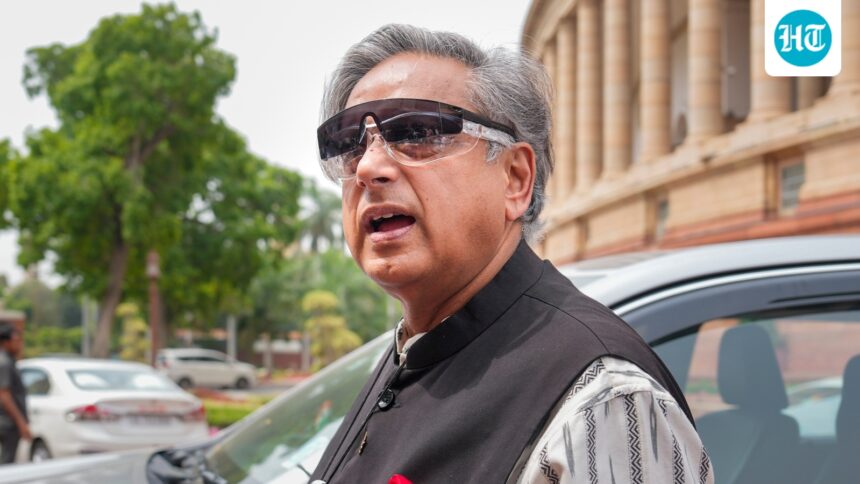
Congress MP Shashi Tharoor has questioned the practice of presenting all five verses of Vande Mataram at the beginning and end of official functions, calling it an “unnecessary imposition” on the masses. His remarks sparked a sharp reaction from BJP leader Amit Malviya, who asserted that the specific performance of the patriotic song was “not optional” under the government guidelines.

The controversy over the national song erupted months after Parliament held long debates on the issue earlier this year.
Tharoor questions full delivery on formal occasions
Tharoor said there was no dispute about respecting Vande Mataram, but raised objections to making the entire song mandatory at the beginning and end of official programmes.
Read also | ‘I was kicked out of Breach Candy Club’: Shashi Tharoor’s story of racism at an exclusive Mumbai club
“Vande Mataram is the national song and we stand in respect when it is sung. The first verse, or the first two verses, is something that most people know by heart,” he said, as reported by news agency PTI on Monday.
According to Tharoor, public functions traditionally followed a different format, with Vande Mataram being sung once and the national anthem played separately.
“Now they want the five verses to be sung at the beginning of each event and again at the end. I think that’s an unnecessary imposition,” the congressman said.
Referring to the controversy in Kerala, he said the state government has taken a stand that singing the full version is optional, while Governor Rajendra Vishwanath Arlikar seems to have a different opinion.
Read also | Shashi Tharoor feels there is an opportunity for the opposition in the rise of the Janata Party
“The matter may have to be decided eventually because there is no law passed by Parliament that requires it. It is a matter of convention,” he said.
Tharoor stressed that his statements should not be interpreted as opposition to the patriotic song itself.
“We all respect Vande Mataram. I can sing it for you with pleasure,” he said.
He also cited his experience at the recent book launch event attended by Vice President CB Radhakrishnan in New Delhi, where the song was played in its entirety before and after the programme.
“For the audience, standing in front of a long, relatively unfamiliar song has become twice as problematic,” he said.
BJP responds and cites union guidelines
The BJP reacted sharply to Tharoor’s remarks, with party IT chief Amit Malviya asserting that the scheduled handover of Vande Mataram at official functions is governed by the Union government’s guidelines and cannot be treated as optional.
In a post on website
He said that the Ministry of Interior has already set clear standards regarding the performance of the song on official occasions.
“The Home Office guidelines are clear: when Vande Mataram is performed at official events, the full official version must be sung, and all six verses must be played at designated government events. The guidelines also stipulate the occasions on which it must be performed and the protocol that must be followed, including standing at attention.”
Rejecting the argument that parliamentary legislation is required before such directions become binding, Malviya said that executive instructions issued by the Union government carry authority in matters relating to official ceremonies and national celebrations.
“The argument that Parliament must first pass a law before such protocols become binding on the functions of government is flawed. Each aspect of governance does not require a separate Act of Parliament. The Union Government routinely issues Executive Directives, Protocols and Administrative Instructions governing official ceremonies, state functions, national symbols and public administration. These flow from the executive power of the Union under the Constitution.”
He further said that countries cannot selectively decide whether to follow national protocols or not.
(With inputs from PTI)