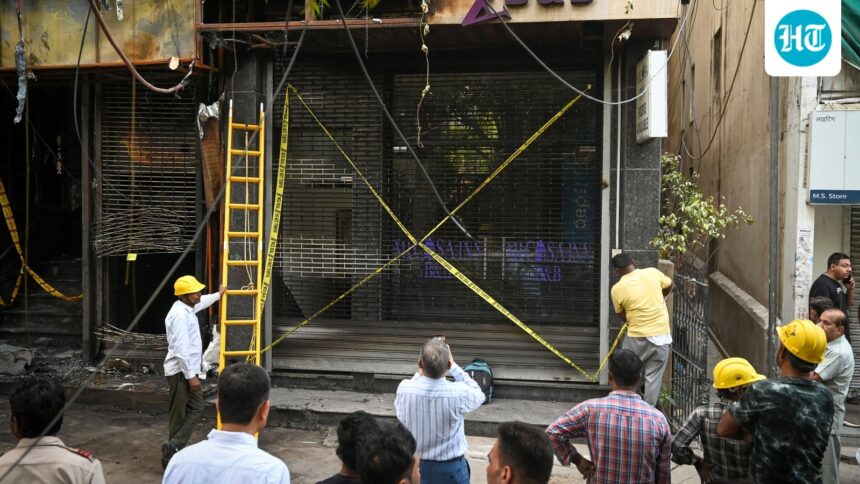
Days after a fire broke out at an illegal B&B in Delhi’s Hauz Rani area, killing 22 people, details of the lapses and events that led to the fire are beginning to emerge.

The investigation is now on the possibility of a series of events – a tea break, an unattended oil fryer, a cook who walked away without alerting anyone about the fire – which caused one of the worst fire incidents in the national capital on June 3.
Police now believe the fire at Flourish Stays B&B in Malviya Nagar’s Hauz Rani area started after an oil fryer was inadvertently left running while the cook was making tea for himself, news agency PTI reported.
Read also: Cook arrested in deadly Delhi hotel fire case, claims fire ‘started after spark in frying pan’
The police have so far arrested the B&B manager and the chef, while Jay Mishra (34), a close aide of the hotel owner Lavkesh Bajaj, surrendered before a Delhi court on Monday.
How did an oil fryer cause a massive fire?
Three B&B staff were present in the building when the fire broke out on June 4 – cook Keshav Negi, an assistant who slept upstairs, and manager Rupesh, known as Rakesh.
Police initially thought the fire might have been caused by an electrical short or a gas cylinder explosion. Police have now revealed that the fire was caused by an unattended oil fryer that was left burning while the chef was on a tea break.
The oil in the fryer reached its self-ignition temperature and caught fire, setting the ceiling on fire. It began to spread rapidly and was fueled by highly flammable materials such as cartons stored inside the building.
During interrogation, the cook, Keshav Negi, allegedly told police that he turned on a frying pan containing oil and then prepared tea for himself, according to PTI.
Read also: Cook arrested in deadly Delhi hotel fire case, claims fire ‘started after spark in frying pan’
While he was drinking tea, he forgot that the fryer was still working. After its temperature rose, it caught fire and spread to the ceiling, engulfing nearby flammable materials.
The cook returned to find that the oil had caught fire. Police said he tried to put out the flames, but fled when the fire got out of control.
Police claimed the cook failed to warn guests, inform neighbors or call emergency services despite having sufficient time to do so.
A 30-minute delay turned the fire into a tragedy
Police also discovered that a delay of about 30 minutes between the time of the fire and the first call to the fire department made the incident tragic for many guests, including foreigners in the south Delhi locality.
Investigators said the 30-minute delay allowed the fire to escalate unchecked, turning what began as a routine kitchen watch into a devastating tragedy that could have been prevented by timely action.
“The gap between the first signs of fire and the first call to the police was about half an hour. This period is being closely examined because a timely evacuation and alerting the authorities could have reduced the scale of the tragedy,” a source told PTI.
The police are also preparing to seek technical assistance from IIT-Delhi to examine how the fire spread so quickly through the building.
The assistant sleeping upstairs escaped by jumping from the balcony, while manager Rupesh escaped from the reception area on the ground floor.
Preliminary findings suggest that the building itself may have contributed to the scale of the disaster. The building was allegedly constructed without the required approvals, and investigators suspect that the use of wood and plastic decorative materials in the stairs, ceilings and floors accelerated the spread of the fire.
Police are also trying to determine whether the building’s only entry and exit route had become a death trap after it filled with thick smoke and heat, preventing guests from escaping.