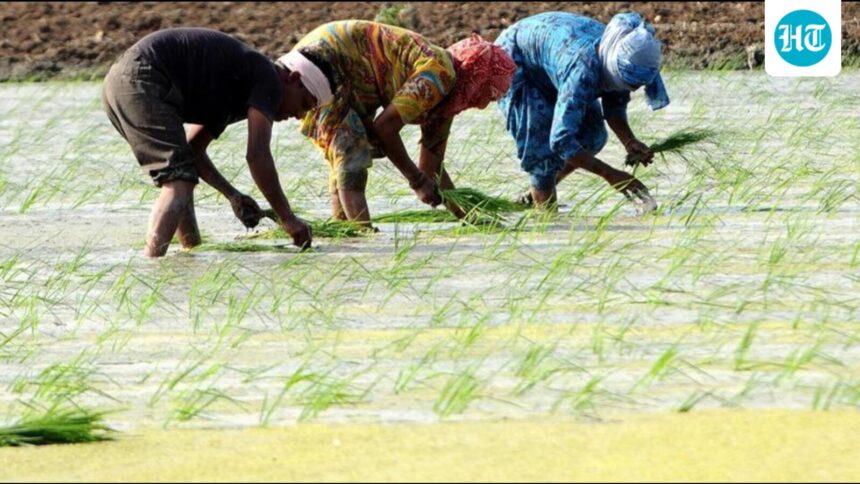
A joint report by the Food and Agriculture Organization and the World Meteorological Organization has warned that heatwaves will become a major threat to Indian agricultural workers and rice production, as labor productivity in key regions such as the Indo-Gangetic plains is expected to decline sharply under high emissions scenarios.

The report, titled “Extreme Heat and Agriculture,” released on Wednesday, said that in the worst-affected regions, such as the Indo-Gangetic plains, average growing-season physical labor capacity (i.e., expected labor output) could fall below 40% by the end of the century under a high-emissions scenario. The most severe risks from future heat waves are concentrated around densely populated agricultural areas in the Ganges and Indus river basins.
The report is particularly important as India prepares for a lower-than-normal monsoon season and other effects of El Niño, which is expected to begin around July.
In order to maintain production, several strategies have already been explored: using early-morning varieties; Adjusting sowing and planting dates; Breeding genetically resistant varieties. Another potential strategy to mitigate heat stress is irrigation, which may have a surface cooling effect from local to subnational levels.
“In India, rice farming is highly mechanized and employs millions of agricultural workers. Based on a set of high-resolution climate change simulations, it shows that extreme humid temperatures in South Asia are likely to approach and, in some locations, exceed critical thresholds for worker safety by the late 21st century under high emissions scenarios.”
In India, 70% of calories come from rice. The summer monsoon provides up to 80% of annual rainfall. Combined hot and dry events pose a major threat to Indian agriculture, the report said, adding that the most severe monsoon events were observed in 1972, 1987, 2002, 2009, 2014 and 2015. The report stated that the 20% shortfall in monsoon rainfall in 2002 led to billions of dollars in economic losses and affected more than a billion people, referring to a 2004 research paper published in the Journal of the American Geophysical Union led by monsoon scientist Sulochana Gadgil.
The report also stated that agriculture in India is still vulnerable to weather fluctuations despite its self-sufficiency in grain production.
According to the report titled “Heatwave 2022: Causes, Impacts and Way Forward for Indian Agriculture”, published by the Indian Council of Agricultural Research (ICAR) and the Central Research Institute for Dryland Agriculture (CRIDA), March and April 2022 were the hottest months on record in India. During this period, maximum temperatures were 8 to 10.8 °C above normal, and precipitation was 60 to 99% below normal in 10 out of 36 meteorological subdivisions.
That year will also be remembered as a classic example of the combined effects of high temperatures and low rainfall on India’s agricultural production systems, especially in the northern and central regions, the report said. Abnormal increase in maximum and minimum temperatures during spring has affected crops, fruits, vegetables, livestock and poultry in more than a third of the states of India, including Punjab, Haryana, Rajasthan, Jammu and Kashmir, Himachal Pradesh, Uttar Pradesh, Madhya Pradesh, Bihar and Maharashtra. Wheat yields decreased by 9 to 34%.
Labor productivity, especially in developing countries, will be a key factor in determining overall crop productivity, profitability and sustainability, the report said. Previous studies on crop productivity under climate change have taken into account extreme heat and other biophysical impacts on crops, but not labor productivity responses to heat stress. HT reported on April 17 last year that the widely accepted wet-bulb temperature survival threshold of 35°C has been called into question after recent physiological studies suggested the limit may actually be closer to 31°C, researchers from Harvard University revealed following a recent multidisciplinary conference.
Extreme heat refers to situations in which daytime and nighttime temperatures rise above their normal ranges for an extended period, resulting in physiological stress to crops and humans.
The report examined how extreme heat can interact with other climate variables, including rain, solar radiation, humidity, wind and drought, to create compound effects that wreak havoc on individuals and entire ecosystems.
“This work highlights how extreme heat is a major risk multiplier, putting increasing pressure on crops, livestock, fisheries and forests, and on the communities and economies that depend on them,” FAO Director-General Qu Dongyu said in a statement.
It is not just an isolated climate risk, it acts as a risk multiplier that exacerbates existing vulnerabilities in agricultural systems,” said WMO Secretary-General Celeste Saulo.
The report also noted that in the spring of 2025, part of Kyrgyzstan’s Ferghana mountain range experienced a prolonged high temperature of 30.8 degrees Celsius, 10 degrees higher than normal. This caused heat shock to fruit and wheat crops, contributing to locust outbreaks, increased evaporation resulting in reduced irrigation capacity, and ultimately a 25% reduction in cereal yields.
The report noted the need for innovation and implementation of adaptation measures such as selective breeding and crop selections appropriate to the new climate reality, adjusting planting windows, and changing management practices that can protect crops and agricultural activities from the effects of extreme heat.