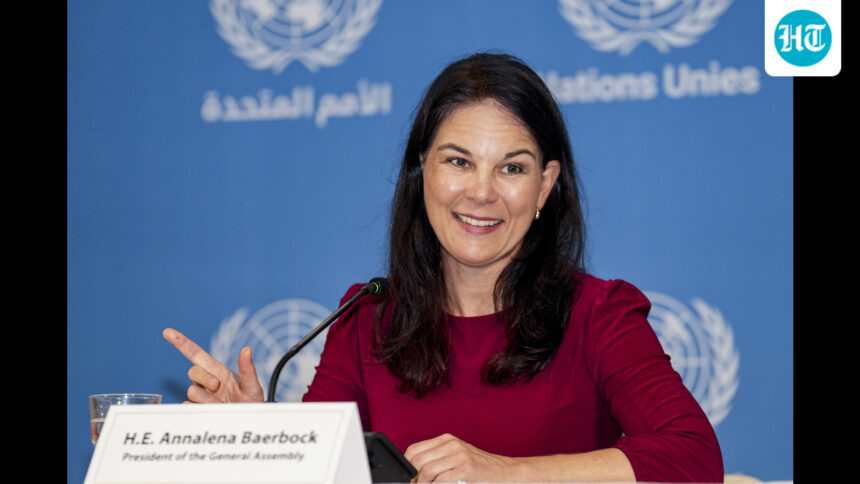
The United Nations alone can ensure global peace and security despite its flaws, because it offers a seat at the table for countries both large and small, unlike the US-led peace council, which can only be joined by paying a fee, Annalena Baerbock, president of the UN General Assembly, said on Tuesday.

Baerbock, who served as Germany’s foreign minister from 2021 to 2025, is visiting India to hold discussions with the country’s leadership on reforming the UN system and addressing crises such as the war in Ukraine and the conflict in West Asia. She met External Affairs Minister S Jaishankar on Tuesday.
Baerbock said in a press conference that UN member states are free to organize themselves into different groups, such as the G20 or other regional and international organizations, but the United Nations alone is responsible for international peace and security “because every country – no matter how big or small, powerful or rich – has a seat at the table.”
“Because you won’t find just peace for anyone in the world if you have to pay [a] “The fees for joining it or if you negotiate how much power you have,” she said, referring to the Peace Council, which US President Donald Trump created last year as part of efforts to end the war in Gaza.
While the UN’s role has been questioned in some quarters, the conflict in West Asia has highlighted the UN’s experience in ceasefire negotiations, Baerbock said. She added: “To achieve a just, equitable and lasting peace, it requires a clear commitment to equality and sovereignty in every country.”
Berbock expressed his support for all efforts to end the conflict in West Asia, saying that the closure of the Strait of Hormuz affected all parts of the world by raising energy and fertilizer prices. She added: “It casts a shadow over the devastating situation that people in Gaza are experiencing. The humanitarian situation in Gaza remains dire. We are witnessing the displacement of 1.3 million people in Lebanon. We have witnessed attacks on peacekeeping forces in Lebanon.”
She said that equality between countries is based on the United Nations Charter and the Universal Declaration of Human Rights, and the United Nations is a unique place where all countries come together to find solutions to global problems. She added that no country, regardless of its size or power, can alone address today’s complex global challenges – such as climate change, global pandemics, and the economic impact of the Russian invasion of Ukraine or the closure of the Strait of Hormuz.
Baerbock said that while complying with international law and achieving the Sustainable Development Goals is not optional, the UN Charter is “our common life insurance.” Besides calling for a regional alliance in support of multilateralism and the United Nations, she said, “India’s continued leadership and partnership for multilateralism is essential in these times.”
Baerbock also recognized the urgent need to reform the United Nations, especially to increase its efficiency and avoid duplication. She said: “Although the United Nations is indispensable, it must reform itself to be more efficient and flexible and avoid duplication, in order to perform better on the ground and meet the challenges of the twenty-first century and beyond.”