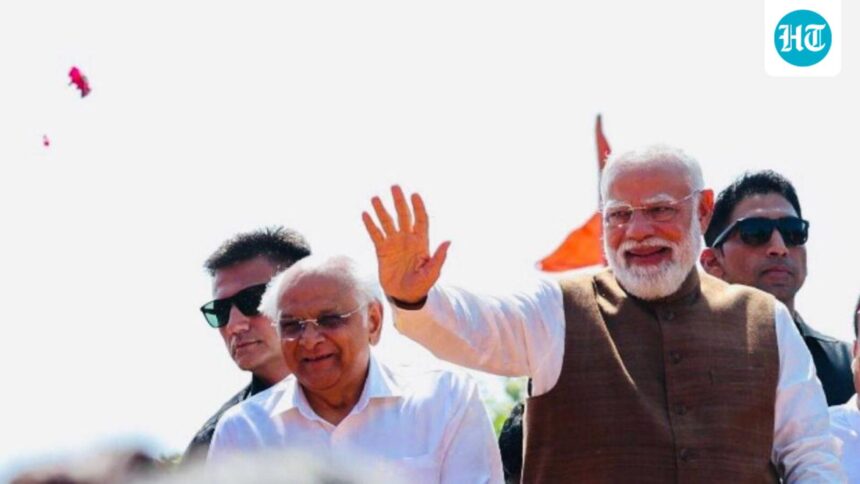
Prime Minister Narendra Modi’s visit to Abu Dhabi on May 15, on his way to an India-Nordic summit, may last only a few hours, but it comes at a moment of unusual strategic consequence. Modi will meet UAE President Sheikh Mohammed bin Zayed Al Nahyan amid exceptional unrest in West Asia. Unrest in the Strait of Hormuz and rising tensions related to Iran have destabilized energy and shipping markets and regional security. Against this background, ongoing coordination with Abu Dhabi has gained new urgency.

Timing is especially important. Modi recently used a public address to urge Indians to use fuel moderation to ease economic pressures caused by high oil prices and conflict in West Asia – an unusually direct appeal that underscores the gravity of the moment. India imports nearly 87% of its crude oil and nearly half of its natural gas. In moments of geopolitical turmoil, energy security becomes an urgent economic necessity.
This reality helps explain why the UAE holds a special place in India’s foreign engagement. The UAE is among India’s major suppliers of crude oil, LNG and LPG, and today is one of our most reliable energy partners. As energy markets become more fragmented and transactional, trustworthy bilateral arrangements are more important than ever for major importers like India.
The relationship extends beyond simple buyer-seller dynamics. Abu Dhabi National Oil Company (ADNOC) is involved in India’s strategic oil reserves, while an Indian consortium led by ONGC Videsh owns a 10% stake in Abu Dhabi’s Lower Zakum oil field. Together, these arrangements give extraordinary strategic depth to the relationship, combining supply reliability, upstream sharing and long-term energy cooperation.
The recent exit of the United Arab Emirates from OPEC adds an important dimension. Outside of the cartel’s production quotas, Abu Dhabi will have greater flexibility to produce at full capacity, which could lead to increased crude oil availability and negotiating space for buyers such as India, especially once disruptions ease. The case for expanding UAE crude storage in India’s strategic oil reserves is also strong. This would give the UAE secure storage space outside Hormuz while enhancing India’s energy resilience.
Abu Dhabi’s discussions are likely to focus on ensuring reliable energy flows, coordinating assessments of the increasingly volatile regional environment, and enhancing maritime and defense cooperation. Drone and missile attacks across the Gulf have shown how quickly instability can threaten trade routes and energy corridors vital to both UAE exports and India’s economic growth.
However, to reduce India-UAE relations to crisis management or hydrocarbons would miss the bigger story. This visit comes on the heels of Mohammed bin Zayed’s visit to India last January and NSA Ajit Doval’s consultations in Abu Dhabi last month, underscoring intense high-level coordination. The leadership-level engagement, which was revived when Modi visited the UAE in 2015 after a 34-year hiatus, reflects a deeper shift in India-UAE relations: from a transactional energy relationship to one of India’s closest strategic partnerships in its extended neighbourhood.
This shift reflects larger shifts in India’s external engagement. With the end of the Cold War and the liberalization of the Indian economy, energy security became a central element of the national strategy. As the Gulf region diversifies economically and the UAE emerges as a global trade and logistics hub, complementarities with India have deepened. A relationship that was once largely defined by oil trade and migrant labor has evolved into a multidimensional partnership that includes investment, connectivity, technology, defense and security.
The economic numbers tell this story. Bilateral trade volume will exceed US$100 billion in 2025, making the UAE India’s third-largest trading partner after China and the United States. The UAE was the fifth largest source of foreign direct investment in India in the period 2024-2025. It has pledged cumulative investments worth $75 billion in India’s infrastructure sector, while the Abu Dhabi Investment Authority – one of the world’s largest sovereign wealth funds – supports India’s National Investment and Infrastructure Fund. Building on the UAE’s presidency of the United Nations Climate Change Conference (COP28) in 2023, cooperation has expanded to include clean energy partnerships, through UAE investments in Indian renewables and green hydrogen. Modi is expected to encourage more UAE foreign direct investment and sovereign fund participation in India’s growth story.
Indian companies are deeply embedded in the UAE’s economy, while the 4.3 million strong Indian community – the largest expatriate group and one of the largest concentrations of Indians abroad – provides lasting ballast to relationships. Their remittances are among the highest in the world. Modi is equally likely to encourage more investment in India by the Indian community in the UAE, whose financial ties form an important pillar of the relationship.
What distinguishes the UAE from other Gulf partners is the unusual focus of its simultaneous strategic roles. Saudi Arabia may be more important for oil markets, Qatar for natural gas, and Oman for maritime access, but the UAE brings it all: energy reliability, logistical connectivity, financial capital, a huge Indian diaspora, security cooperation, and sustained political trust into one relationship.
For India, the UAE increasingly serves as a trusted partner, energy security anchor, logistics hub, investment source, security hub, and bridge to the wider region. For Abu Dhabi, India represents a key market, a trusted development partner and a rising geopolitical player, with whom deeper engagement holds long-term strategic value.
The partnership also fits comfortably within India’s broader approach to strategic autonomy and multiple alliances. In a divided international system, New Delhi benefits from establishing reliable partnerships across regions and centers of power rather than relying excessively on any one country or bloc. By being equally pragmatic and comfortable with geopolitical divisions, the UAE has become a natural partner in that strategy.
Amid the ongoing unrest in West Asia, Modi’s stop in the UAE is by no means routine. It reflects a larger truth: few relationships in India’s extended neighborhood are more important today than India’s partnership with the UAE. Although it may be short, the Abu Dhabi meeting could be one of the most important entries in Modi’s larger itinerary.
Ajay Malhotra, Distinguished Fellow, TERI. Former Indian Ambassador and former Independent Director of ONGC and ONGC Videsh. The opinions expressed are personal.