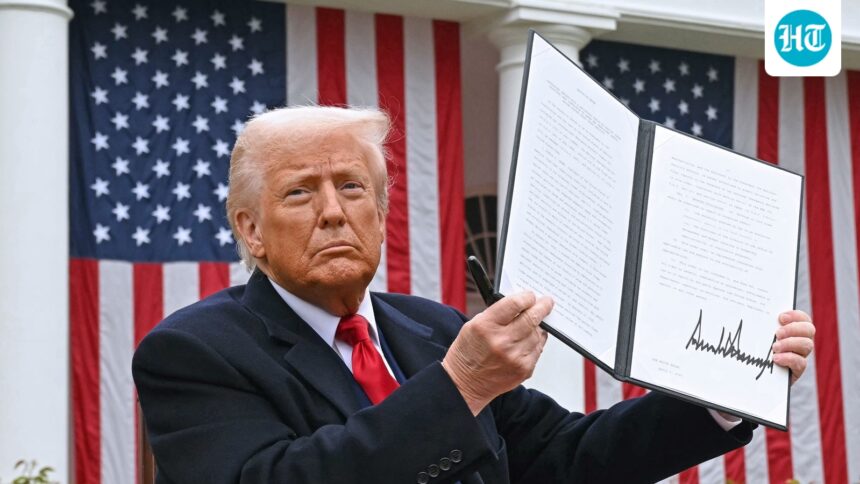
A year after he imposed reciprocal trade tariffs on countries, a move that has since been struck down by the US Supreme Court, President Donald Trump has now imposed new tariffs on patented pharmaceutical imports.

This step aims primarily to pressure pharmaceutical companies to manufacture more in the United States of America. The photo was taken due to national security and supply chain risks following the investigation. However, generic drugs are currently exempt from the tariffs; Officials have warned that this may change if the generic drug industry does not move its production to the United States.
How does this move affect India?
For India, the exemption for generic medicines, as stated in the announcement, is crucial. Indian companies dominate the global markets in the generic pharmaceutical sector.
Read also | President Trump’s tariff strategy revealed
Therefore, in the short term, excluding generics provides a buffer, facilitating exports of low-cost medicines, which form the backbone of India’s drug trade with the US, news agency ANI reported.
“Generic drugs, which constitute a majority of India’s drug exports, are duty-free, but the Commerce Department will evaluate the case of generic drug remanufacturing and reassess tariffs accordingly,” a senior White House official told the news agency.
According to a report by the Global Trade Research Initiative, cited by The Times Of India, about 90% of India’s pharmaceutical exports to the United States are generic drugs. However, while Indian pharmaceutical companies are unlikely to face immediate challenges, the long-term consequences could be more serious.
The Trump administration’s heavy tariffs on patented medicines and active pharmaceutical ingredients will impact global supply chains, in which Indian companies play a vital role.
This will be particularly evident in manufacturing contracts and supplies to intermediaries for multinational pharmaceutical companies, according to ANI.
Siddharth Mittal, CEO and MD, Biocon Limited, told ANI that excluding generics would prevent immediate disruption. “However, the move raises a layer of political uncertainty. While the immediate impact is contained for now, the broader signal is one of increased protectionism, which the industry will be watching closely,” Mittal added.
However, think tank GTRI noted that some Indian companies may still be affected, including those that produce branded or specialty drugs, or those that provide inputs for patented drugs.
What about other countries?
According to a senior US official quoted by Agence France-Presse, large companies have 120 days to commit to resettlement plans, while small companies have a 180-day buffer period.
Countries that have already signed a repatriation agreement with the US Department of Commerce or a Most Favored Nation Pricing (MFN) agreement with the US Department of Health and Human Services (HHS) will face reduced or no tariffs. For example, the European Union, Japan, South Korea and Switzerland would each face a 15% tariff. The UK, whose major companies have signed repatriation agreements and most-favored-nation agreements, will face 10% tariffs.