The India-US joint statement issued on February 6 provides for rebalancing the proposed interim trade agreement if circumstances change, Union Commerce Minister Piyush Goyal said on Friday, adding that New Delhi is monitoring the evolving situation following the US Supreme Court ruling.

Speaking at the News18 Rising Bharat Summit 2026 in New Delhi, Goyal said India values comparative advantage over its rivals more than the tariff rate itself. His comments were in reference to the joint statement – issued on February 7 Indian time – in which Washington committed to reducing customs duties on Indian goods from 50% to 18% in exchange for preferential access for its products to the Indian market. An 18% tariff would have made Indian labour-intensive goods competitive against rivals such as China, Sri Lanka, Vietnam and Indonesia. But before the two sides could sign a formal agreement, the US Supreme Court on February 20 struck down the sweeping global tariffs imposed by President Donald Trump under emergency powers.
Responding to a question – “Is our position changing” – regarding the commitments proposed by the two sides in the joint statement before the court ruling, Goyal said: “As I said, this is an evolving situation, we will have to see.” He was alluding to the rapidly changing landscape in Washington, where the administration has indicated its intention to use alternative legal tools since the ruling. He added: “They have many other tools that they could use. They have already used one of them, Article 122, under which they imposed a 10% tariff. I think they have gone on record that next week they may increase it to 15% for the first 150 days. So, there are different dialogues going on. We will have to watch.”
He then referred to the guarantee contained in the joint statement itself. “By the way, you must have read the joint statement that we have finalized with the US. It has categorically stated that if circumstances change, the agreement will be rebalanced… so that the balance of the agreement is maintained on both sides,” Goyal said. According to the joint statement issued by the Ministry of Commerce on February 7, the two sides agreed to include a rebalancing clause in the proposed interim agreement. “In the event of any changes in the agreed upon tariffs of either country, the United States and India agree that the other country may modify its obligations,” the clause reads.
Explaining the government’s broader strategy on FTAs, Goyal said: “We are starting to engage with developed countries in 2021-22, unlike the Congress era, where they used to do FTAs largely with competitors.” In recent years, India has signed free trade agreements with major trading partners, including the United Arab Emirates, Australia, the four-nation European Free Trade Association bloc, the United Kingdom and the 27-nation European Union.
“prime minister [Narendra] Modi’s strategy has been to engage with the developed world, but from a position of strength, taking into account our strategic interests and sensitivities, while opening the doors to greater engagement with the world. “I think this strategy helped us quickly build very strong, very good, win-win positions with our business partners,” he added.
Asked whether the Supreme Court ruling had given India more room to negotiate, Goyal said: “This is an evolving situation. We are monitoring what is happening. We are in dialogue with the administration in the US and, of course, in internal consultations. We will have to wait and watch and ensure that India’s best interests are protected.”
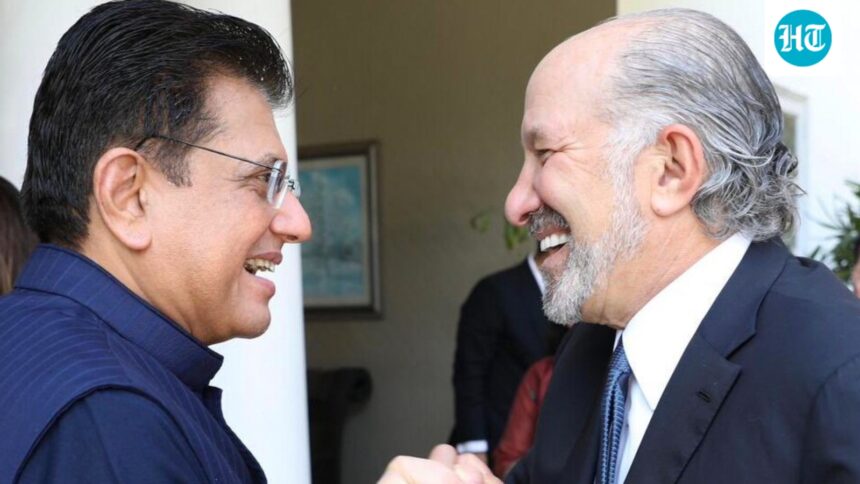
At US Commerce Secretary Howard Lutnick’s lunch with him in New Delhi on Thursday, Goyal noted in Hindi that even before the Supreme Court’s February 20 ruling, a lower court had issued a similar ruling on Trump’s use of the International Emergency Economic Powers Act in mid-2025 – suggesting that engagement between India and the US has continued during the previous legal uncertainty and will continue in the same vein.
“For us, the United States is a very important trading partner,” Goyal said, adding that the two countries also have a strategic relationship. He cited India’s goal of attracting $200 billion in investments in data centers and AI-related projects, and opportunities in pharmaceuticals, gems and jewellery, textiles and smartphones as areas where deeper partnership with Washington could yield results. “We have 40 million people working in the textile sector,” he said.
Goyal reiterated that the Indian dairy sector is “completely” exempt from the proposed trade deal, as are sensitive items including wheat, rice, corn, soy flour, poultry and genetically modified foods.
As for what the deal could ultimately achieve, Goyal was expansive. “The tariff reduction is an opportunity for everyone to continue exporting unhindered,” he said. “But the deal was better because it included many other elements. When you finally see the deal, you will realize – oh my God, these are there too! So, until we finally sign it, I am not in a position to share all the details. But I can assure you that there are a lot of positives in the deal.”
He returned to the principle of comparative advantage to explain his confidence. “Trade is not just about tariffs – it is more about the competitive advantage you get over your competitors. When you imposed a 50% tariff, we were at a huge disadvantage in our exports.”
“India is on the move. Despite all the global turmoil, our exports this year should be higher than last year,” Goyal said. India’s total exports of goods and services in 2024-25 reached a record high of $824.9 billion.