The British colonial era witnessed widespread plundering of India’s cultural and material heritage, with countless priceless jewels and antiques stolen and removed from their rightful place.

One of the most famous is the Koh-i-Noor, “Mountain of Light,” a flawless 105.6-carat diamond that once adorned the Peacock Throne. In 1849, after the Anglo-Sikh Wars, it was handed over – a euphemism for colonial theft – by the young Duleep Singh of Patiala to Queen Victoria, and is now the main attraction of the Tower of London, a dazzling reminder of colonialism and loss. It is expected to exceed its value today $1 lakh crore (about $12 billion).
The Kohinoor was not the only priceless stone that came to Britain from India. In 1701, Thomas Pitt, while governor of Madras, helped obtain a diamond weighing over 410 carats from the Golconda mines of the Mughal emperor. It was christened the Pitt Diamond, and was until then valued at £125,000; Pitt later sold it to the Prince Regent of France, who made it part of the French Crown. Governor Robert Clive was also famous for converting his vast loot from India into diamonds for safe passage to England.
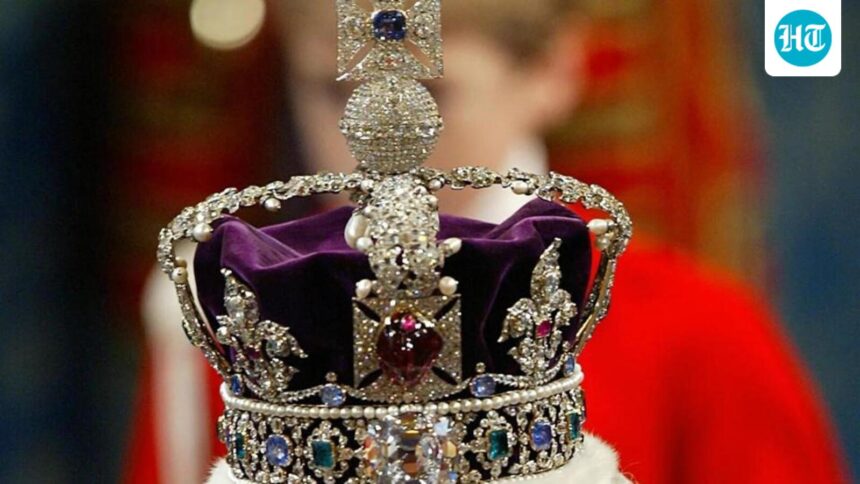
Tipu Sultan’s ring, inscribed with the word “Ram” in Devanagari, was seized by the British from the Battle of Srirangapatna in 1799, and was bought at auction by fugitive businessman Vijay Mallya much later. Also notable on this list of loot is Shah Jahan’s wine cup, made of exquisite white jade and decorated with intricate designs. It was seized by the British after the Revolution of 1857, and is now housed in the Victoria and Albert Museum in London. The Imperial Crown of India, “gifted” by “grateful” subjects to the British King at a durbar in 1911, is set with rubies and sapphires, and set with diamonds, with a huge deep green emerald at its center and a diamond orb at the top. It is also on display in the Tower of London.
Apart from jewellery, two of the biggest losses to India are the Amravati Marbles and the Sultanganj Buddha statue. The marbles were a collection of 120 limestone sculptures and reliefs that adorn a Buddhist stupa in Andhra Pradesh. These loots are now proudly displayed in the British Museum. Buddha is a colossal copper statue weighing half a ton, dating back to the Gupta period (4th to 5th century AD). It was discovered during the construction of railways in Bihar in 1862. This pride of India is now part of the Birmingham Museum.
Rare manuscripts, historical texts, and works of art were also removed, representing a significant loss of intellectual and cultural heritage. Thousands of ancient temples were destroyed across India, and sacred idols and architectural elements were taken away and displayed in museums or sold to private collectors. Aside from what has been documented, there is much that has been looted and stolen, of which there is no record.
I believe we should not let the issue of colonial-era plunder fade into an irreparable void. The discussion extends beyond mere ownership to include the moral and ethical responsibilities of museums and individuals holding such artifacts. An accurate critical assessment is futile for what is essentially priceless. As such, there can be no such thing as compensation or reparation. The artifact itself must be returned, because its cultural and historical importance to the country of origin is priceless and irreplaceable.
Current global discourse increasingly favors the return of culturally significant artifacts, while recognizing the historical injustices of colonial plunder. The narrative of British colonial rule in India is closely linked to the systematic extraction of wealth, resources and cultural treasures. This period, spanning nearly two centuries, saw the East India Company and later the British Crown control vast territories, resulting in the forced acquisition of invaluable assets. These acquisitions were not merely economic transactions, but acts of profound cultural displacement, separating historical objects from their intrinsic cultural and spiritual significance. Its economic value did not constitute a significant part of the 347% increase in British per capita income in the period from 1747 to 1947, while the growth rate in India in the same period did not exceed 14%.
Continued advocacy and diplomatic efforts are essential to address these historical wrongs and achieve the restoration of cultural heritage to its rightful place. The Government of India should not falter in its efforts.
(Pavan K Varma is an author, diplomat and former Member of Parliament (Rajya Sabha). Views expressed are personal)