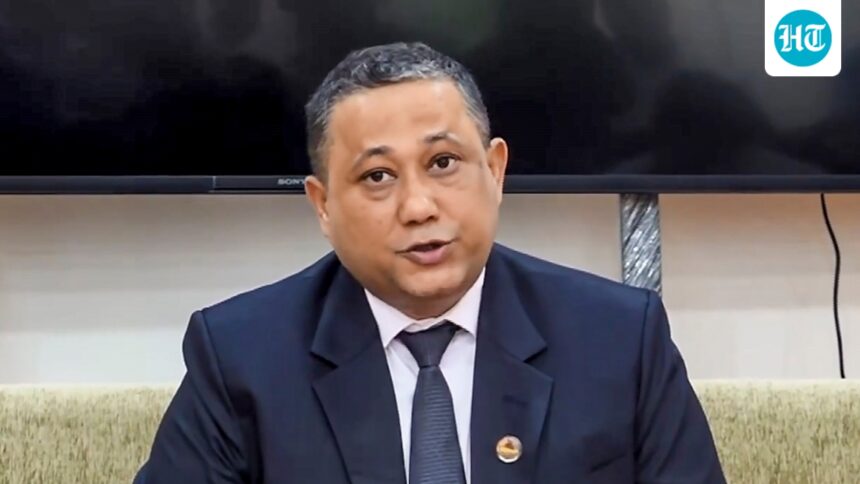
Amid the ongoing dispute over the Lipulekh Pass, Nepali Foreign Minister Shishir Khanal on Sunday said that Nepal wants to resolve its border dispute with India through an “open heart”.

Speaking to reporters in New Delhi, Khanal added that Nepal wants to resolve issues with India through diplomacy.
“We look at India with an open heart, clear eyes, and with one transparent agenda: Nepal’s economic transformation,” Khanal said.
These statements from the Nepalese leader come after Kathmandu raised concerns about the renewal of relations between India and China and the trade route.
Last year, India and China announced the resumption of direct flights, visas and the Kailash Mansarovar Yatra as part of an attempt to rejuvenate relations.
Read also | India and Nepal discuss ways to move bilateral relations and development cooperation forward
However, Nepal, a landlocked country between India and China, has raised objections, especially against the use of the Kalapani and Lipulekh region for pilgrimage and Indo-China trade.
Speaking to reporters during his visit to India, Khanal said that while the pilgrimage is taking place across various border points, the main concern is regarding India and China’s use of the Kalapani and Lipulekh region.
“Our concerns are regarding the renewal of the agreement between India and China across the Kalapani and Lipulekh region, as we have said for a very long time that the land belongs to us, and without Nepal’s consent, the two countries alone cannot conclude those agreements,” Khanal said.
Nepal claim
The Lipulekh Pass has been the subject of a long-standing dispute between India and Nepal. The dispute escalated in 2020 after Nepal released a political map that showed Limpiyadhura, Kalapani and Lipulekh as Nepali territories.
Nepal insists that these areas are part of its territory under the Sugauli Treaty of 1816.
However, in an amendment in 1865, the British in India shifted the boundary near Lipulekh to the watershed of the Kalpani River, which would later be known as the Kalpani Territory. After independence from the British Raj, India inherited these lands.
Read also | All about Lipulekh: The key corridor that has left India and Nepal locked in a 210-year-old conflict
However, Kathmandu maintains that these areas lie to the east of the Kali River and therefore fall within its territory.
Where does India stand?
India denied the allegations and also condemned Nepal for its “unilateral and unjustified” move regarding the 2020 map.
Despite Nepal’s claim, New Delhi has maintained that the corridor is part of Uttarakhand state. Moreover, India also claims the territory due to its control and administration of the region since the 1962 Indo-China War.
In a recent press conference, External Affairs Minister Randhir Jaiswal also stated that India is committed to reaching a peaceful solution through diplomacy and talks.
(With inputs from Annie)