India on Tuesday rejected any involvement of third parties in resolving its border dispute with Nepal, days after reports that Nepali Prime Minister Balendra Shah sought the participation of China and the United Kingdom to address the long-standing issue.

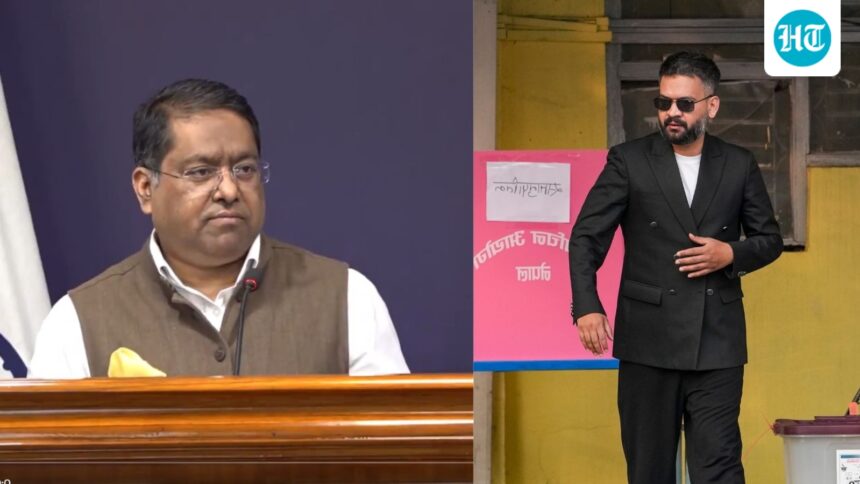
In response to a media query regarding Nepalese Prime Minister Balendra Shah’s “encroachment on India” remark, External Affairs Minister’s spokesperson Randhir Jaiswal said: “All parties concerned must be clear that any bilateral issues between India and Nepal will be resolved only between the two countries, and there is no role for any third party in such matters,” news agency PTI reported.
Nearly 98% of the border between India and Nepal has already been demarcated, he said, adding that some issues remain unresolved in certain parts.
“Nearly 98 per cent of the India-Nepal border has already been demarcated. However, some issues remain unresolved in certain parts. This situation has arisen due to changes in the course of the Gandak River.”
“In addition, there are cases of cross-border encroachment and encroachment on prohibited lands in some of the demarcated areas, which are currently being jointly mapped,” Jaiswal added.
What did Balendra Shah say?
Jaiswal’s comments come after rapper-turned-politician Shah on Sunday said that apart from discussions with India over the Lipulekh Pass border dispute, Nepal is in touch with China and Britain as well.
“Since this problem dates back to the time when British India left the region, we feel that England should be involved in this matter,” he said.
Read also: ‘Not just India’: Nepal PM’s ‘encroachment’ remark on Lipulekh Pass dispute sparks controversy at home
“You will be surprised to know a fact that I did not know until after I became prime minister. It was not only India that encroached on Nepalese territory, but Nepal also encroached on Indian territory in many places,” Shah said during his first appearance in the ongoing parliamentary session.
What is the border issue?
Nepal and India had it The ancient border dispute over LipulekhLimpiadora and Calapani. India has consistently maintained that these lands are part of the state of Uttarakhand.
The dispute gained renewed attention in 2020 when Nepal, under then Prime Minister KP Sharma Oli, aggressively pushed its claims over the region amid mounting domestic political pressure.
The issue escalated after Kathmandu released a revised political map showing Lipulekh, Kalapani and Limpiyadhura within Nepal’s borders. Nepal insists that these areas belong to it under the Treaty of Sugauli in 1816 signed with British India.