After Pradhan said that NCERT had done a “good job” by putting it “at the forefront”, Yadav replied that a chapter on emergency was already in textbooks.

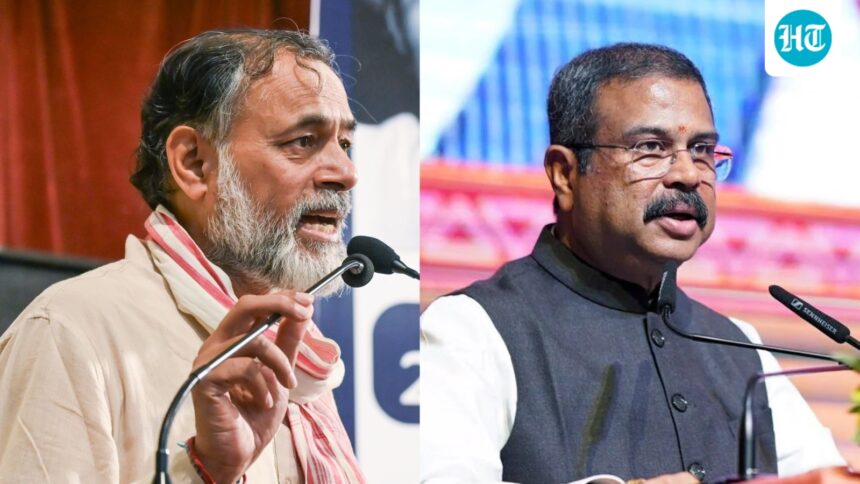
Activist and founder of Swaraj India Yogendra Yadav has opposed Union Education Minister Dharmendra Pradhan’s statements on NCERT including reference to the 1975 Emergency in his textbook.

After Pradhan said NCERT had done a “good job” of bringing the topic “at the forefront,” Yadav replied that a chapter on emergency had already been included in a 2007 textbook, which he helped write.
The dispute began after NCERT, in its newly developed Class IX social science textbook, cited the Emergency as “one of the major challenges” faced by Indian democracy. The section on the state of emergency is included in a chapter highlighting the strengths and challenges of democracy.
Read also | ‘The Challenge to Democracy’: Why NCERT’s new Class 9 chapter on ‘Emergency’ is attracting attention
Complimenting Pradhan for NCERT, Yadav replied “Lie”.
Supporting NCERT’s move to introduce the 1975-77 national emergency in the Class IX social science syllabus, Pradhan said the move helped future generations understand the “dark deeds of that period”.
“That’s right. NCERT has done the right thing. Future generations should know and understand the dark deeds of the Emergency so that such a situation does not arise again. That’s why NCERT has brought it to the fore. NCERT has done a good job…” Pradhan said.
Reacting to the statement, Yadav said it was a “lie”, adding that the “ugly truth” was not hidden from the students.
“Dear @dpradhanbjp ji, this is a lie,” he said in a post on Yadav also attached an editorial written by him in which he spoke about how ‘Emergency’ made its way into textbooks during the Congress government.
What does NCERT book say about emergency?
The text in the section under Challenges to Democracy highlights “dissatisfaction” with the Indira Gandhi government, issues including unemployment, inflation and others. “One of the major challenges to democracy in India was recorded when the Emergency was imposed in 1975-77. In the early 1970s, public dissatisfaction with the government led by Indira Gandhi was growing. Rising unemployment, inflation and allegations of mismanagement led to widespread protests,” it said.
It states that “the majority of fundamental rights were suspended” during this period, due to internal unrest. “In June 1975, the government imposed a national emergency on the basis of internal unrest. During this period, the majority of basic rights were suspended, press censorship was imposed, and many political leaders and activists were arrested.

Arya Mishra is a content producer at Hindustan Times, based in New Delhi, and a key member of the digital news team focusing on breaking news developments across India and the world. With her keen editorial sense and strong reporting skills, Arya covers high-impact crime incidents, public safety and justice issues, political developments, education policy and international affairs, consistently delivering clear, accurate and timely journalism. Highlights of its recent reporting include detailed coverage of serious criminal cases and politics as well as analyzes of national education reforms and international diplomatic moves. On the global news front, she wrote about changes in global trade policy and security developments, including tariff shifts by the United States and strategic anti-terrorism strategies implemented by the Ministry of Home Affairs. Arya thrives in fast-paced environments – running live blogs, crafting in-depth explainers and real-time news coverage that keeps readers informed as stories develop. Before joining Hindustan Times, she was part of The Indian Express online team. Outside of the newsroom, she is an avid reader, loves thrillers and suspense, and enjoys music as a way to relax. With more than three years of experience in dynamic newsrooms, Arya brings curiosity, clarity and commitment to every story she covers.Read more