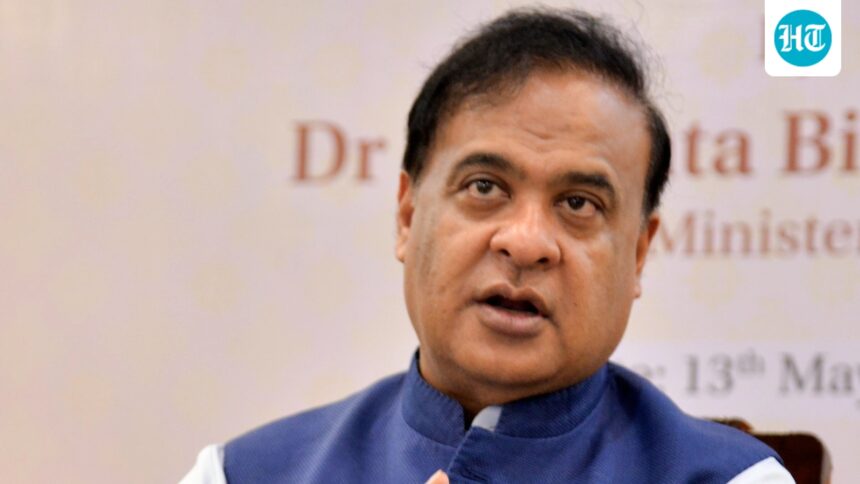
The draft law on the Uniform Civil Code introduced in the Assam Assembly on May 25 proposes for the first time a legal framework to govern direct relations in the state. “By requiring registration, the law ensures that the rights of partners – and any children born from such marriages – are formally recognized and protected,” CM Himanta Biswa Sarma said.

What are the provisions?
The Assam UCC Bill makes registration of live-in relationships mandatory. It is also proposed to establish an administrative mechanism, including the appointment of registrars, to deal with these registrations alongside marriage and divorce registrations.
Scheduled tribes are completely exempt from the provisions of the bill relating to uniform personal laws. Tribal communities account for 12.45% of Assam’s population and Muslims 34.22%, according to the 2011 census.
The proposed legislation could protect women and children by providing a legal safety net in cases of abandonment in a live-in relationship. This would also ensure a uniform system of inheritance, thus granting rights to children born outside such marriages.
Exact details, such as registration timelines, penalty for non-compliance, required documents, and verification process, were not available in the tabular version. These details are likely to become clearer when the full text is made public and the draft law is debated on May 27.
Opposition parties, including the Congress, Raijor Dal and Trinamool Congress, opposed the move and demanded wider consultations with all stakeholders before it is introduced.
Invoice basis
Article 44 of the Constitution, in its Directive Principles of State Policy, calls for the establishment of a UCC. But religion-based civil laws have governed personal matters since independence.
In February 2024, Uttarakhand became the first state in the country to pass the UCC Act. The other BJP-ruled state of Gujarat followed suit in March. The BJP-ruled Madhya Pradesh state has formed a committee to draft the UCC.
The creation of an all-India UCC is the third major ideological promise of the BJP. The construction of a Ram temple in Ayodhya and abrogation of Jammu and Kashmir’s semi-autonomous status under Article 370 of the Constitution, the other two major ideological goals, have been achieved since the BJP came to power at the Center in 2014.
The BJP promised to introduce UCC in Assam in its manifesto ahead of the 2026 Assembly elections. The state cabinet approved the legislation in its first session on May 13.
Assam Minister Atul Bora introduced the Assam Uniform Civil Code Bill, 2026. The bill is expected to be discussed and voted on on Tuesday, the last day of the first session of the 16th Assembly formed after elections in April.
Sarma said the Marriage Coordination Committee will regulate the minimum age for marriage, protect women’s right to family property, abolish polygamy, recognize direct relationships, and impose compulsory registration of marriages and divorces.
Precedents follow
The UCC in Uttarakhand is a precedent that Assam is clearly following. Under this law, which came into effect in January 2025, couples are required to register their live-in relationship within one month of entering into it. Failure to comply may result in imprisonment of up to three months and a fine $10,000 or both. Registrants are also required to inform parents if either partner is under 21, and must also report the end of relationships to the local police.
After some provisions drew criticism for possible invasion of privacy, the Uttarakhand government has filed an affidavit in the Supreme Court saying it has amended several provisions, including removing requirements for Aadhaar and community certificates. It also removed the rule requiring mandatory reporting of a live-in partner’s pregnancy.
Gujarat’s UCC bill, passed in March, includes near-identical provisions on the live-in relationship with Uttarakhand. He defines a cohabiting relationship as a relationship between a man and a woman “of the nature of marriage.”