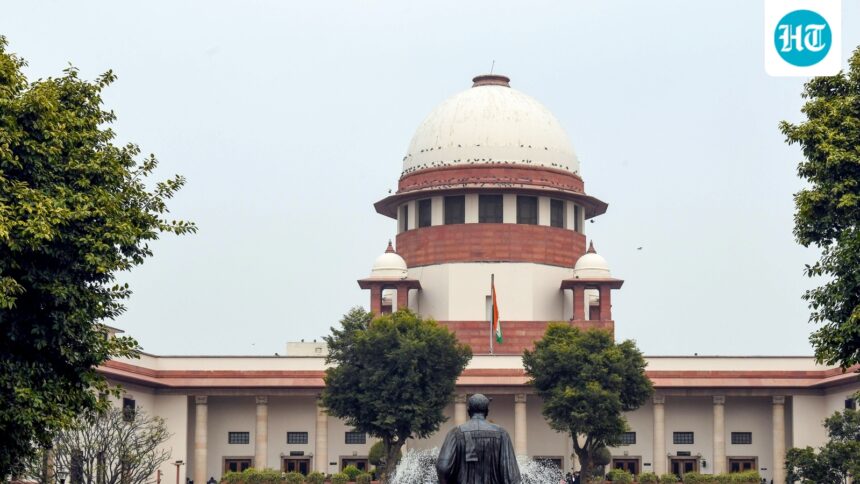
In an unusual institutional moment in the Supreme Court, a clash of judicial views between two coordinating benches on the jurisprudence of bail under the Unlawful Activities (Prevention) Act came to light on Friday, with one of the two benches formally requesting Chief Justice of India, Surya Kant, to constitute a larger bench for the “formal resolution” of the law.

A bench of Justices Aravind Kumar and BP Varali, while hearing the bail petitions filed by Delhi riots accused Taslim Ahmed and Khalid Saifi, referred to the CJI the bigger question of how the Supreme Court’s landmark three-judge ruling in Union of India Vs KA Najeeb (2021) should be applied in UAPA cases involving long imprisonment and delay of trials.
The development came days after another two-judge bench – comprising Justices PV Nagaratna and Ujjal Bhuyan – publicly criticized the January 5 judgment passed by Justice Kumar in the Delhi riots conspiracy case involving Omar Khalid and Sharjeel Imam, holding that the earlier judgment had adopted an unduly restrictive understanding of bail under the Anti-Terrorism Act.
Read also | Bail, Liberty and the Supreme Court Divided on Reading of the UAPA
Friday’s order effectively turned this judicial dispute into an official institutional reference, paving the way for a constitutionally significant reconsideration by a larger body of how courts reconcile national security and personal liberty concerns in counterterrorism prosecutions. It may also finally settle the increasingly apparent doctrinal divide that has emerged within the Supreme Court itself over the meaning and extent of Najib’s reach.
Without directly ruling on the validity of the criticisms leveled against its earlier decisions, Justice Kumar Bench took the specific view that a bench should not undermine another bench of equal strength by “strong observations” and should instead refer the matter to a larger bench if it has doubts about the validity of a previous ruling.
“The rulings of this court should not be responded to by counter observations from another body of similar power. The system of precedence requires a higher institutional approach,” the bench noted.
“When a coordinating body has a reservation about a previous ruling of another coordinating body, particularly with regard to applying a binding three-judge decision, the proper course is well settled. The matter should normally be brought before the Chief Justice of India to constitute an appropriate bench,” she added.
The bench said that while the disagreements between the coordinating bodies “were neither unusual nor undesirable”, institutional discipline required that such disagreements be resolved through a formal declaration by a larger judicial body and not through competing judicial observations.
“If a coordinating body expresses reservation about the manner in which K.A. Najib has been pursued by another coordinating body, the correct answer is not further reservation but a formal decision,” Justice Kumar observed.
Accordingly, the bench directed that the matter be referred to the ICJ to constitute an appropriate larger bench “to clarify or explain the position of law laid down in K.A. Najib’s case, particularly against the backdrop of the stringency of Section 43D(5)” of the UAPA.
The court has meanwhile granted six-month interim bail for the extradition of Ahmed and Khaled Saifi in the larger Delhi riots conspiracy case, with conditions including a ban on interacting with the media or commenting publicly on the proceedings.
The order represents a major escalation in an increasingly apparent disagreement within the Supreme Court over the balance between personal liberty and national security in UAPA trials.
Earlier this week, the Nagarathna-Bhuyan court, while granting bail to Syed Iftikhar Andrabi, a resident of Jammu and Kashmir, in a drug terror case investigated by the National Investigation Agency, issued one of the strongest judicial criticisms in recent years of the Coordinated Bench’s ruling.
This bench categorically asserted that “bail is the rule and imprisonment is the exception” even under the UAPA and expressed “serious reservations” over the January 5 judgment in the Delhi riots conspiracy case involving Omar Khalid and Sharjeel Imam.
Read also | Clearing the air on the right to bail
The January ruling by Justices Kumar and Anjaria had denied bail to Khalid and Imam while granting relief to five other accused, including Julvisha Fatima, Meeran Haider and Shifaur Rahman.
In Andrabi case, Justice Bhuiyan held that the judgment in Delhi riots case and the earlier judgment in Gurwinder Singh case (2024) appeared to have diluted the constitutional force of the three-judge Supreme Court judgment in K.S. A. Najib, who conceded that lengthy imprisonment and delay in trial could justify bail despite the legal prohibition under Section 43D(5) of the UAPA.
“A judgment rendered by a less powerful tribunal is bound by the law declared by a tribunal of greater power. Judicial discipline stipulates that such binding precedent must be followed or referred, in case of doubt, to a greater tribunal,” Andrabi’s ruling said.
The ruling also criticized what it described as smaller courts “progressively hollowing out” the constitutional protections recognized in the K case. A. We answer without explicitly disagreeing with her.
But on Friday, the Kumar-Varali panel appeared to take issue with the way those criticisms were expressed.
The court stressed that K. could not be dealt with. A. We answer that it is a “mathematical formula” that imposes bail in every case of lengthy imprisonment under the UAPA.
According to the court, its ruling earlier in January in the Delhi riots case did not downplay Najib, but instead treated him as a “guarantee of principle” requiring an individual assessment of each accused.
The bench noted that while bail was granted to five accused in the Delhi riots conspiracy case, it was simultaneously denied to Omar Khalid and Sharjeel Imam after examining their alleged roles separately.
“The present reference is necessary because A. A. Najib deserves to be presented with the clarity, consistency and institutional fidelity ordered by a binding bench of three judges,” the bench observed.
The court cautioned against adopting either of two “extreme positions” — one where lengthy imprisonment alone automatically leads to bail regardless of national security considerations, and the other where legal rigidity obscures Article 21 constitutional protections.
“The question is how Section 21 will be applied when Parliament has imposed restrictions on bail in matters relating to national security.”
Additional Solicitor General SV Raju and advocate Rajat Nair, representing the Delhi Police, had argued before the court that prolonged imprisonment alone cannot be treated as a blanket reason for bail under laws that stipulate strict double conditions.