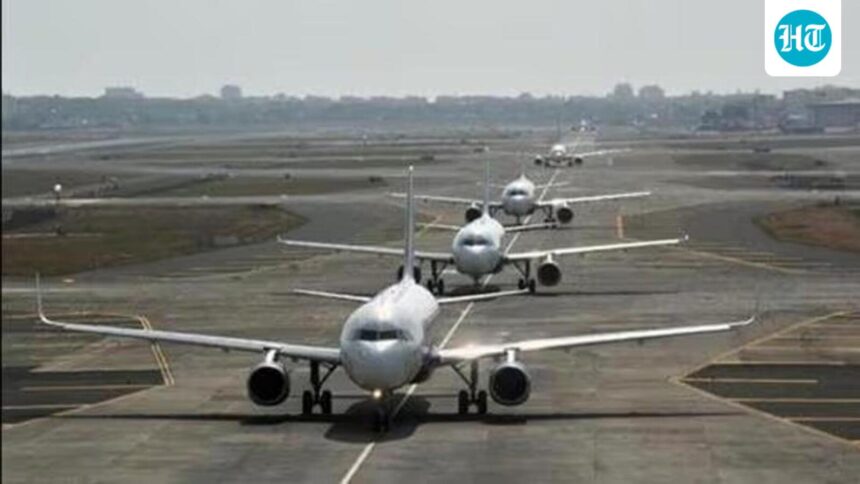
The Supreme Court on Friday urged the Center to take steps to “rationalize” air ticket prices, pointing out the stark disparity in ticket prices charged by different airlines for the same route on the same day, with economy class fares ranging from $8000 LBP $18000.

A bench of Justices Vikram Nath and Sandeep Mehta was hearing a public interest litigation (PIL) seeking regulatory guidelines to control unforeseen air ticket price fluctuations and surcharges charged by private airlines during festive seasons, holidays and emergencies.
During the hearing, Solicitor General Tushar Mehta, representing the DGCA and the federal government, informed the court that the Bharatiya Vayuyan Adhiniyam (BVA) Act, 2024, has already come into effect and the rules under the new legislation are currently under consultation.
“There is a new law that has come into effect. The 2024 Act has come into force. The rules are under consultation. We will look at all aspects,” Mehta said.
However, the bench stressed the need to provide immediate relief to travelers suffering from fluctuating and widely varying airfares.
“Try to provide some relief to people because of the inconsistency. On the same day, for flights on the same sector, one airline charges $8000 while another charges $The court noted that 18,000 were in economy class.
Mehta acknowledged the problem but stressed that any lasting solution must emerge through the legal rules established under the new aviation law. He added: “I do not dispute the problem, but the solution must be through legal rules.”
The petitioner, social activist S Laxminarayan, through advocate Charu Mathur, urged the court to issue effective interim directions, claiming that adequate regulatory powers already exist under the existing legal framework but are not being exercised.
“The rules are there, the powers are there, and they are not being exercised,” the petitioner’s counsel said during the hearing on Friday, pointing out that even under the previous Aircraft Act regime, the authorities had powers to intervene when airlines indulged in predatory or excessive pricing. The petitioner also asserted that until new rules are formulated under the 2024 Act, the existing regulatory framework will continue to operate.
“Under the new rules, it stipulates that if the DGCA is satisfied that airlines are, in a particular situation, indulging in charging exorbitant or excessive fares, it will issue directions,” the lawyer submitted.
Mehta responded by saying that the DGCA was already issuing directions wherever required.
However, the jury emphasized that some degree of “rationalization” in airfare prices was necessary.
“There has to be some rationalization,” the court said, while asking the Center how much time it would take to finalize the new rules under the BVA.
The court in its order recorded the Centre’s assertion that the process of making rules under the 2024 Act was ongoing and may take some time. “The Secretary General confirms that after the enactment of the Bhartiya Vayuyan Adhiniyam Act, 2024, the rules of the said legislation are being framed and the process is ongoing and may take some time,” the bench noted in its order.
The Court also took note of the petitioner’s position that the rules established under the previous legal regime were still applicable and should be relied upon even under the new law.
After adjourning the matter for further hearing in July, the court granted time to the petitioner to file a response to the Centre’s affidavit.
The issue of volatile air fares has repeatedly caught the attention of the Supreme Court over the past few months, especially in the context of alleged price increases during festivals, emergencies and major events like the Kumbh Mela.
In an affidavit earlier filed before the court, the Center urged the bench to do away with the PIL by treating it as a set of proposals or endorsements for new aviation rules currently being drafted.
The government said that the Ministry of Civil Aviation and the Directorate General of Civil Aviation were in advanced stages of finalizing the draft rules under the BVA, which will replace the regulatory framework under the Aircraft Rules, 1937.
The Center also defended the deregulated pricing system, arguing that liberalization has improved connectivity and affordability while allowing the government to intervene in exceptional situations affecting public interest. At the same time, she assured the court that the welfare of passengers remains a priority and the government is trying to expedite the rulemaking process “in the wake of the emerging scenario”.
The PIL challenges what it describes as “unregulated, opaque and exploitative” air travel practices adopted by airlines, especially during peak travel seasons and emergencies. It also raises concerns about reductions in baggage allowances and increased surcharges imposed on passengers. The petition seeks to establish binding rules on air ticket prices, regulate high prices during periods of peak demand, control surcharges, and establish an independent aviation regulatory body to protect the interests of consumers.