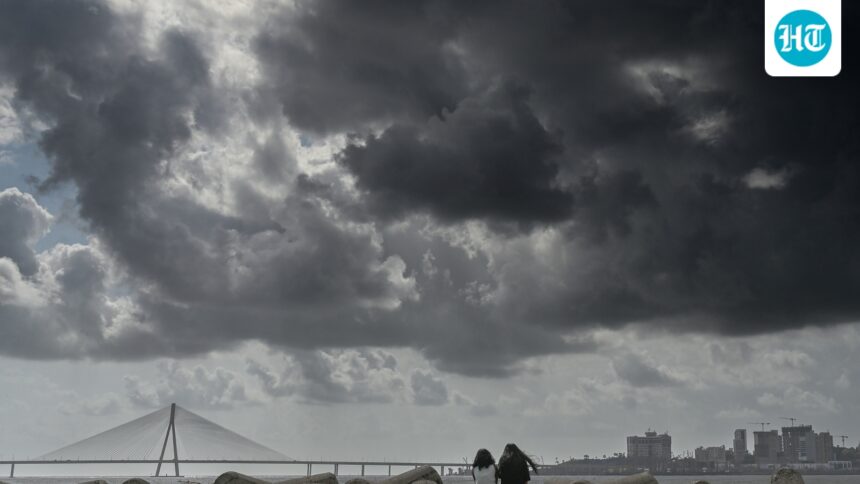
India is experiencing a lackluster monsoon season, with rains already delayed in several parts of the country, including Maharashtra and Goa, with the onset of the El Niño weather phenomenon.

The region-wise rainfall map released by the India Meteorological Department shows that the rainfall deficit in central India, eastern and northeastern India, southern peninsula and northwest India is 67 percent, 42 percent, 22 percent and 6 percent, respectively. The bleak monsoon outlook, a major factor for Indian farms, threatens agriculture and other industries.
Read also: $Rs 1 crore compensation for suicides linked to paper leak”>The Sarsour Janta Party demands, in an open letter to the Prime Minister $Rs 1 crore compensation for suicides linked to paper leak
As of Wednesday, June 17, monsoon rainfall across India was nearly 40% below normal, according to the latest data from the India Meteorological Department. The rainy season extends between June and September and accounts for the bulk of the country’s annual rainfall.
India has already missed the first two weeks of the crucial 122-day rainy phase. According to HT’s analysis, the rainfall deficit has widened rather than decreased since rains first reached the Kerala coast on June 4.
Bloomberg reported that the bad start is hampering the growing season for basic commodities from rice to soybeans, as well as disrupting key sectors such as construction.
Read also: $7.68 crore in cyber fraud, over $4 Crores recovered”>Former Prime Minister IK Gujral’s son loses $7.68 crore in cyber fraud, over $Rs 4 crore recovered
The slow northward advance of the southwest monsoon, coupled with the recent emergence of El Niño conditions over the tropical Pacific, reducing rainfall in India, could have serious consequences for kharif crops, which need timely rainfall to thrive.
Gloomy first two weeks of monsoon
Regarding the monsoon delay in Maharashtra, the IMD on Thursday said that “absence of widespread favorable meteorological conditions” was the main reason behind the failure of the southwest monsoon to advance further into the remaining parts of Maharashtra in the last few days, PTI reported.
Read also: “Desperate Trump used all kinds of influence”: Iranian Supreme Leader Mojtaba Khamenei on the US-Iranian agreement
Weak monsoon rains are expected this year, as 2026 is an El Niño year.
By June 15, the latest period for which normal advance data are available, the monsoon was supposed to cover Maharashtra, the southern half of Chhattisgarh, and Odisha from the south/southwest side; The eastern half of Jharkhand and Bihar are on the eastern side.
India received an average of 50.3 mm of rain from June 1 to 16, the 34th lowest rainfall during this period since 1901, the first year for which the IMD published gridded data. Rainfall received so far is also 27.1% below the 1971-2020 average for the period June 1-16.
Why is the monsoon delayed?
Experts point to five main factors behind the slowdown in the progress of the monsoon northward.
- First, the current monsoon flow lacks a strong wave from the Arabian Sea, according to IMD. “Such increases are generally responsible for enhancing moisture infiltration and widespread rainfall leading to further advance of the monsoon,” the Meteorological Department said.
- Low southwesterly winds associated with the monsoon cycle over the Arabian Sea have weakened. This has resulted in reduced moisture transport towards coastal Maharashtra and interior areas.
- The International Meteorological Institute said that the trans-equatorial flow over the western Indian Ocean and Arabian Sea, which serves as a source of moisture for the southwest monsoon, has weakened during the recent period, leading to a decline in monsoon activity.
- Monsoon weather systems such as areas of low pressure or cyclonic circulation over the Arabian Sea and Bay of Bengal, or a marine trough of sufficient density along the western coast that facilitates the advance of the monsoon, are so far absent.
- The weak phase of the Madden-Julian Oscillation (MJO), a moving system of wind, clouds and pressure that brings rain as it circles the equator, also caused the delay. When it is in an active phase, it brings more clouds to southern India, which are carried northward by the monsoon winds, resulting in increased rainfall. “As a result, rainfall activity over most parts of Maharashtra is likely to remain isolated for the next four-five days,” the IMD was quoted as saying.
With inputs from Abhishek Jha